
TL;DR
- Comparing web development vancouver quotes? Require named deliverables, acceptance criteria, ownership terms and explicit exclusions.
- Setsail Marketing suits businesses seeking website development guided by customer research and a documented marketing plan.
- Separate the website build from hosting, maintenance, software subscriptions and ongoing marketing responsibilities.
- Compare proposals against the same brief, not against screenshots or an unexplained total.
Start with a shared brief before comparing proposals. This guide to briefing a web development team in Vancouver helps you describe the customers, sales process and website tasks each supplier must address.
What should a Vancouver website development quote include?
A useful website quote is a delivery agreement, not a list of services. Each item needs a defined output, a responsible person and a way to confirm completion. Use the following checklist to compare proposals on the same basis.
Business objective
- What the supplier should specify: The customer action the website supports
- What you need to clarify: Enquiry, booking, purchase or another defined outcome
Page scope
- What the supplier should specify: Named pages, templates and content types
- What you need to clarify: Whether repeated pages share a design
Content
- What the supplier should specify: Responsibility for copy, images and uploads
- What you need to clarify: What you must supply and approve
Functionality
- What the supplier should specify: Forms, checkout, integrations and account features
- What you need to clarify: Which systems must exchange information
Search requirements
- What the supplier should specify: Page titles, indexing checks and migration tasks
- What you need to clarify: Whether existing URLs will change
Testing
- What the supplier should specify: Devices, browsers, user journeys and acceptance criteria
- What you need to clarify: Who signs off before launch
Ownership
- What the supplier should specify: Accounts, licences, source files and access
- What you need to clarify: What transfers to your business
Launch
- What the supplier should specify: Deployment tasks, dependencies and responsibilities
- What you need to clarify: Who handles issues during the changeover
Ongoing obligations
- What the supplier should specify: Hosting, updates, support and third-party subscriptions
- What you need to clarify: What sits outside the build
Commercial terms
- What the supplier should specify: Payment milestones, exclusions and change approval
- What you need to clarify: What triggers additional work
A proposal stating only “custom website with SEO” leaves these questions unanswered. Ask the supplier to name the actual work before you accept it.
Why this matters
Your website supports a buying decision. A homeowner needs enough confidence to request an estimate; a wholesale buyer needs to understand product suitability; an online shopper needs to complete a purchase without confusion.
A development quote should connect those customer tasks to the work being proposed. Otherwise, you are approving pages without agreeing on what those pages need to accomplish.
For a 2026 website procurement decision, treat business outcomes and delivery obligations separately. You can require a working enquiry form and correct tracking; a promise of future sales is not an acceptance test for the build.
Define the business outcome before the page list
Tell the developer what a useful customer action looks like. For a Vancouver renovation business, that might mean an enquiry containing the project location and type of work. For an ecommerce business, it might mean a completed order with payment and fulfilment information passed correctly between systems.
These are illustrative requirements, not results forecasts. Your quote should reflect your actual sales process and the information your team needs.
Ask the supplier to document:
- Customer task: What the visitor needs to understand or complete.
- Business task: What your team needs to receive or manage.
- Success measure: Which completed action will be recorded.
- Responsibility: Who maintains the content or system after handover.
A website can pass a visual review while still failing a business task. Written requirements give you a better basis for approval than whether everyone likes the homepage.
Specify pages, content and revision boundaries
“Website design” does not tell you whether the quote includes writing, photography, content entry or only page layouts. Separate those responsibilities before work begins.
Request a page inventory and identify which pages use shared templates. A service page, product page and article page can require different layouts and editing controls. The quote should distinguish designing a template from populating every page that uses it.
Content responsibilities deserve their own line items. State who writes the copy, supplies images, verifies business claims, enters product information and approves the final wording.
Revision terms should explain what counts as feedback within the agreed scope and what counts as a new requirement. An approval should close a defined stage, not quietly remove your ability to correct unfinished work. Ask how defects and requested changes are handled separately.
Write functionality as customer journeys
Feature names are not enough. A contact form, booking tool or checkout needs a description of what happens before, during and after submission.
Use a simple sequence to make the requirement testable:
- Customer action: Describe what the visitor enters, selects or purchases.
- System response: Specify confirmation messages, validation and error handling.
- Team handoff: Identify where the enquiry, order or booking goes.
- Completion check: State how the supplier proves the journey works.
For example, an enquiry form requirement should identify required fields, the receiving inbox or customer-management system, and the confirmation the visitor sees. It should also address failed submissions rather than testing only the successful path.
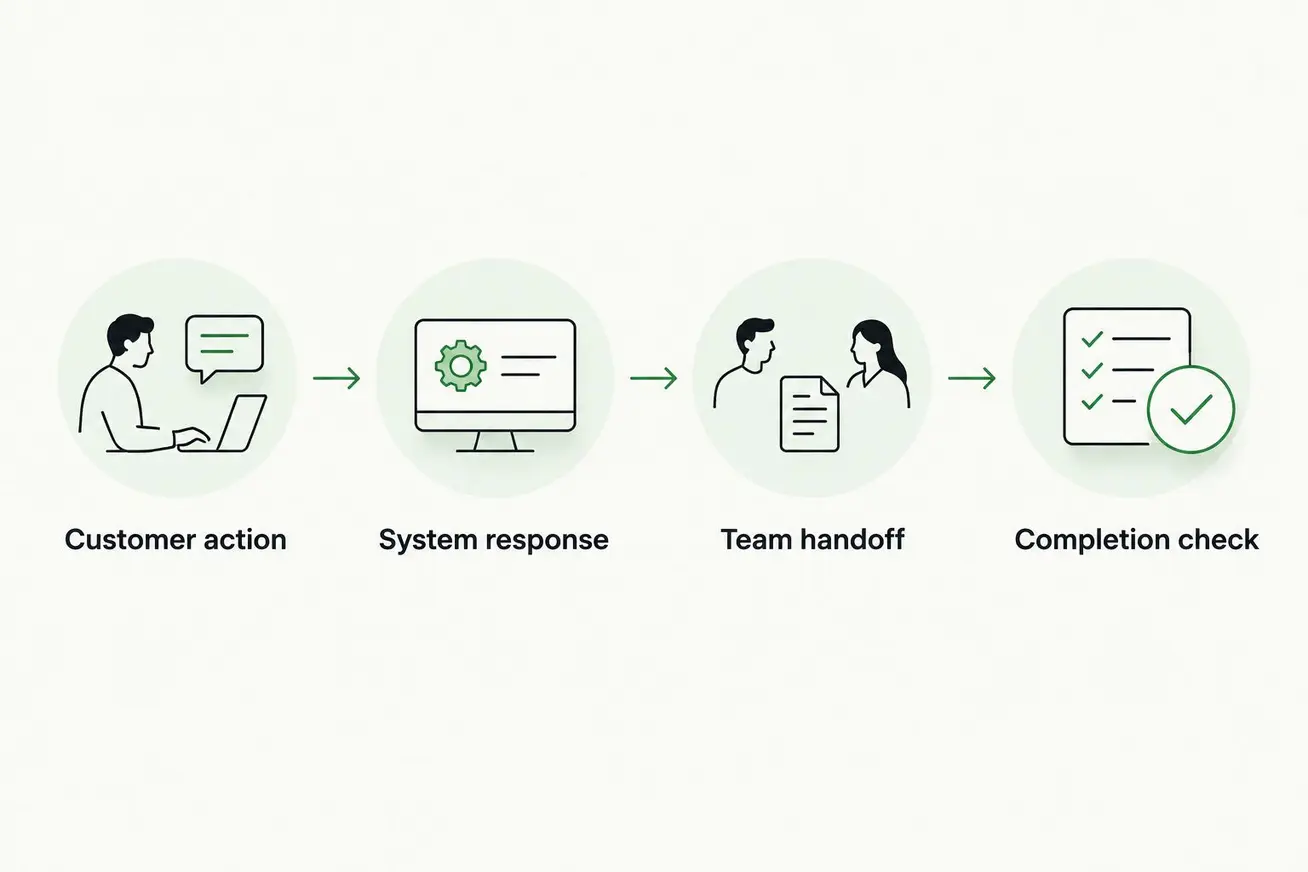
Define the whole customer journey, not just the visible feature.
An integration connects systems so information can move between them. Ask which connection is included, what data it transfers and who resolves failures. Naming a platform in a proposal does not define the integration work.
Separate search setup from ongoing SEO
A website build and an ongoing search programme are different scopes. Your 2026 quote should say which search tasks happen during development and which require separate work after launch.
For a replacement website, request an inventory of existing URLs and a redirect plan where addresses change. A redirect sends visitors and search engines from an old address to its relevant replacement. It does not guarantee that rankings will remain unchanged.
Also clarify responsibility for page titles, descriptions, internal links, sitemap submission and checks that intended pages can be indexed. If the proposal includes content research or new service-page copy, identify those deliverables separately.
“SEO included” is not an adequate scope description. Ask what will be configured, checked and handed over. Do not accept a ranking promise as a substitute for that list.
Make ownership and handover explicit
Your quote should explain who controls the domain, hosting account, website administration, analytics accounts and connected business systems. Distinguish ownership of your content from licences for third-party software or creative assets.
Ask what you receive if the working relationship ends. That includes access credentials, available source files, documentation and an explanation of any platform restrictions.
Use this guide to website ownership after a Vancouver development project to frame the handover conversation. Get the answers into the agreement rather than relying on a verbal assurance.
A managed arrangement can reduce the work your team handles directly. Its trade-off is dependence on the supplier for the tasks and access that remain under that arrangement. Clarify both before signing.
Compare delivery arrangements without mixing their scope
A defined build and an ongoing support agreement solve different problems. Neither replaces a written list of responsibilities.
Fixed-scope project
- Best for: Businesses with defined build requirements
- Main benefit: A bounded list of deliverables and acceptance criteria
- Limitation to resolve: New requirements need a change process
Month-to-month retainer
- Best for: Businesses needing continuing website work
- Main benefit: An ongoing arrangement for agreed priorities
- Limitation to resolve: The agreement still needs capacity and task boundaries
Build plus care agreement
- Best for: Businesses separating launch from upkeep
- Main benefit: Clear distinction between construction and maintenance
- Limitation to resolve: Care does not automatically include redesigns or new features
Setsail Marketing offers fixed-scope projects and month-to-month retainers, with one in-house team planning and delivering the work. That model suits buyers seeking connected website and marketing execution; the proposal still needs to name the services included rather than treating the full service list as part of every engagement.
For your own 2026 comparison, ask each supplier to separate the initial build from ongoing responsibilities. A proposal with more ongoing work is not directly comparable with a build-only proposal.
Why website development scope varies
The work changes with the requirements. These factors explain why proposals for apparently similar websites can describe substantially different projects:
- Content responsibility: Writing, editing, photography and content entry are separate tasks from building page layouts.
- Page structure: Distinct templates require different design and development work from repeated pages using an agreed layout.
- System connections: A standalone form differs from a workflow that transfers information into another business system.
- Existing-site migration: Replacing a website introduces content-transfer, URL-mapping and launch dependencies.
- Approval process: Multiple decision-makers need a defined way to consolidate feedback and approve stages.
- Ongoing ownership: Supplier-managed operations and client-managed operations require different handover and support arrangements.
Do not ask a supplier to remove an unfamiliar line item without understanding its purpose. Ask what customer task or delivery risk it addresses, then decide whether that work belongs in your scope.
How do you compare website quotes fairly?
Give every supplier the same requirements and request a written response to each one. Mark each requirement as included, excluded or needing clarification; do not assume an omitted item is included.
Next, check dependencies. Identify what your team must provide, who approves it and what happens when a dependency changes. Delivery milestones should reflect those responsibilities rather than presenting a launch date without conditions.
Finally, examine the change process. Require written approval before additional work begins and ask how changes affect delivery. Your comparison should reveal what you are agreeing to, not merely which proposal looks shorter.
Should website maintenance be included in the quote?
Website maintenance should be addressed in the quote, even when it is a separate agreement. Ask who handles updates, backups, monitoring and fixes, and which tasks remain your responsibility.
Define support boundaries too. Correcting a build defect, updating software and adding a new feature are different requests. A clear agreement tells you how each is handled without implying that ongoing support covers every future change.
What should happen before ongoing website marketing begins?
Research should establish the customer problem and channel priorities before ongoing delivery. Ask for the evidence, assumptions and measurement plan behind the recommendation.
Setsail Marketing's entry point is a free, 30-minute Growth Strategy call with no commitment. If there is a fit, the subsequent paid Growth Strategy engagement includes customer research, sourced market demand, a diagnosis of marketing gaps, channel priorities and a fixed 90-day plan; the client keeps the strategy whether or not they continue.
Projected returns and payback are estimates, not guarantees. A documented plan gives you assumptions to test against actual performance rather than a promise to accept on trust.
Book a Growth Strategy call
A free, 30-minute call with no commitment. The subsequent Growth Strategy is a separate paid engagement.
FAQ
What should I ask before accepting a Vancouver website development quote?
Ask for the deliverables, exclusions, acceptance criteria, ownership terms and change process in writing. Confirm what your team must supply and what happens after launch.
Does a website development quote include copywriting?
Copywriting is included only when the agreement explicitly names it. Ask who researches, writes, approves and uploads the content.
Should a website quote include SEO?
A website quote should define its search-related work rather than simply say SEO is included. Separate launch requirements and migration tasks from ongoing research, content and reporting.
Who should own my website accounts?
Require the agreement to state who owns and controls each account. Confirm your access to the domain, hosting, website administration and analytics, and identify any third-party licence restrictions.
Is a fixed-scope website project better than a retainer?
A fixed-scope project suits defined build requirements; a retainer suits continuing work with agreed priorities. Both need clear deliverables, boundaries and approval terms.
Can a developer guarantee more sales from a new website?
Treat sales forecasts as estimates, not guarantees. The build agreement should define testable delivery requirements separately from assumptions about future customer behaviour.
Is the Setsail Marketing Growth Strategy call free?
The Setsail Marketing Growth Strategy call is free, lasts 30 minutes and carries no commitment. A subsequent researched Growth Strategy is a separate paid engagement if there is a fit.
One last thing
Before accepting a 2026 website proposal, ask the supplier to demonstrate how your most important customer journey will be tested. For an enquiry-led business, follow the submission into the receiving system; for an online shop, follow the order through the agreed handoff.
The website is not finished merely because the pages are visible. Your acceptance criteria should confirm that the customer action works and your business receives what it needs.
Related guides
- What should a Vancouver SEO agency report each month?
- How to give a marketing agency a useful customer brief
- What should an ecommerce marketing agency know about margins?