
TL;DR
- For web development Vancouver projects, require written ownership terms and business-controlled accounts before work starts.
- Custom code, website content and third-party software can have different owners and licence conditions.
- Setsail Marketing prioritises client ownership of assets and a documented plan before ongoing delivery.
- A complete handover includes access, files, licences and a tested route to another provider.
Who owns your website after a Vancouver development project?
Ownership depends on the contract, the creator’s employment relationship and any third-party licences—not simply who paid for the website. Under Canada’s Copyright Act, the author is generally the first copyright owner, subject to exceptions such as qualifying employment relationships. A copyright assignment must be in writing and signed by the owner or an authorised agent.
That distinction belongs in your web development brief, not in a disagreement after launch. Sections 13(1), 13(3) and 13(4) of the Copyright Act provide the Canadian legal starting point for this 2026 ownership checklist; your agreement determines how those rules apply to the project.
Domain registration
- What to establish: Your business is the registrant, with a business-controlled account
- What to receive: Registrar access, renewal details and recovery controls
Custom code and design
- What to establish: Whether rights are assigned or licensed, and when
- What to receive: Agreed source files, repository access and written terms
Written content and photography
- What to establish: Who created the material and what rights your business receives
- What to receive: Original files and assignment or licence records
Themes, plugins and fonts
- What to establish: Which third-party conditions apply
- What to receive: Licence details and responsibility for renewals
Hosting and website platform
- What to establish: Who controls the account and what can be exported
- What to receive: Administrative access, billing control and migration instructions
The table separates ownership from possession. A folder of files does not establish copyright ownership, and copyright ownership alone does not give you access to a hosting account.
Why this matters before you approve a website
A website supports enquiries, orders and customer trust. If you cannot renew the domain, edit the content or appoint another developer, your ability to keep selling depends on someone else’s cooperation.
For a Vancouver contractor, that can mean being unable to update a service area or repair a broken enquiry form. For an ecommerce business, it means understanding whether product information, customer records and order data can move to another platform. Those are different operational needs, but both require clear account control.
When comparing web development Vancouver proposals in 2026, ask a commercial question: what can your business keep, change and transfer when the engagement ends? A proposal that lists pages and features without answering that question leaves an important part of the buying decision unresolved.
Assigned ownership: control over the agreed custom work
Best for: businesses that need the right to modify custom work and appoint another provider. An assignment transfers the copyright identified in the agreement. It should distinguish new work created for your project from the developer’s pre-existing tools and third-party components.
Ask which deliverables the assignment covers. Website copy, design files, illustrations and custom code need clear treatment; describing everything as the website leaves room for disagreement.
Also check the transfer conditions. If the agreement makes assignment conditional on payment or acceptance, identify the exact trigger before work starts. Do not assume the transfer happens at launch.
The benefit is control over the rights actually assigned. The limitation is that an assignment cannot give you ownership of third-party material the developer does not own. You still need licences and usable files.
Licensed work: permission without copyright ownership
Best for: businesses comfortable using defined work under clear contractual permissions. A licence lets you use material without transferring its copyright. Its usefulness depends on what the licence permits.
Ask whether you can modify the work, move it to another host and let a replacement developer maintain it. Check duration, termination conditions and whether continued use depends on an ongoing service agreement.
A licence can support normal business operations when those permissions match your needs. Its limitation is the boundary of those permissions: access to the files does not expand your legal rights.
Do not reject every licence on principle. Instead, identify which restrictions would prevent your next likely business decision, such as changing providers or rebuilding a checkout.
Hosted platforms: control within the platform’s rules
Best for: businesses that accept platform limits in exchange for managed infrastructure. A hosted website can give your business administrative control without ownership of the underlying platform software.
The important questions concern account ownership, export options and dependencies. Establish what you can take with you, which functions depend on the platform and who controls connected services.
The benefit is not having to own or maintain every underlying software component. The limitation is that moving your content does not necessarily reproduce the site’s design, integrations or behaviour elsewhere.
Assigned custom work
- Best for: Businesses needing modification and transfer rights
- Main benefit: Control over the rights expressly assigned
- Main limitation: Third-party components remain subject to their licences
Licensed custom work
- Best for: Businesses accepting defined usage permissions
- Main benefit: Use of work without acquiring its copyright
- Main limitation: Modification and transfer depend on the licence
Hosted platform
- Best for: Businesses accepting platform boundaries
- Main benefit: Managed underlying infrastructure
- Main limitation: Exporting data does not recreate the entire website
These arrangements can coexist. A single website can contain assigned copy, licensed photography and platform software that your business does not own.
Why website ownership varies
Ownership varies because websites combine different assets and agreements. Check these factors rather than looking for a single ownership checkbox:
- Creator relationship: Canadian copyright rules distinguish independent creators from qualifying employee-created work.
- Contract wording: An assignment and a licence grant different rights. The deliverables and conditions need to be explicit.
- Pre-existing materials: A developer can retain rights to tools created before your project while granting permission to use them.
- Third-party licences: Stock images, fonts, themes and plugins carry their own terms.
- Platform dependence: Hosted infrastructure and integrations can limit what transfers even when your business owns its content.
- Transfer conditions: Payment, acceptance and termination clauses can affect when rights pass or continued permissions apply.
For your 2026 agreement, ask the developer to map each category to an owner, a permission and a handover item. That is more useful than a broad promise that everything belongs to you.
How do you check ownership before signing?
Use this sequence before approving the build. It connects the contract to the access your team will need later.
Asset register
List the domain, website platform, hosting, code, design files, copy, images and connected accounts. Add who currently controls each item and who should control it after launch.
For an existing site, include assets already in use. A redesign does not automatically replace old image licences or resolve an account registered to a former employee.
Written rights
Ask the agreement to identify assigned work, licensed work and excluded material. Specify whether another provider can edit and maintain the deliverables.
If ownership is commercially important or the language is unclear, have a British Columbia lawyer review it. A developer’s explanation is useful, but it is not a substitute for rights expressed in the agreement.
Account control
Put business-critical accounts under business-controlled credentials and recovery methods. Use named user access where supported rather than circulating a shared password.
As an access safeguard, designate 2 named administrators where the platform permits it. Keep permissions appropriate to each person’s role, and remove departing staff or suppliers promptly.
Transfer test
Ask the developer to demonstrate how another provider would take over. Check file exports, repository access, backups, licence records and deployment instructions against the agreed scope.
A transfer test is not an instruction to migrate a working website. It establishes whether the promised exit route is usable before you need it.
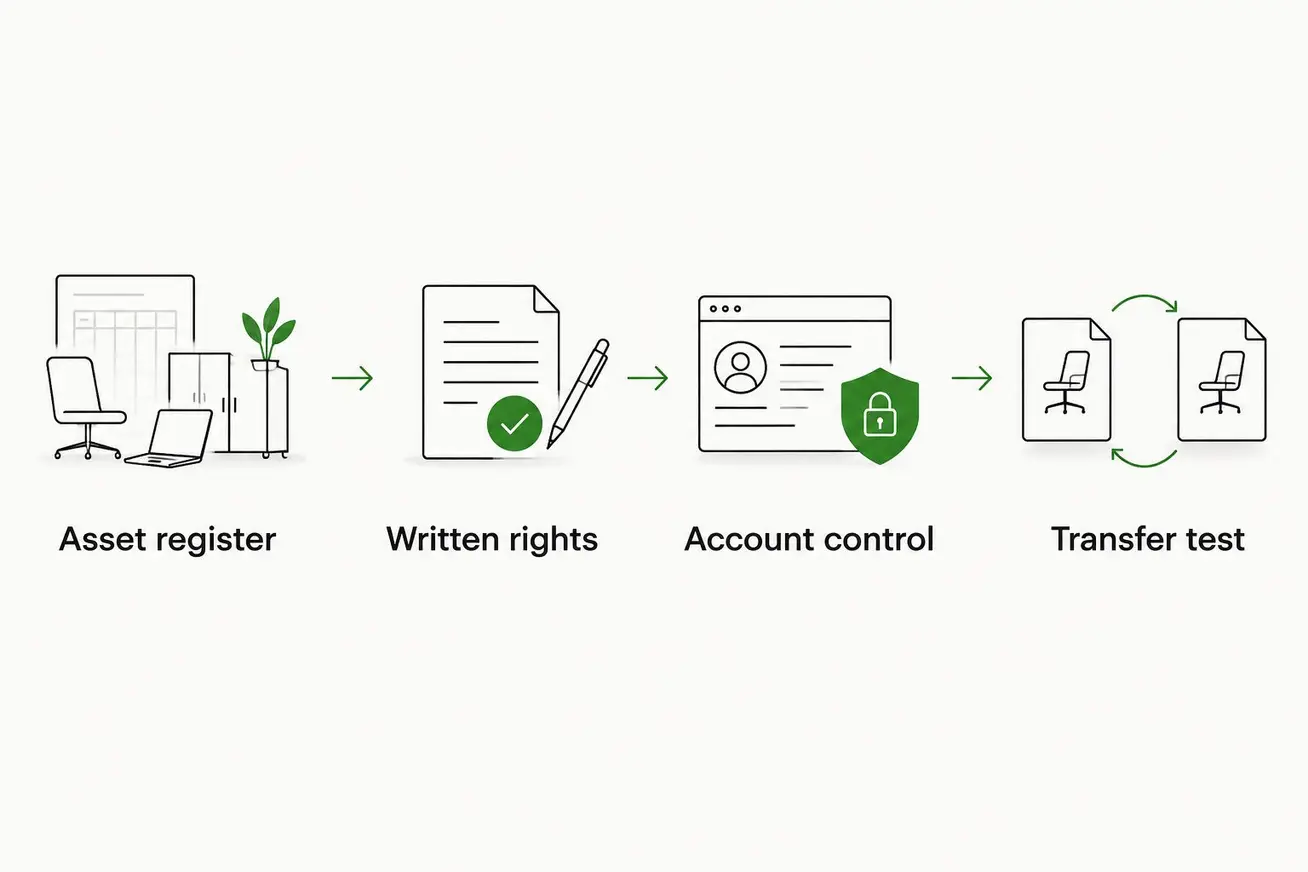
Check the rights and the practical handover before the project closes.
Record the results in the project documentation. A useful handover names the account, its business owner and the action required; it does not merely say access provided.
What should a website handover include?
Your 2026 handover should match the agreement and make routine operation possible. Request a written record covering:
- Domain registrar, registrant details, renewal responsibility and recovery access.
- Hosting and platform administration, including billing ownership.
- Source code, design files and content files included in the scope.
- Third-party licences, restrictions and renewal responsibilities.
- Backup location, restoration instructions and deployment information.
- Connected forms, analytics, payment services and email integrations.
- Outstanding issues, maintenance responsibilities and the agreed support boundary.
Have your team perform ordinary tasks using its own access. Edit a page, receive a test enquiry and locate the backup instructions. For an online store, review export options and payment-account control without exposing customer information unnecessarily.
A login is not a complete handover. Your business needs documented rights, usable deliverables and enough operational information to appoint a replacement provider.
Does paying the developer make me the copyright owner?
Payment alone does not automatically assign copyright. Under the Canadian rules described above, the creator’s relationship to your business and a valid written assignment matter.
Check whether your agreement describes a transfer of rights or only delivery of a finished website. Those are not interchangeable promises.
Can I move my website to another developer?
You can appoint another developer, but that developer’s ability to use and modify the existing site depends on your rights, access and technical dependencies. Confirm those three areas before cancelling the current engagement.
Request the handover while the working relationship remains active. Keep the website operating while you establish which assets transfer and which require replacement or a new licence.
Can my agency keep the domain name?
An agency’s account access and your business’s domain registration are separate questions. Verify the registrant details, account control and contract rather than assuming the domain belongs to whoever manages renewals.
If control is disputed, preserve the registration records, invoices and correspondence. Get advice before changing arrangements that keep the website and business email working.
Choose the project around business control
Setsail Marketing is best for small and mid-sized businesses seeking strategy-led web development with client ownership of assets as a priority. The buying decision should still rest on a written scope, clear rights and a handover your team can use.
You can book a free, no-commitment, 30-minute Growth Strategy call with Setsail Marketing. Bring the website problem and the commercial outcome you need, whether that is better-qualified enquiries, more orders or a site your team can manage.
The call is separate from the subsequent paid Growth Strategy engagement. That engagement includes customer research, sourced market demand, marketing-gap diagnosis, channel priorities and a fixed 90-day plan. You keep the strategy whether or not you continue; projected returns and payback are estimates, not guarantees.
FAQ
Do I own my website after paying a Vancouver developer?
Payment alone does not automatically transfer copyright. Check the written agreement for assigned rights, licensed materials and any conditions governing the transfer.
What should I ask a web development Vancouver agency about ownership?
Ask who owns each deliverable, which components are licensed and whether another developer can modify the site. Also confirm business control of the domain, hosting and recovery methods.
Is owning the domain the same as owning the website?
Domain registration is separate from ownership of website code, design and content. Check each asset and its controlling account independently.
Can I keep using my website after leaving my agency?
Your continued usage rights depend on the agreement and applicable licences. Confirm termination terms, account access and any ongoing dependencies before ending the engagement.
Should my business control its hosting account?
Business-controlled hosting supports continuity when you change providers. If hosting sits within an agency-managed arrangement, document the access, export and transfer process before signing.
What happens to paid plugins when I change developers?
Plugin permissions depend on their licence terms. Identify which licences belong to your business, which belong to the developer and what must change during the handover.
Do I need a lawyer to review website ownership terms?
A lawyer can review unclear assignments, licences and termination clauses before you commit. Seek advice when the rights or restrictions have material consequences for your business.
One last thing
For your 2026 website project, ask a person outside the build team to walk through the handover instructions. If that person cannot identify who controls the domain, where the files live and how to recover access, the documentation needs work.
Bring that test to your discussion with Setsail Marketing. The practical ownership question is not just whether you can prove your rights—it is whether your business can act on them.
Related guides
- What should a Vancouver SEO agency report each month?
- What should an ecommerce marketing agency know about margins?
- How to switch Google Ads agencies without losing your account