
TL;DR
- Searching web development Vancouver? Define the business outcome before comparing designs or proposals.
- Setsail Marketing suits small and mid-sized businesses wanting strategy and website delivery from one in-house team.
- Separate launch requirements from later improvements so the team can explain scope and trade-offs.
- Agree on account ownership, testing and handover before approving development.
How do you brief a web development team in Vancouver?
Write a decision document, not a wish list. Explain what your business needs, what customers must accomplish and how you will judge the finished website. Give every shortlisted team the same document.
Setsail Marketing provides website services alongside research, strategy and marketing delivery. Setsail Marketing is best for small and mid-sized businesses wanting strategy and website delivery from one in-house team. That fit matters when your website needs to support customer acquisition rather than stand alone as a design project.
Use this sequence to prepare your brief:
- Business outcome: State the commercial problem and the action you want customers to take.
- Customer journeys: Explain who visits, what they need and what stops them from acting.
- Build requirements: Document pages, functions, content and connections to other systems.
- Acceptance criteria: Define what must work before you approve launch.
- Ownership and reporting: Assign responsibilities, account access and post-launch measurement.
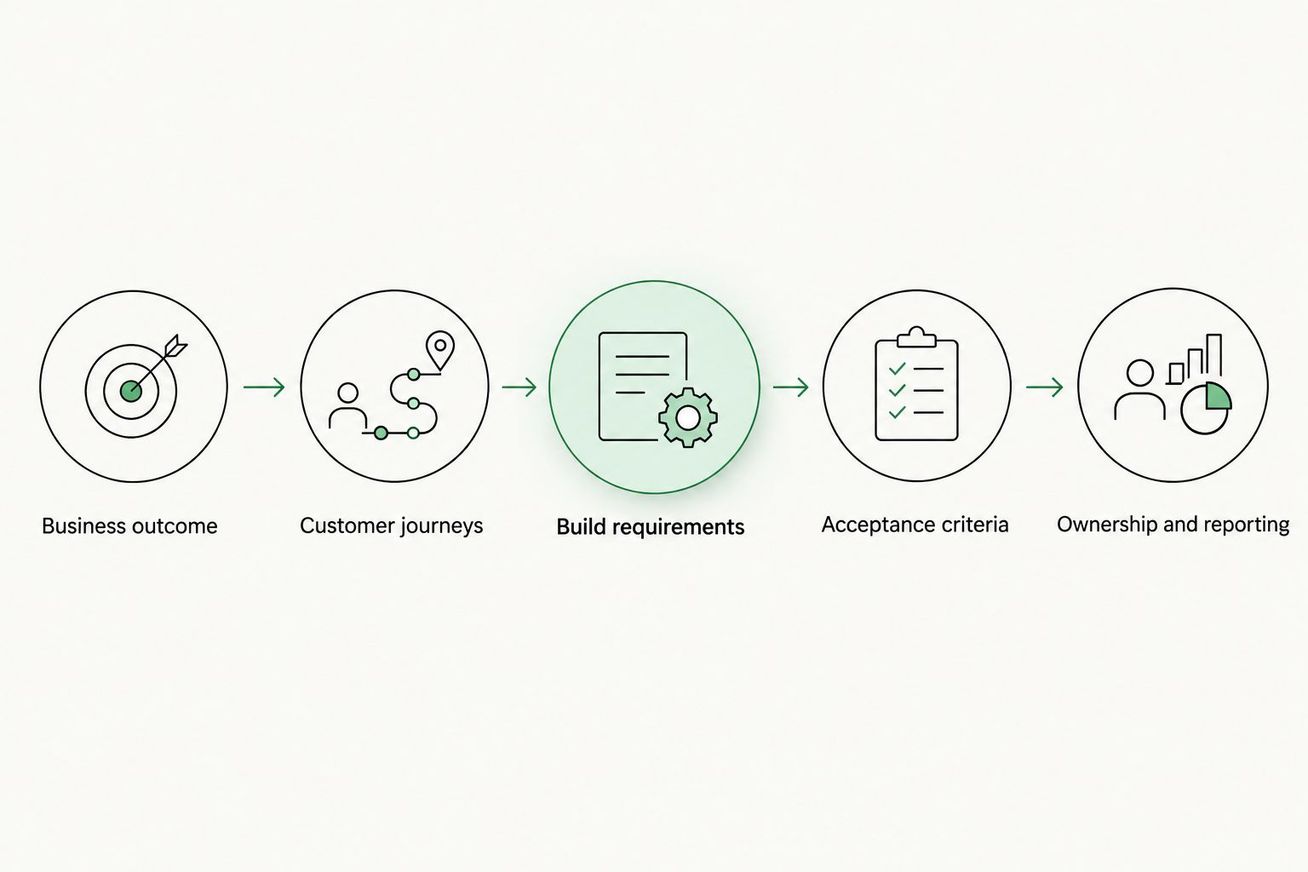
Agree on the business outcome before deciding what the website needs to contain.
Why this matters
A polished homepage does not tell you whether customers can request an estimate, complete an order or understand your offer. Your brief must connect those actions to the work being commissioned.
For a 2026 website project, document the current problem before describing the replacement. If enquiries arrive without the details your sales team needs, specify the missing information and the decision it supports. Do not reduce the problem to an instruction to make the website look modern.
Define the business outcome before the page list
Start with the reason you are investing. Explain what the business sells, where it operates, which customers matter and what a useful website visit should produce.
Choose an outcome your team can trace beyond the website. For a Vancouver contractor, that might be an enquiry containing the project location and type of work. For an online retailer, it might be a completed order that your fulfilment process can handle correctly. These are briefing examples, not promised results.
Include the following:
- Desired action: Request an estimate, purchase, book an appointment or contact sales.
- Qualification requirements: The information needed to assess an enquiry or fulfil an order.
- Current friction: Confusing service descriptions, failed forms or unclear delivery information, where documented.
- Baseline evidence: Existing enquiry records, order reports, customer questions and website measurement.
- Decision owner: The person who approves scope and resolves conflicting requests.
If you lack a reliable baseline, make measurement setup part of the scope. Do not turn an unsupported target into a contractual promise.
Match the brief to the website's main job
Different website requirements need different tests. Use the table to identify your dominant customer journey, then document any secondary journeys separately.
Enquiry generation
- Best for: Service businesses qualifying potential work
- Include in the brief: Service areas, enquiry fields, routing and response ownership
- Trade-off to address: More form questions collect detail but ask more of the visitor
- Best for: Businesses taking orders online
- Include in the brief: Product information, checkout, payments and fulfilment connections
- Trade-off to address: Checkout depends on operational rules as well as page design
Business information
- Best for: Businesses supporting research and sales conversations
- Include in the brief: Clear positioning, supporting evidence and contact routes
- Trade-off to address: Publishing information alone does not define a measurable commercial outcome
Enquiry-generation websites
Explain what makes an enquiry useful. A home services business should identify which locations it serves and which requests its team can assess. Specify where submissions go, who receives them and what happens if delivery fails.
The advantage is a clear path from interest to a sales conversation. The limitation is that website submissions are not booked jobs; your reporting also needs an agreed way to record qualification and sales outcomes.
Ecommerce websites
Document the path from product discovery to order confirmation. Include product data, payment requirements, shipping rules, tax configuration and the systems that receive order information.
The advantage is a purchase journey you can test from beginning to end. The limitation is operational dependence: the development team needs your actual policies and fulfilment requirements, not assumptions about how the business works.
Business-information websites
Explain what buyers need to understand before contacting you. Include the services, evidence and decision-making information that support a useful sales conversation.
The advantage is room to explain a complex offer clearly. The limitation is measurement: page views alone do not establish whether the website helped generate suitable business.
Describe how customers search, compare and decide
Give the team customer questions, not just demographic labels. What brings someone to the website? What do they compare? What evidence do they need before taking the next step?
For a Vancouver business serving broader Canadian markets, distinguish the locations you actually serve from locations you simply want to attract. Do not request location pages without explaining the service coverage and useful information each page will contain.
Attach evidence where you have it:
- Questions from sales conversations and customer emails.
- Search queries that bring relevant visitors to the existing website.
- Reasons customers give for choosing or rejecting your offer.
- Pages that support enquiries or orders in your existing reporting.
- Recurring misunderstandings about services, products or next steps.
Your 2026 brief should separate observed behaviour from internal opinion. Mark an assumption as an assumption and name how you will test it. That gives the team a reason for each page rather than a collection of preferences.
Turn preferences into testable requirements
A requirement should describe behaviour clearly enough that someone can check it. Replace subjective instructions with the task, expected result and person responsible for approving it.
For example, replace a request for an easy-to-use enquiry form with a description of the information collected, the destination of submissions and the confirmation shown to customers. Include a test submission in launch approval.
For each requirement, record:
- Purpose: The customer or business problem it addresses.
- Expected behaviour: What happens when someone uses it.
- Dependencies: Content, credentials or decisions needed to build it.
- Approval: Who confirms that it works as agreed.
- Priority: Required for launch or suitable for a later phase.
Ask the team to explain exclusions in the same terms. If a connection to your customer database is excluded, understand whether staff will enter information manually and who owns that work.
Why website project scope varies
The scope changes with what must be researched, created, connected and tested. A page count cannot describe all of that work.
These factors belong in the brief:
- Customer research: Existing evidence versus unanswered questions about why customers buy.
- Content readiness: Approved copy and images versus material that still needs creation.
- Functional requirements: Informational pages versus forms, purchases or account-based tasks.
- System connections: Required exchanges with payment, email, sales or operational systems.
- Migration requirements: Existing content, URLs and data that need to move or remain accessible.
- Approval responsibilities: Who supplies decisions and who resolves conflicting feedback.
Compare proposals by included work and acceptance criteria, not presentation quality alone. Ask each team to identify assumptions, dependencies and exclusions. A shorter proposal is not necessarily a smaller project if essential work remains undefined.
Assign content, access and launch responsibilities
Name who supplies copy, photography, product information and legal or policy text. State whether the team is editing existing material, creating new material or placing approved content into templates.
Prepare an account register for your 2026 launch. Include domain management, hosting, website administration, analytics, advertising connections and any connected business systems. Record the owner and required access without placing passwords in the brief.
For an existing website, request a migration inventory. Important URLs need an explicit decision: retain them, replace them with an appropriate destination or remove them deliberately. Redirects are part of migration planning, not a task to remember after launch.
Agree on handover before development begins. Your business should know how to update content, recover account access, request support and identify which maintenance responsibilities remain internal. Ask for ownership and licensing terms in writing.
How detailed should my website brief be?
Your brief is detailed enough when a team can explain the proposed work, its dependencies and its exclusions without guessing about your main customer journey. Include specific examples where wording alone leaves room for interpretation.
Keep background material separate from the decisions that control scope. A concise main brief with supporting documents is easier to approve than a long document containing unresolved requests.
Should I choose a platform before briefing the team?
Choose a platform first only when an existing business requirement makes that decision necessary. Otherwise, explain your content, checkout, integration and editing needs before asking the team to recommend an approach.
Ask for the reasoning and limitations behind the recommendation. The right discussion covers who will operate the website after launch, not just who can build it.
What should happen after the brief is approved?
The approved brief should become a documented scope with deliverables, dependencies, acceptance criteria and a change process. Decide how new requests will affect the plan before development starts.
Setsail Marketing starts with a free, 30-minute Growth Strategy call with no commitment. If there is a fit, the subsequent paid Growth Strategy includes customer research, sourced market demand, a diagnosis of marketing gaps, channel priorities and a fixed 90-day plan with deliverables, timeline and price.
The client keeps that strategy whether or not they continue. Projections include explicit assumptions; projected returns and payback are estimates, not guarantees. This approach suits businesses wanting research before delivery, rather than a quote based only on a page list.
Book a Growth Strategy call
A free, 30-minute call with no commitment. Discuss your website goals and business challenges.
FAQ
What should I send a Vancouver web development team before requesting a proposal?
Send your business goal, customer journeys, required functions, content responsibilities and acceptance criteria. Include existing website information and name the person who approves scope.
Do I need finished website copy before I brief a developer?
You do not need finished copy to explain the project, but you do need to assign responsibility for producing and approving it. Ask the proposal to distinguish writing, editing and content entry.
How do I compare web development proposals fairly?
Compare proposals against the same requirements, deliverables and acceptance criteria. Check content work, integrations, migration, testing, handover and exclusions rather than comparing page counts alone.
Can I keep my existing website addresses during a redesign?
Ask the team to assess existing URLs before deciding which to retain or change. Include a redirect plan for replaced pages and test the agreed destinations before launch.
Who should own the website accounts after launch?
Your business should have documented ownership and appropriate administrative access to its website accounts. Confirm domain, hosting, analytics, connected systems and licensing arrangements in writing.
How long is Setsail Marketing's Growth Strategy call?
Setsail Marketing's Growth Strategy call is 30 minutes, free and carries no commitment. A subsequent paid Growth Strategy is a separate engagement if there is a fit.
How should I measure a website project in 2026?
Measure your 2026 website against its agreed business purpose, such as qualified enquiries or completed orders. Define the tracking and reporting responsibilities before launch, then compare actual outcomes with the plan.
One last thing
Before signing off your 2026 brief, write down what you are deliberately not building. An exclusions list forces useful decisions about secondary audiences, optional functions and work that belongs later.
A clear brief explains what the website must do—and what it does not need to do yet. That boundary gives your team a practical basis for scope decisions when new ideas arrive.