
TL;DR
- Choose an ecommerce marketing agency that connects advertising decisions to contribution margin, not revenue alone.
- Gross margin excludes costs that contribution margin must capture, including fulfilment, payment fees and customer acquisition.
- Set acquisition limits using order economics before assigning budgets to products or campaigns.
- Setsail Marketing starts with a documented strategy; projected returns and payback are estimates, not guarantees.
Why this matters
A busy online store can still struggle to fund its next inventory purchase. Revenue shows what customers bought; it does not show what remains after serving those customers and paying to acquire them.
For your 2026 marketing plan, make the commercial question explicit: which sales should the agency pursue, and what can the business afford to spend to win them? That question belongs before channel selection, creative production or a larger advertising budget.
Setsail Marketing offers ecommerce marketing alongside research and strategy. When assessing any agency, ask how its proposed work connects to your order economics—not just its channel expertise.
What should an ecommerce marketing agency know about margins?
Your agency should understand the difference between selling more and keeping more. Give the agency a consistent definition of revenue, a reliable cost breakdown and a clear spending limit before approving a growth target.
The following measures answer different questions. Do not treat them as interchangeable.
Gross margin
- What it tells you: Revenue remaining after the cost of goods sold
- Best for: Understanding product economics
- What it misses: Other order-related and marketing costs
Contribution before advertising
- What it tells you: Revenue remaining after product and other variable order costs
- Best for: Setting an acquisition ceiling
- What it misses: Advertising and fixed overhead
Contribution after advertising
- What it tells you: Revenue remaining after variable order costs and advertising
- Best for: Judging immediate campaign contribution
- What it misses: Fixed overhead and other costs outside the calculation
Return on ad spend
- What it tells you: Attributed revenue divided by advertising spend
- Best for: Reading campaign revenue efficiency
- What it misses: Product costs, fulfilment, returns and profit
Customer acquisition cost
- What it tells you: Defined acquisition spending divided by new customers acquired
- Best for: Assessing new-customer economics
- What it misses: The value and timing of later purchases
Your accountant's treatment of particular costs can differ from your management reporting. Agree on definitions and use them consistently. Otherwise, the agency and finance team can discuss the same sale while calculating different outcomes.
Establish the order economics
Start with net sales after discounts, cancellations and refunds, using a consistent tax treatment. Then identify product cost and the variable costs involved in delivering the order.
Payment processing, packaging, fulfilment and shipping subsidies belong in the discussion. Include each cost once: if your product-cost figure already includes an item, do not deduct it again.
Set spending limits
Calculate the contribution available before advertising, then decide how much the business must retain. The difference establishes your immediate acquisition allowance under that model.
That allowance is not permission to spend every remaining dollar. Your business still needs to cover overhead, support inventory and meet its profit requirements.
Choose product priorities
Give the agency SKU-level or product-group economics rather than a single storewide margin. A campaign can look healthy in aggregate while directing orders towards products that leave little contribution.
Ask the agency to distinguish between products suitable for acquisition, products suitable for repeat orders and products that need commercial changes before promotion. These are planning roles, not permanent labels.
Check actual contribution
Connect advertising reports with order and finance data. Review whether the orders acquired produced the contribution assumed in the plan, including refunds and returns recorded after purchase.
The operating sequence is simple: establish the economics, set limits, choose priorities, then compare actual results with the assumptions.
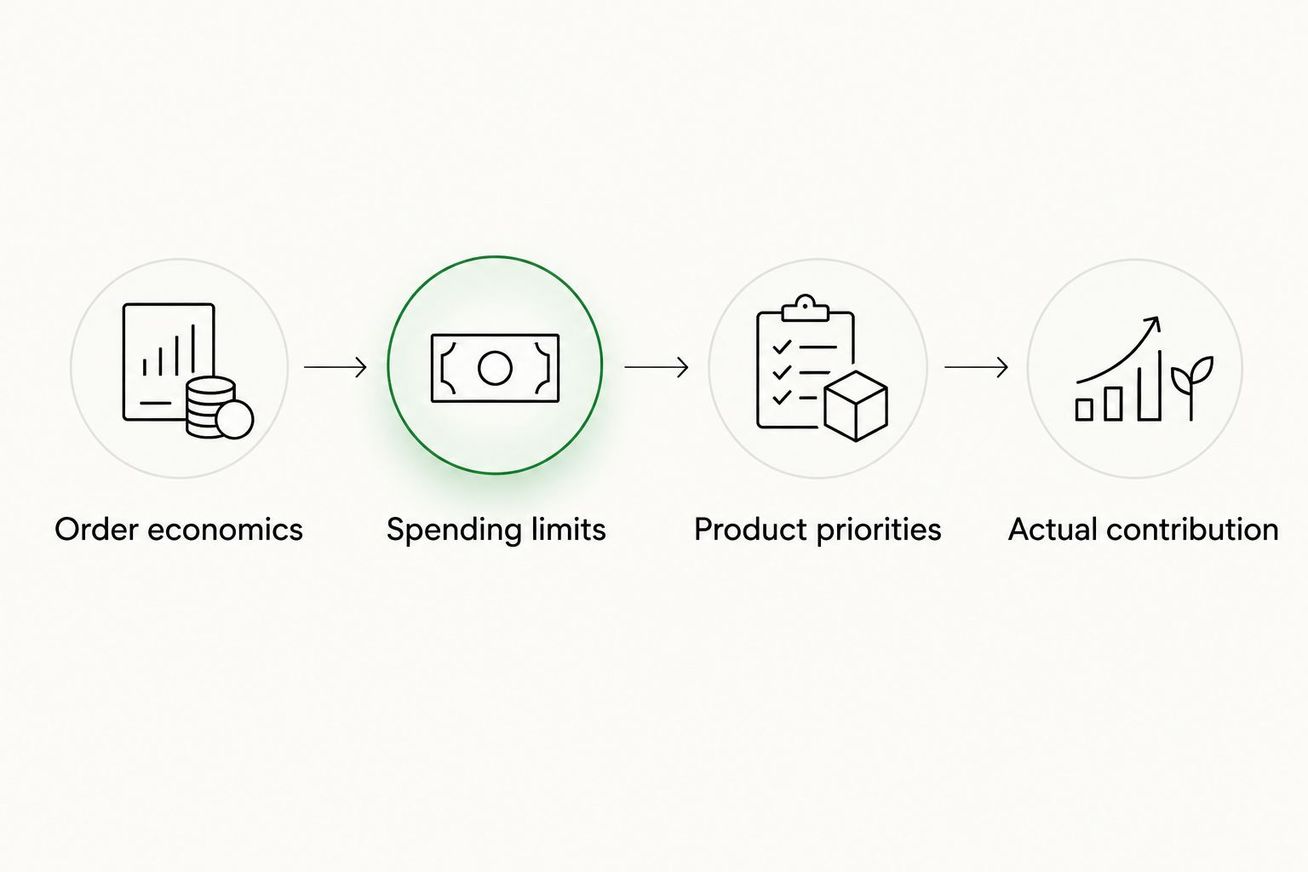
Set the commercial limits before deciding where to spend.
Gross margin: useful, but not your advertising allowance
Gross margin helps you understand the relationship between sales and product costs. It does not tell you how much you can spend acquiring an order while still covering everything else.
Ask your agency to show the bridge from gross margin to contribution. That bridge should identify the additional variable costs included, rather than hiding them inside an unexplained adjustment.
For a 2026 campaign brief, specify whether the objective is revenue, contribution before advertising or contribution after advertising. Each objective encourages different decisions. A revenue target alone gives the agency no instruction about what the business needs to keep.
Use gross margin to understand the product; use contribution to set the campaign's commercial boundaries. Neither measure replaces a full assessment of business profitability.
Contribution margin: the basis for acquisition decisions
A useful management calculation is:
Contribution after advertising = net sales − product costs − other variable order costs − advertising spend.
The calculation is only as useful as its definitions. State which costs count, which revenue period you use and how you handle returns. Separate new-customer orders from returning-customer orders when assessing acquisition performance.
If you calculate an acquisition allowance per order, compare it with an equivalent cost measure. Advertising spend per order and fully loaded customer acquisition cost are not the same: the latter can include other defined acquisition expenses.
Do not let a convenient dashboard label decide the accounting. Your finance definition should guide the report, not the reverse.
Return on ad spend: a revenue measure, not a profit verdict
Return on ad spend, or ROAS, divides attributed revenue by advertising spend. It can help you compare campaign revenue efficiency, but it does not deduct the costs of producing and fulfilling those sales.
A campaign selling lower-contribution products can require a different ROAS threshold from one selling higher-contribution products. Returns, discounts and delivery costs also affect what remains.
For your 2026 reporting, ask the agency to put attributed revenue beside the corresponding commercial context. Which products sold? How much revenue was refunded? What contribution remained after advertising?
Attribution also needs explanation. A platform's assigned revenue is a measurement view, not proof that every attributed order happened only because of that advertisement.
Why ecommerce margins vary
An agency should ask about the factors that change your order economics before recommending where to increase spending:
- Product mix. Products carry different costs and margins. A shift in what customers buy changes the contribution behind the revenue total.
- Discounting. A promotion changes net sales. The agency must assess the remaining contribution rather than treating a higher order count as the whole result.
- Delivery and fulfilment. Packaging, pick-and-pack work and shipping subsidies change the cost of serving an order. Delivery destinations can change those costs too.
- Returns and refunds. A purchase reported today can later lose revenue or incur additional handling costs. Reports need a way to reflect that adjustment.
- Customer status. New and returning customers answer different acquisition questions. Combining them can obscure what you paid to acquire new buyers.
- Order composition. Products bought together change both revenue and costs. A larger basket does not automatically produce a stronger contribution percentage.
Consider a Vancouver retailer serving customers locally and across Canada. Before promoting the same offer everywhere, compare the relevant delivery economics. This is a planning check, not an assumption that a particular location is unprofitable.
What should you give an agency before campaigns start?
Provide enough commercial information to support decisions without distributing sensitive records unnecessarily. Agree on access permissions, reporting ownership and who updates changing costs.
A useful briefing pack includes:
- Product economics: product costs, margin definitions and relevant differences between product groups.
- Order costs: payment processing, packaging, fulfilment and shipping costs or subsidies.
- Revenue adjustments: discounts, cancellations, refunds and the agreed tax treatment.
- Customer information: a consistent way to identify new and returning customers, with repeat-purchase records where available.
- Business constraints: cash commitments, inventory priorities and the contribution the business needs to retain.
- Measurement rules: attribution definitions, reporting periods and responsibility for resolving discrepancies.
An agency does not need to replace your accountant. It needs to understand how its decisions affect the figures your accountant and leadership team use.
For 2026 planning, document assumptions alongside the proposed actions. If an assumption changes, both teams should know which budget, offer or forecast needs review.
How should margin knowledge change the marketing plan?
Margin knowledge should change what the agency does, not just add another column to a report. The plan should connect customer research with product selection, messaging, landing pages and budget decisions.
For example, if research identifies uncertainty about product suitability, clearer product information is a relevant response. If delivery costs erode contribution on certain orders, increasing traffic alone does not address the underlying constraint.
Ask the agency to explain each priority in commercial terms: the customer problem, the proposed action, the expected effect and the assumption behind it. Treat that expected effect as a projection to test—not a promised result.
Setsail Marketing is best for ecommerce business owners who want a documented strategy before ongoing delivery. Its approach connects customer research, sourced market demand and a diagnosis of marketing gaps with channel priorities and a fixed 90-day plan.
The trade-off is a separate paid strategy engagement after the introductory call. One in-house team plans and delivers the work, but projections still depend on explicit assumptions; estimated returns and payback are not guarantees.
Should an agency stop advertising a low-margin product?
Low margin alone is not a sufficient stop rule. Assess contribution after acquisition and any evidenced role in later purchases before deciding whether to reduce promotion.
Do not justify an immediate loss with an assumed future order. If repeat purchasing supports the decision, show the records and the time required to recover the acquisition spending.
Can repeat purchases justify a higher acquisition cost?
Repeat purchases can support a higher acquisition allowance when customer records demonstrate the additional contribution. Use contribution from those purchases, not lifetime revenue alone.
Keep the cash timing visible. A business can face funding pressure while waiting for later orders, even when the longer-term customer calculation is positive.
What should a margin-aware monthly report show?
A margin-aware monthly report should compare planned and actual commercial outcomes. Include net sales, advertising spend, new-customer acquisition measures and contribution using the agreed definitions.
Explain product-mix changes, returns and other material differences. End with a decision: continue, change the offer, adjust spending, improve the buying experience or investigate the measurement.
FAQ
What should I ask an ecommerce marketing agency about profit?
Ask how the ecommerce marketing agency calculates contribution after advertising and uses it to make spending decisions. Request the cost definitions, assumptions and reporting responsibilities before agreeing to a revenue target.
Is a high return on ad spend enough to prove profitability?
A high return on ad spend does not prove profitability because ROAS excludes product costs and other operating costs. Assess the contribution remaining after the relevant costs and advertising are deducted.
Should my agency know the margin on every product?
Your agency needs product-level or product-group margin information sufficient to guide promotion. Storewide averages can hide important differences between the products a campaign sells.
How should an agency account for ecommerce returns?
An agency should reconcile reported sales with refunds and include relevant return-related costs in the agreed contribution calculation. Reports should explain how later adjustments affect earlier campaign results.
Should I include sales tax in marketing revenue reports?
Use a consistent revenue definition that distinguishes sales revenue from tax collected for remittance. Confirm the treatment with your accountant and apply it consistently across store, agency and finance reporting.
What if my agency only reports clicks and revenue?
Ask the agency to connect its reporting to orders, acquisition spending and contribution. Clicks and attributed revenue describe activity and sales, but they do not establish what the business retains.
Is the Setsail Marketing Growth Strategy call free?
The Setsail Marketing Growth Strategy call is free, lasts 30 minutes and carries no commitment. The subsequent researched Growth Strategy is a separate paid engagement; the client keeps the strategy whether or not they continue.
One last thing
Your most useful agency interview question is not about a platform. Ask: What would make you recommend less advertising? A clear answer should identify commercial limits, evidence and the decision those findings would trigger.
Before approving your next 2026 campaign, require that stop rule alongside the growth target. It makes the plan accountable to your business rather than to spending alone.
Book a Growth Strategy call with Setsail Marketing to discuss your goals and constraints. The introductory call is free, lasts 30 minutes and has no commitment; if there is a fit, the subsequent paid Growth Strategy includes a deposit credited towards the project if you proceed.
Related guides
- What should a Vancouver SEO agency report each month?
- How to brief a web development team in Vancouver
- How to switch Google Ads agencies without losing your account