
TL;DR
- For your seo agency vancouver search, ask for reporting tied to qualified enquiries, orders and revenue.
- Setsail Marketing suits business owners who want a documented strategy before ongoing marketing delivery.
- Google Search Console measures search visibility; it does not establish lead quality or profit.
- Every monthly report should connect completed work, observed results and the next business decision.
What should a Vancouver SEO agency report each month?
Your monthly SEO report should answer three questions: did search bring useful business opportunities, what changed, and what happens next? Rankings and traffic support those answers. They are not the answer on their own.
If you are assessing Setsail Marketing, or another agency, ask to see how the proposed reporting connects search activity to your sales process. Agree on the meaning of a qualified enquiry before work starts, rather than debating it after traffic increases.
For your 2026 reporting agreement, use this checklist:
Business outcomes
- What the report should show: Qualified enquiries, orders and attributable revenue where tracked
- Decision it supports: Whether organic search supports commercial goals
Lead quality
- What the report should show: Relevant enquiries, disqualified leads and sales feedback
- Decision it supports: Whether search attracts suitable customers
Search performance
- What the report should show: Clicks, impressions, click-through rate and average position
- Decision it supports: Which searches and pages need attention
- What the report should show: Organic visits and tracked outcomes by entry page
- Decision it supports: Which pages deserve improvement
Local visibility
- What the report should show: Relevant Google Business Profile interactions and local search observations
- Decision it supports: Whether nearby customers can find and assess you
Completed work
- What the report should show: Specific changes, affected pages and completion status
- Decision it supports: Whether agreed work was delivered
Technical health
- What the report should show: Material indexing, crawling and website issues
- Decision it supports: Which obstacles require action
Next priorities
- What the report should show: Proposed actions, owners, dependencies and intended outcomes
- Decision it supports: What to approve before the next reporting period
A useful report ends with decisions, not a dashboard tour. Ask for a short explanation of the main result before opening the supporting charts.
Why this matters
More visits do not necessarily mean more suitable customers. A Vancouver contractor needs enquiries for work within its service area and capabilities; an ecommerce business needs orders that make commercial sense after fulfilment and other costs.
A report that stops at traffic leaves the owner to make those connections. A report built around business outcomes makes the gaps visible, including situations where visibility improves but enquiries do not.
Treat the 2026 report as a test of the agreed strategy. The agency should explain which assumptions still hold, which need revision and what evidence supports the next move.
Business outcomes: start with enquiries, orders and revenue
The opening summary should distinguish a recorded action from a business result. A submitted form is an enquiry, not automatically a qualified lead; a booked consultation is not automatically a sale.
For service businesses, connect enquiry records to sales feedback wherever your systems permit it. Report whether the customer wanted the right service, was in the service area and progressed toward a booked job.
For ecommerce, distinguish recorded orders from net commercial value. State whether reported revenue includes shipping, taxes, refunds or cancellations, and keep that definition consistent between reports.
Ask for these distinctions in plain language:
- Enquiries: Calls, forms or other recorded contact actions, with duplicate and spam handling explained.
- Qualified enquiries: Contacts that match your agreed buying criteria.
- Sales outcomes: Booked jobs, accepted proposals or completed orders where records support attribution.
- Revenue: The revenue definition, attribution source and any exclusions.
- Profit: Only reported when the required cost information exists; revenue is not profit.
Do not accept a lead total without its definition. If the agency cannot connect an enquiry to a sales outcome, the report should identify the gap rather than label every contact a win.
Search performance: explain what changed and where
Google Search Console reports clicks and impressions from Google Search, alongside click-through rate and average position. These measures help explain visibility, but they do not tell you whether a visitor became a profitable customer.
Ask for branded searches, which include your business name, to be separated from relevant non-branded searches. An increase in people searching for your name answers a different question from an increase in people discovering your services.
Useful search analysis should identify:
- Queries associated with your actual services or products.
- Pages gaining or losing relevant search clicks.
- Changes in impressions that explain whether search exposure changed.
- Differences between mobile and desktop performance when they affect the decision.
- Geographic patterns where the source provides sufficient detail.
Average position needs context. It summarises positions across recorded impressions and should not be presented as a fixed ranking that every Vancouver customer sees.
For a 2026 report, require the date range and comparison period beside each chart. Compare the latest month with the previous month and the equivalent period a year earlier when comparable records exist; those views answer different questions about recent movement and seasonality.
Local reporting: distinguish discovery from contact
A local SEO report should explain how customers find and assess the business through Google Search and Maps. Google Business Profile interactions provide part of that picture, but an interaction is not proof of a completed sale.
A website click shows that someone selected the website link. A directions request shows an action within the profile, not a verified visit or purchase.
If an agency reports local rankings, ask which locations, queries and devices the measurement covers. A result observed near a business address does not establish visibility across Vancouver or neighbouring municipalities.
The local section should connect observations to practical work. Examples include correcting business information, improving a relevant service page or resolving a profile issue; the report should explain the actual issue rather than list generic local SEO tasks.
Report your real service area, not an attractive-looking map. A construction company serving selected municipalities needs visibility aligned with those locations, while a Canadian ecommerce business needs a different geographic view.
Completed work: show the change, not just the activity
A monthly activity list should identify what changed, where it changed and why it mattered to the plan. “Worked on SEO” does not provide enough information to assess delivery.
For a revised service page, record the page, the customer question addressed and the intended outcome. For technical work, identify the problem, the correction and the evidence used to check the correction.
Ask the agency to separate these statuses:
- Completed: The agreed change is published or implemented.
- Verified: The implementation has been checked using an appropriate method.
- Awaiting evidence: The change is live, but its business effect is not established.
- Blocked: Delivery depends on an approval, access, asset or external party.
Publication is not proof of impact. A page can be complete while search visibility, enquiry quality and revenue effects remain unproven.
The same discipline applies to links and mentions. A count alone does not explain relevance or value; request the underlying placements and the reason each belongs in the strategy.
How should the agency turn reporting into next steps?
The next-action section should follow a clear sequence. Ask the agency to move from an observed problem to an action and then to a defined check, without skipping the commercial reason for doing the work.
- Customer research: Identify how buyers describe the problem, compare providers and decide whom to trust.
- Strategy: Connect that evidence to a business goal and choose the priority.
- Execution: Specify the page, tracking correction or other work required, with an owner.
- Reporting: Review the observed result against the original expectation and record the next decision.
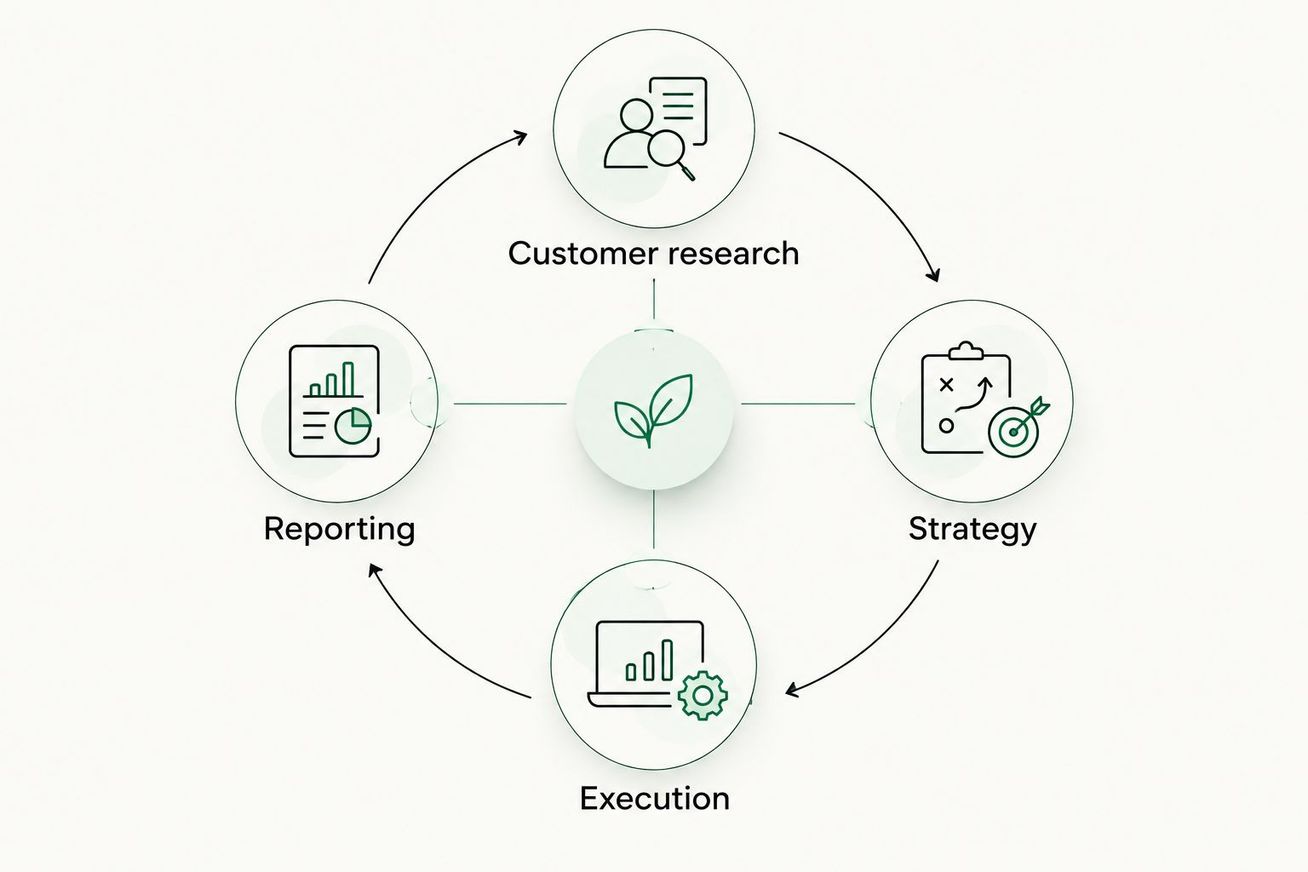
Reporting should test the strategy and inform the next action.
Suppose a Vancouver home-services page attracts relevant search clicks but produces unsuitable enquiries. The next step is to inspect the page promise, service-area wording, contact form and enquiry records before commissioning more content.
For an ecommerce category page, a different investigation applies. Review whether search intent matches the products, whether visitors reach relevant product pages and whether purchase tracking works before attributing the problem to rankings.
These are diagnostic examples, not reported client results. The principle is to choose the next action from evidence rather than repeat the same monthly task list.
Why monthly SEO results vary
Monthly movements need an explanation tied to the business and the measurement method. Ask the agency to investigate these factors, not use them as automatic excuses:
- Customer demand: Changes in relevant search impressions help assess whether search exposure moved.
- Search visibility: Query and page data show where exposure or clicks changed.
- Website changes: Redesigns, redirects, removed pages and tracking edits can change performance or its measurement.
- Customer fit: More enquiries can include more unsuitable enquiries; sales feedback separates the two.
- Measurement limits: Consent choices, missing events and disconnected sales records can leave outcomes unrecorded.
- Commercial conditions: Service-area changes, product changes or different buying requirements can affect what visitors do next.
For each explanation, request evidence and a response. “Seasonality” without a relevant comparison does not explain a decline, and “tracking issue” without a correction plan does not resolve one.
Which reporting approach gives you the clearest picture?
A dashboard, written explanation and review meeting serve different purposes. Choose the combination that makes decisions clear without turning reporting into another job for your team.
Dashboard
- Best for: Checking performance between reviews
- Strength: Provides access to recorded measures
- Limitation: Does not explain causes by itself
Written summary
- Best for: Owners who need a decision record
- Strength: Connects evidence, interpretation and actions
- Limitation: Requires clear definitions and supporting detail
Review meeting
- Best for: Resolving questions and approvals
- Strength: Brings sales feedback into the plan
- Limitation: Decisions disappear unless documented
Use a written decision summary supported by accessible data. A meeting can resolve disagreements, but the agreed actions should remain available afterwards.
For your 2026 reporting process, retain access to your business accounts and reporting history. Record who owns each account, who has administrative access and how access will be handled if the engagement ends.
How do you judge whether the agency is accountable?
Accountability means showing the difference between the plan and the result. Ask the agency to distinguish a projection, an observed outcome and an explanation that still needs testing.
If a projection assumed a certain level of qualified enquiries, the report should revisit that assumption using actual records. It should not quietly replace the original objective with a more flattering traffic chart.
Setsail Marketing is best for business owners who want a documented strategy before ongoing marketing delivery. Its researched Growth Strategy includes customer research, sourced market demand, marketing-gap diagnosis, channel priorities and projections with explicit assumptions, followed by a fixed 90-day plan.
The trade-off is that strategy is a separate paid engagement after the introductory call, not ongoing delivery bundled into that call. You keep the strategy whether you continue or not; projected returns and payback remain estimates, not guarantees.
The introductory Growth Strategy call is free, lasts 30 minutes and carries no commitment. Bring your business goals, current reporting and the questions you cannot yet answer.
Book a Growth Strategy call
Free, 30 minutes, no commitment. Discuss your goals and reporting gaps before a separate paid strategy engagement.
FAQ
What should I ask an SEO agency in Vancouver to report monthly?
Ask for qualified enquiries, orders, attributable revenue, relevant search performance, completed work and next priorities. Every measure should have a definition, source and comparison period.
Are higher Google rankings enough to show SEO is working?
Higher Google rankings are not enough to establish business value. Connect relevant visibility to visits, qualified enquiries and sales wherever your tracking and sales records support that connection.
Should my SEO report include Google Business Profile results?
Your SEO report should include Google Business Profile results when local discovery matters to your business. Keep profile interactions separate from verified enquiries, visits and sales.
How do I check whether reported SEO leads are genuine?
Check reported SEO leads against enquiry records and your agreed qualification criteria. Exclude spam and duplicates, then use sales feedback to identify suitable opportunities and booked work.
What should happen when organic traffic rises but sales do not?
The agency should investigate search intent, landing pages, enquiry quality and tracking before recommending more traffic. The report should distinguish an observed problem from an untested explanation.
Is Setsail Marketing's Growth Strategy call the same as the paid strategy?
Setsail Marketing's free 30-minute Growth Strategy call is separate from the subsequent paid Growth Strategy engagement. The researched strategy includes a fixed 90-day plan, and you keep it whether or not you continue.
One last thing
Before approving your next 2026 SEO report, ask: what business decision changes because of this report? The answer might be to improve a service page, correct tracking, change a priority or continue a promising approach.
Continuing the plan is a valid decision when the evidence supports it. What matters is that you can explain why, identify what happens next and check the result in the following report.