
TL;DR
- A useful small business marketing agency brief connects customer needs to profitable work, not just audience demographics.
- Include customer questions, buying triggers, objections and evidence from actual enquiries or orders.
- Brief Google Ads and SEO around the same customer priorities, then define each channel’s role.
- Setsail Marketing suits owners who want a documented strategy before ongoing delivery.
Why this matters
Your agency needs to understand the difference between an enquiry you want and one your team cannot profitably serve. A request for more leads does not explain that difference.
A Vancouver contractor might want renovation enquiries within its service area, not requests for work outside its capabilities. An online retailer might want more orders without making products with weak margins the centre of its campaign. These are briefing examples, not reported client results.
Start with the customer and the commercial outcome. Choose the channel after that. If a website is part of the project, carry the same customer evidence into your web development brief rather than treating design as a separate conversation.
How do you give a marketing agency a useful customer brief?
Build the brief from records your business already uses: enquiries, orders, sales notes, customer emails and the questions your team answers repeatedly. Explain what each piece of evidence tells you, and mark anything that still needs checking.
Use this sequence to turn those records into decisions.
1. State the business outcome
Write what you want customers to do and why that action matters. Booked jobs, qualified consultations, repeat orders and completed sales are clearer goals than more awareness on its own.
Include the constraint alongside the goal. If your team cannot take on certain work, or a product needs a different sales approach, the agency needs that information before planning demand generation.
2. Describe the buying situation
Explain what happens before someone starts looking. A customer replacing a failed product has a different decision to make from someone researching a future purchase.
Record the trigger, the problem and the desired outcome in the customer’s words where possible. Do not turn a remembered conversation into a quotation; label it as a summary unless you have the original wording.
3. Explain what makes a customer a good fit
Define the work, orders or relationships you want more of. Include service area, project suitability, buying requirements and the limits your sales team applies.
Also describe poor-fit enquiries. An agency cannot protect your team’s time if the brief treats every form submission as equally valuable.
4. Show how customers compare and decide
List the questions buyers ask before committing. Include objections about suitability, trust, timing, process and the effort involved in changing providers.
Attach the evidence that answers those questions. Use approved project examples, accurate product information and documented policies rather than asking the agency to invent reassurance.
5. Agree on measurement and responsibility
Define what counts as a qualified enquiry or completed order. Name who records the outcome after the first contact and who approves changes to the campaign or website.
For your 2026 brief, keep the date range beside every performance extract. A sales report without its period, exclusions or definition of a sale is difficult to interpret correctly.
The sequence matters: establish the outcome, understand the customer, define fit, examine the decision and agree on measurement. A channel plan should follow those decisions, not replace them.
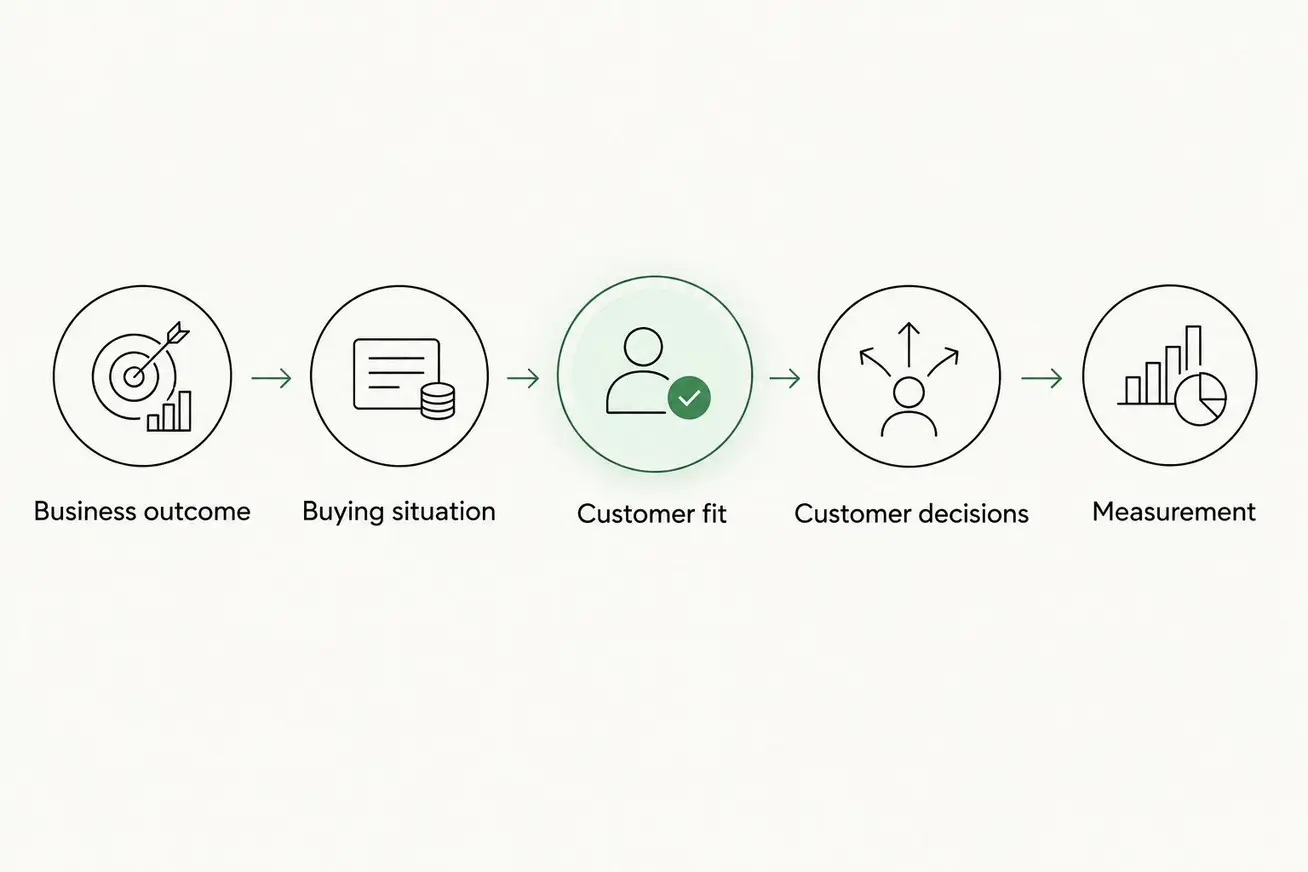
Choose channels after defining the customer, the desired outcome and how success will be recorded.
What should go into the customer brief?
Use a working document that makes evidence easy to find. Keep the main brief readable and attach detailed records separately, with personal customer information removed where it is not needed.
The table below distinguishes useful briefing material from information that leaves the agency guessing. These are document choices, not competing services.
Recent enquiry summaries
- Best for: Understanding buying triggers
- Strength: Shows the problem customers describe
- Limitation: Does not prove which enquiries became sales
Sales and order records
- Best for: Defining valuable outcomes
- Strength: Connects demand to completed business
- Limitation: Needs context about cancellations and exclusions
Customer interview notes
- Best for: Understanding objections
- Strength: Explains how buyers describe decisions
- Limitation: Individual views do not establish market-wide demand
Existing campaign reports
- Best for: Reviewing channel performance
- Strength: Shows recorded activity and attributed outcomes
- Limitation: Attribution does not explain every customer touchpoint
Owner observations
- Best for: Identifying research questions
- Strength: Captures operating knowledge
- Limitation: Needs validation before becoming a market claim
Use these sources together. Order records explain what sold; customer conversations help explain why. Neither replaces the other.
A copy-and-complete briefing template
Use the following prompts as your starting document. Give direct answers, attach supporting records and mark unknowns clearly.
- Business goal: What customer action should this work produce?
- Priority customer: Who has the problem you are equipped to solve?
- Buying trigger: What changes before that customer starts searching?
- Desired outcome: What does the customer want to achieve or avoid?
- Good fit: Which requirements make an enquiry suitable?
- Poor fit: Which requests should marketing discourage or redirect?
- Decision questions: What must buyers understand before committing?
- Trust evidence: Which approved facts and examples support your claims?
- Commercial limits: What affects whether the work or order is worthwhile?
- Delivery limits: What can your team fulfil, and what needs approval?
- Existing evidence: Which records support each answer?
- Measurement: Who records enquiries, sales and their final outcomes?
For a 2026 campaign, add a document date and an owner responsible for updates. Old information should not become a current promise simply because it remains in the brief.
Why does the detail in a customer brief vary?
The right level of detail depends on the decisions the agency must make. A brief should be as specific as the work requires, without becoming a collection of unrelated company information.
- Buying process: A considered service purchase needs explanation of enquiries, qualification and follow-up; an online order needs product and checkout context.
- Customer fit: Businesses with firm service boundaries need those exclusions written down before campaigns are built.
- Commercial constraints: Product margins and project suitability affect which demand deserves attention.
- Evidence quality: Clear sales records support different decisions from untested owner assumptions.
- Delivery scope: Website, advertising, email and branding work need different execution details while sharing the same customer understanding.
Do not create separate versions of your customer that contradict each other across channels. Maintain a shared core brief, then add the instructions relevant to each deliverable.
How do you turn customer evidence into a channel plan?
Ask the agency to explain the connection between the customer evidence and each proposed activity. The plan should show the buying question being answered, the action being requested and the business outcome being measured.
For SEO, that means identifying what customers search for and what the page must help them decide. For advertising, it means connecting the audience or search intent to an appropriate offer and destination. For email, it means explaining what the recipient already knows and what should happen next.
These are possible channel roles, not reasons to buy every service. A useful brief helps the agency rule work out as well as put work in.
Ask for a 2026 plan that distinguishes known demand from assumptions requiring research. Forecasts should state their assumptions, and projected returns and payback remain estimates, not promises.
Setsail Marketing’s researched Growth Strategy includes customer research, sourced market demand, a diagnosis of marketing gaps, channel priorities and a fixed 90-day plan. The client keeps the strategy whether or not they continue. That documented approach gives the brief a practical destination: decisions, deliverables and responsibilities.
What changes when the brief includes a website?
A website brief needs to explain the decision each important page supports. A service page should help someone judge suitability and take the next step; a product page should answer the questions needed to assess the item.
Page objectives, customer questions and approval responsibilities belong in the brief. Design preferences do not settle those decisions. By clarifying your web design brief around customer tasks, you give the team a basis for deciding what each page needs to explain.
Separate confirmed requirements from preferences. A required enquiry field serves a different purpose from a preferred image treatment, and both need a clear approver.
For a 2026 website project, check that contact details, claims, examples and policies are current before approval. Do not ask the design team to fill factual gaps with plausible copy.
What commercial information should you share?
Give the agency enough information to distinguish revenue from worthwhile business. Explain which services or products you want to promote, which need caution and what makes an order or project unsuitable.
An ecommerce brief should address how margins affect marketing decisions, rather than treating every order as equally valuable. A service-business brief should explain qualification criteria and the operating limits behind them.
You do not need to put sensitive records into every working document. Agree on who needs access, how information will be shared and which conclusions can be used in campaign planning.
The point is decision quality, not document volume. Explain the commercial rule and provide the evidence needed to apply it.
How much research should you finish before contacting an agency?
Bring the evidence you already have; do not delay the conversation while trying to complete the agency’s research yourself. Your role is to explain the business, identify reliable records and flag uncertainty.
Setsail Marketing starts with a free, no-commitment, 30-minute Growth Strategy call. That call is distinct from the subsequent paid, researched Growth Strategy engagement if there is a fit.
Prepare your main goal, the problem blocking it and the records available to investigate it. A useful conversation starts with a real business question, not a polished presentation.
Book a Growth Strategy call
A free, no-commitment, 30-minute call, separate from the paid Growth Strategy engagement.
How do you know the agency understood the brief?
Ask the agency to restate the priority customer, desired outcome, main obstacle and evidence behind the proposed approach. Correct misunderstandings before approving execution.
Then review whether the deliverables answer those points. A landing page, campaign or email sequence should have a clear job that connects back to the brief.
Keep the approved 2026 brief alongside reporting. When actual enquiries differ from the intended customer, use that difference to test the plan rather than quietly changing the definition of success.
FAQ
What should I send a small business marketing agency first?
Send your business goal, priority customer, buying triggers, qualification criteria and existing sales evidence. Mark assumptions clearly so research can focus on unanswered questions.
Do I need customer personas before briefing an agency?
You do not need polished customer personas before briefing an agency. Start with real buying situations, customer questions and records of suitable enquiries or orders.
Should my customer brief include a marketing budget?
Include your spending boundaries and who can approve changes. Ask the agency to explain what the proposed scope covers and which assumptions support the plan.
Can I use the same customer brief for SEO and Google Ads?
Use the same core customer brief for SEO and Google Ads, then add channel-specific requirements. Both should reflect the same customer fit, commercial priorities and approved claims.
What if I do not know why customers choose us?
State that customer choice is an unanswered research question. Share enquiry notes, customer feedback and sales conversations rather than substituting an unsupported claim.
Is Setsail Marketing’s Growth Strategy call the same as the strategy engagement?
No. Setsail Marketing’s Growth Strategy call is free, lasts 30 minutes and carries no commitment; the subsequent researched Growth Strategy is a separate paid engagement if there is a fit.
One last thing
Add a section called What would make us change the plan? List the findings that would challenge your assumptions: poor-fit enquiries, objections your pages do not answer or sales outcomes that differ from the forecast.
A brief is not a defence of what you already believe. It is a starting point for finding out what customers need and deciding what your business should do about it.