
TL;DR
- A small business marketing agency should connect research, execution and reporting to enquiries, orders and profit.
- Setsail Marketing suits small businesses seeking a researched strategy before ongoing agency delivery.
- Agree on deliverables, account ownership and measurement before approving work.
- Judge the first 90 days against the documented plan, not a guaranteed lead total.
The delivery model at Setsail Marketing starts with strategy before ongoing execution. Use the checkpoints below to assess any agency proposal in 2026; they are recommended review points, not promises about when sales will arrive.
What should a small business marketing agency deliver in 90 days?
Your agency should leave you with something you can inspect, use and retain. That means more than published posts, an advertising dashboard or a presentation full of impressions.
Ask for the following deliverables in writing before work begins. The exact scope depends on your business, but every agreed item needs an owner and an acceptance criterion: what must be true for you to approve it.
Business diagnosis
- What you should receive: Customer research, demand evidence and a baseline
- What it lets you decide: Which problem deserves attention first
Documented strategy
- What you should receive: Priorities, assumptions, responsibilities and exclusions
- What it lets you decide: Whether the proposed work fits your goals
Measurement setup
- What you should receive: Defined enquiries, orders and sales tracking, with checks
- What it lets you decide: Whether reported activity reflects real opportunities
Agreed execution
- What you should receive: Completed work matched to the approved scope
- What it lets you decide: Whether the agency delivered what you bought
Performance review
- What you should receive: Projected versus actual results, limitations and next actions
- What it lets you decide: Whether to continue, change direction or stop
Asset ownership
- What you should receive: Appropriate business control of accounts and work
- What it lets you decide: Whether you can operate without agency dependency
A completed task and a commercial result are different things. A landing page can be delivered and approved before enough qualified enquiries exist to judge its contribution to sales. Your reporting should distinguish those facts rather than treating either as proof of the other.
Why this matters
You are buying a better business decision, not just a busier marketing calendar. A Vancouver renovation company might need suitable project enquiries; an ecommerce business needs orders that leave enough margin after acquisition and fulfilment.
Those goals require different plans. In 2026, the useful question remains straightforward: what must change between a customer finding you and deciding to buy? Research identifies the obstacle, strategy chooses the response, and reporting tests whether that response worked.
By day 30: a diagnosis and an approved plan
Treat the first 30 days as a planning checkpoint, not a licence for a month of unexplained preparation. Some execution can start earlier when the need is clear. You should still know why it takes priority.
Customer research
Your agency should explain who buys, what triggers the search and what makes someone hesitate. Ask what evidence supports that explanation: customer conversations, sales feedback, search demand or existing enquiry records.
For a home services business, a search for an urgent repair represents a different buying situation from a search for a major renovation. The page, message and follow-up should reflect that difference. A generic customer profile does not resolve it.
A business baseline
Record the starting position before judging progress. Separate raw enquiries from qualified opportunities and separate orders from profitable orders.
If your sales records cannot connect an enquiry to a booked job, make that limitation explicit. Establish a workable method for recording outcomes rather than presenting website conversions as completed sales.
A documented plan
The plan should identify the problem, the chosen response and the work required. It should also state what is outside scope.
Look for:
- A commercial objective: the type of customer action you want.
- Evidence: what supports the chosen audience and channel.
- Deliverables: specific work you can accept or reject.
- Dependencies: approvals, access, stock information or sales input you must provide.
- Assumptions: conditions behind projected returns and payback.
- Decision rules: what evidence would justify changing the plan.
You should be able to explain the plan to a colleague without translating agency jargon. If you cannot, ask the agency to make it clearer before approving delivery.
By day 60: agreed work and checked measurement
Use day 60 to review execution against the approved scope. This is a recommended checkpoint, not a claim that every website, campaign or search programme should be finished within 60 days.
The delivery sequence should be understandable. Fixing a broken enquiry form before sending paid traffic to it is a clear priority; producing unrelated content while the form remains broken is not.
Inspect the work
Ask to see the finished deliverables in their working environment. A screenshot does not prove a form reaches the right inbox or that a purchase event records correctly.
For each completed item, confirm:
- The work matches the approved brief.
- The intended customer action works.
- Your team knows who handles the response.
- Tracking records the agreed action without obvious duplication.
- You have the access needed to review and retain the work.
Completion should mean usable, not merely uploaded. Record outstanding fixes and their owners so they do not disappear into a status report.
Test the measurement chain
A website submission, a qualified enquiry and a sale belong at different stages. Ask the agency to show how information moves between those stages and where your team must update the record.
Privacy choices, phone conversations and offline sales can limit attribution—the process of connecting a sale to marketing activity. A candid report explains those limits. It does not claim every sale belongs to the last advertisement someone clicked.
By day 90: evidence and a next-step decision
At the 90-day review, compare the approved plan with completed work and observed outcomes. Do not let a fresh presentation replace the original commitments.
A practical review follows this sequence:
- Compare commitments. List agreed deliverables beside completed, delayed and changed work.
- Check outcomes. Review qualified enquiries, orders and sales where records support them.
- Explain differences. Identify which assumptions held and which did not.
- Choose next actions. Continue, revise or stop work with a stated reason.
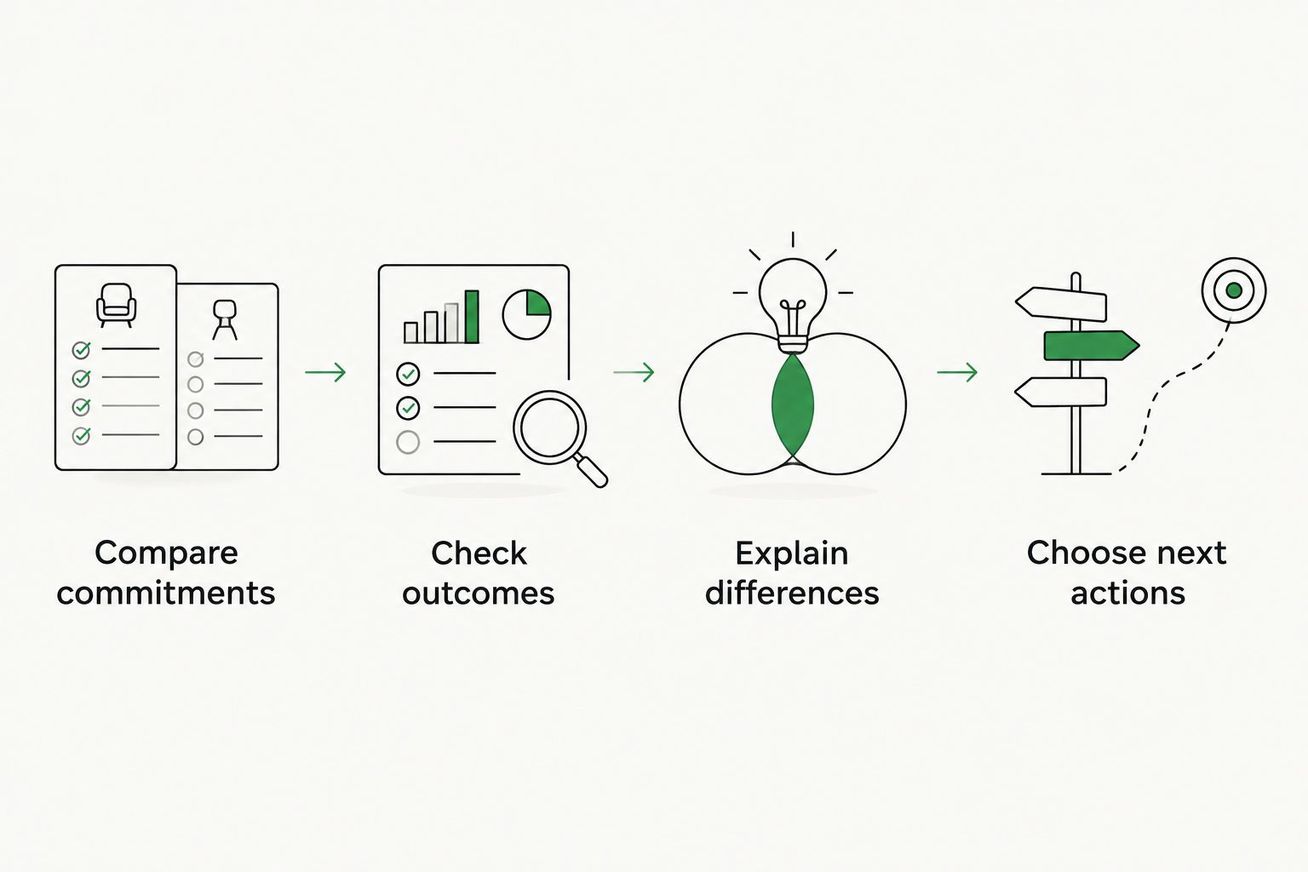
Review the original commitments before approving the next phase.
In 2026, a useful performance report still needs both operational and commercial evidence. Published work shows delivery; customer outcomes show whether that work is contributing to the business. Neither should stand in for the other.
Where the buying cycle extends beyond the review period, inspect intermediate evidence without calling it revenue. A qualified proposal request can show progress. It is not a signed contract.
Why first-quarter deliverables vary
The right scope depends on the obstacle between your business and its next customer. Ask your agency to connect each priority to evidence rather than offering the same service bundle to everyone.
- Starting condition. Broken forms, unclear offers or missing measurement change the work required before promotion.
- Buying cycle. An immediate purchase and a considered commercial contract need different evidence of progress.
- Demand evidence. Searches showing clear buying intent support a different approach from an unfamiliar offer customers do not yet seek.
- Customer doubts. Missing project details, unclear delivery terms or weak explanations can leave buying questions unanswered.
- Sales follow-up. Marketing cannot report reliable booked-job outcomes if enquiries receive no recorded disposition.
- Delivery dependencies. Missing access, delayed approvals and unavailable product information affect the agreed sequence.
These factors explain scope differences; they do not excuse vague accountability. If a dependency changes the schedule, your agency should document the change and its effect on the plan.
What should your agency refuse to guarantee?
An agency should commit to agreed work, transparent reporting and clear responsibilities—not a guaranteed sales outcome. Revenue depends on more than campaign settings, including demand, your offer, customer decisions and how enquiries are handled.
Discuss realistic lead generation expectations by separating controllable commitments from business outcomes: the agency can specify the work it will deliver, but a lead forecast remains an estimate based on stated assumptions.
Ask what qualifies as a lead before discussing volume. A duplicate form submission, a job applicant and a suitable buyer requesting a quote should not become interchangeable entries in a performance total.
A useful projection names its assumptions and explains how actual results will test them. For your 2026 plan, require that distinction wherever projected returns or payback appear. Confidence should come from clear reasoning, not certainty about decisions customers have not made.
How do you judge results without confusing activity with value?
Start with the customer action that matters, then work backwards. For construction, that might be an enquiry that fits your service area and project requirements. For ecommerce, it might be an order assessed alongside acquisition costs, returns and margin.
Your report should answer:
- What work was completed against the plan?
- What customer actions were recorded?
- Which actions met the agreed quality criteria?
- What became a booked job or sale?
- What remains unknown?
- What decision follows from the evidence?
Platform metrics still have a role. Clicks can help diagnose traffic delivery, and search visibility can show whether pages appear for relevant queries. Their limit is commercial: neither proves that you earned revenue.
In 2026 reporting, request projected-versus-actual comparisons using consistent definitions. If the agency changes what counts as a conversion, the report should explain that change before comparing periods.
Who should own the accounts and marketing assets?
Your business should retain appropriate control of its domain, advertising accounts, analytics, website and customer information. Give the agency the access required to work without making the agency the sole route into your own systems.
Clarify ownership and handover terms before signing. Ask which deliverables transfer to you, which tools require separate subscriptions and what remains accessible if the engagement ends.
Account access alone is not a complete handover. You also need understandable documentation: what is running, what has changed, where customer responses arrive and which work remains unfinished. That protects continuity without requiring you to become the campaign operator.
Is a strategy-first agency the right fit?
Setsail Marketing is a strategy-first small business marketing agency for owners who want a researched plan before ongoing delivery. Its free, no-commitment Growth Strategy call lasts 30 minutes; the subsequent Growth Strategy is a separate paid engagement.
That strategy includes customer research, sourced market demand, a diagnosis of marketing gaps, channel priorities, projections with explicit assumptions and a fixed 90-day plan. The client keeps the strategy whether or not they continue. One in-house team plans and delivers the work.
The benefit is a documented basis for execution. The trade-off is a separate planning engagement before ongoing delivery; this approach does not replace a narrowly defined task you already know how to brief. Projected returns and payback remain estimates, not guarantees.
Book a Growth Strategy call if you need to decide what deserves investment before commissioning more marketing activity.
Book a Growth Strategy call
Free, 30 minutes, no commitment. Bring your goals and challenges. We’ll bring the data.
FAQ
What should a small business marketing agency deliver in the first 90 days?
In the first 90 days, a small business marketing agency should deliver the agreed plan, scoped work, measurement and a performance review. The review should distinguish completed activity from qualified enquiries, orders and sales.
Should an agency guarantee leads within 90 days?
A 90-day lead guarantee is not a substitute for a researched plan and explicit assumptions. Define a qualified lead and separate commitments to deliver work from projections about customer responses.
What should I ask to see at the first review?
Ask for the business diagnosis, starting baseline, agreed priorities and delivery status. Each recommendation should connect customer evidence to a commercial objective.
Is search traffic enough to prove marketing is working?
Search traffic alone does not prove marketing is producing sales. Review relevant customer actions and sales outcomes alongside traffic, and identify gaps in the records.
Who should own my advertising accounts?
Your business should retain appropriate ownership and administrative control of its advertising accounts. Give the agency working access and agree on handover responsibilities before delivery begins.
What happens during Setsail Marketing’s Growth Strategy call?
Setsail Marketing’s Growth Strategy call is a free, 30-minute, no-commitment conversation about your goals and challenges. If there is a fit, the researched Growth Strategy is a separate paid engagement.
One last thing
Before approving another phase, ask: if we stopped today, what would our business retain? A sound answer includes usable work, account access, a documented plan and a clearer understanding of customers—not just a dashboard you can no longer open.