
TL;DR
- Your small business marketing agency should own agreed execution; your team should own business decisions and customer feedback.
- Setsail Marketing suits small businesses seeking a documented strategy and in-house agency delivery.
- Assign an owner, approver and completion standard to each marketing deliverable.
- Judge the arrangement by qualified enquiries, orders and profit—not activity alone.
Why this matters
A campaign can bring enquiries without bringing the jobs you want. Your agency needs to know which customers fit, what your team can deliver and why previous prospects bought or walked away.
Your team needs an equally clear view of what the agency will produce. Start with a useful customer brief, then turn that information into responsibilities. Otherwise, both sides can work hard while leaving the important decisions untouched.
The right split protects your time without removing your control. You should not need to manage every advertisement, but you should know what it promises and whether the resulting business is worthwhile.
How should you divide work between your team and a marketing agency?
Divide responsibilities by decision authority and access to information, not by who happens to have time. Your business knows its customers and operating limits; the agency should turn that knowledge into an agreed marketing plan and deliver the work assigned to it.
Use this sequence before production begins:
- Define outcomes. Name the business result: suitable enquiries, booked jobs, completed orders or repeat purchases. Define what counts and where the result is recorded.
- Assign ownership. Give each deliverable an owner responsible for completing it. Identify dependencies, such as customer interviews, product information or website access.
- Set approvals. Name the person authorised to approve claims, creative work and spending decisions. Keep feedback together rather than sending conflicting instructions.
- Check results. Agree how the agency will report marketing performance and how your team will return sales and customer-quality information.
A handoff is incomplete until the receiving person knows what to do next. Sending a draft is not the same as securing approval; sending an enquiry is not the same as booking a job.
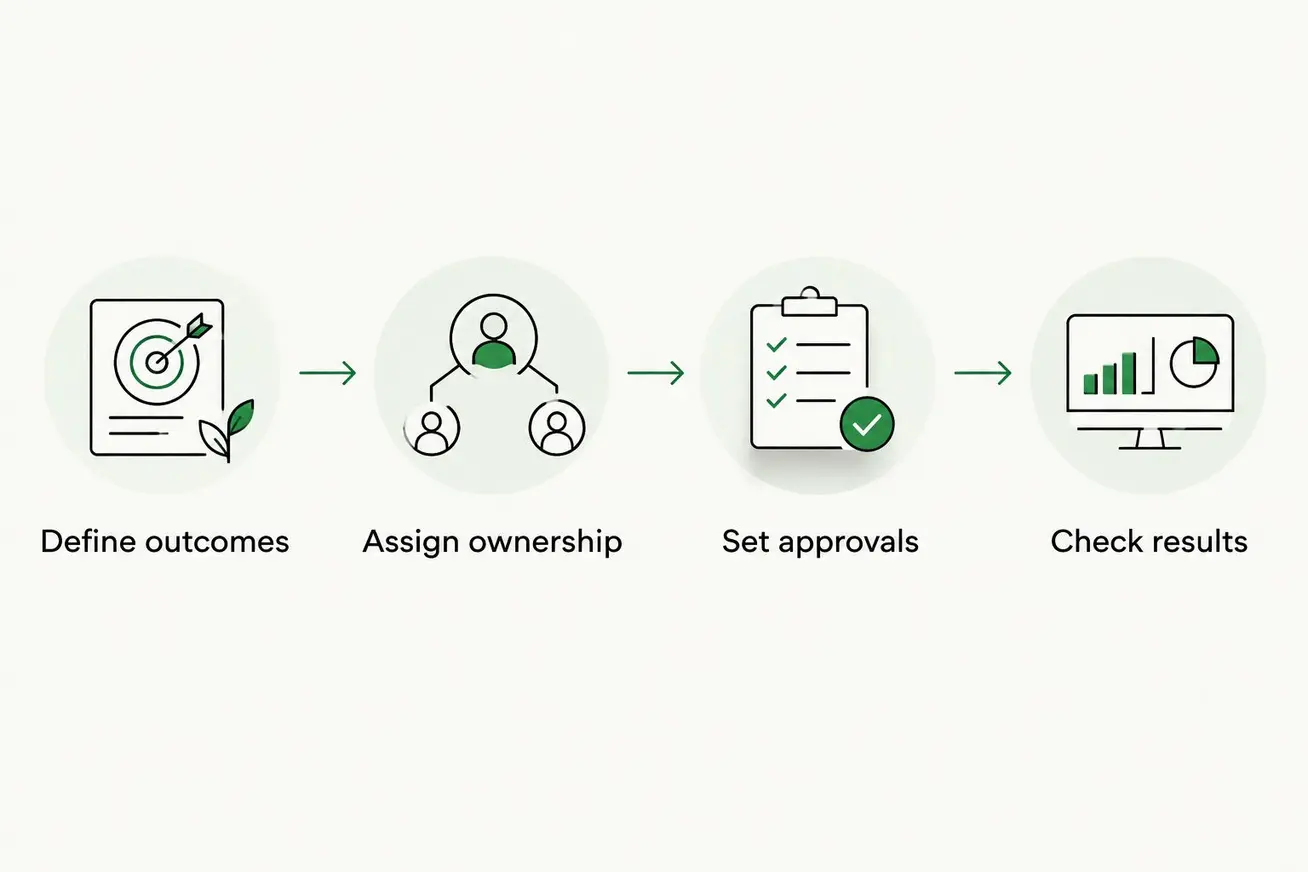
Agree on the result before assigning production work.
A practical responsibility table
Use this table as a starting point, not an assumption about your contract. Replace broad service names with the actual deliverables in your scope.
Customer research
- Your team owns: Access to customers, sales history and frontline observations
- Agency owns when included in scope: Research design, interviews and findings
- Completion standard: Findings explain buying decisions and unanswered questions
Strategy
- Your team owns: Business goals, operating constraints and final priorities
- Agency owns when included in scope: Diagnosis, channel recommendations and documented plan
- Completion standard: Deliverables, assumptions and responsibilities are recorded
Advertising
- Your team owns: Offer accuracy, spending authority and sales follow-up
- Agency owns when included in scope: Campaign setup, creative production and management
- Completion standard: Approved campaigns run with agreed measurement
Website work
- Your team owns: Business requirements, factual claims and account ownership
- Agency owns when included in scope: Agreed design, development and measurement setup
- Completion standard: The agreed customer actions work and handover is documented
Content and email
- Your team owns: Subject knowledge, consent information and claim approval
- Agency owns when included in scope: Agreed writing, production and delivery
- Completion standard: Approved content reaches the intended audience
Reporting
- Your team owns: Sales outcomes, cancellations and customer-quality feedback
- Agency owns when included in scope: Marketing analysis and recommended changes
- Completion standard: Decisions connect marketing activity with business outcomes
Keep commercial decisions with your team
Your agency should challenge assumptions, but your business must decide what it wants to sell and can profitably deliver. A Vancouver contractor seeking a particular type of renovation needs to explain which projects fit, which enquiries waste estimating time and where the crew can work.
An ecommerce business has a different brief. Order volume alone does not explain whether a campaign supports profit; your team needs to supply relevant margin, fulfilment and return information before approving priorities.
Keep these responsibilities inside your business:
- Confirm the services or products you want to promote.
- Explain customer objections and reasons for choosing you.
- Approve factual claims and commitments made to customers.
- Set spending authority and escalation rules.
- Record what happens after an enquiry or order arrives.
Do not ask an agency to infer these decisions from your website. Existing copy can reflect an outdated offer or a customer group you no longer want to attract.
Give the agency ownership of agreed execution
Delegation works when the agency owns an output, not just a stream of tasks. “Improve lead quality” needs a defined customer, campaign changes, a destination page and feedback from the people handling enquiries.
Your agency should explain what it will deliver, which inputs it needs and what sits outside the agreement. Your team should not have to discover those boundaries after a missed handoff.
Setsail Marketing is best for small businesses that want a documented strategy and in-house agency execution. Its services span research-led planning and delivery across advertising, websites, search, email and other agreed channels. The trade-off remains real: your business still needs to supply accurate information, make decisions and report sales outcomes.
For your 2026 scope, separate ongoing management from project work. A website build has completion and handover requirements; campaign management needs recurring decisions. Putting both under “marketing support” leaves too much open to interpretation.
Which working arrangement fits your team?
Choose the division of work according to your actual capacity, not the arrangement that sounds most hands-off. If nobody internally can review technical claims or follow up enquiries, outsourcing campaign production does not solve that gap.
Agency-led delivery
- Best for: Businesses without a dedicated marketing operator
- Main advantage: The agency owns agreed production and channel management
- Main limitation: Your team must still provide decisions, access and customer feedback
Shared delivery
- Best for: Businesses with someone who can coordinate marketing
- Main advantage: Internal knowledge stays close to production
- Main limitation: Handoffs need clear boundaries to avoid duplicated work
Internal-led delivery
- Best for: Businesses with established marketing capacity
- Main advantage: Your team controls daily execution and context
- Main limitation: Internal staff need time to implement specialist recommendations
Agency-led delivery
Ask for a named contact, a written scope and a clear approval process. Give the agency enough context to make recommendations without asking permission for every routine adjustment.
Keep exceptions explicit. Changes to the offer, customer promises or spending authority should follow the approval rules you agreed, even when routine campaign decisions sit with the agency.
Shared delivery
Split work at a clear handoff. Your team might supply technical notes and customer questions while the agency handles writing and publication; avoid assigning both parties to produce the same draft independently.
Shared delivery needs a coordinator with authority to collect feedback. Without that role, your agency becomes the messenger between colleagues who disagree about the brief.
Internal-led delivery
Use the agency for a defined gap, such as research, specialist campaign work or a website project. Keep implementation ownership clear when recommendations return to your team.
The limitation is capacity. Advice does not become completed work until someone accepts the task, fits it into the schedule and checks the result.
Why the right division of work varies
The service list is not enough to decide ownership. These factors change what your team should retain and what the agency can responsibly take on:
- Internal capacity: Assign work to people with time to finish it, not simply a relevant job title.
- Customer knowledge: Keep access to sales conversations and frontline staff available to the agency.
- Offer complexity: Technical products and specialised services need informed factual review.
- Asset access: Website, advertising and measurement tasks depend on appropriate permissions.
- Delivery model: Fixed-scope projects need acceptance criteria; ongoing work needs recurring decisions.
- Sales visibility: Enquiry-led businesses need feedback beyond form submissions, while ecommerce reporting needs order context.
Review the split when these conditions change. Adding a new service, changing your sales process or hiring an internal marketer can make an old responsibility map unhelpful.
Set approval rules before work reaches your inbox
Build approval into your 2026 plan rather than treating it as an interruption. Name an approver and a backup, record when feedback is due and decide what happens if a required decision is late.
Distinguish factual corrections from preferences. A service description that promises work you do not perform needs correction; a stylistic preference should be resolved against the agreed brief, not personal taste alone.
Ask for consolidated feedback. The agency should receive a clear decision, not separate messages from sales, operations and the owner with incompatible requests.
Before approving a deliverable, check:
- Does it address the intended customer's question?
- Are the offer and factual claims accurate?
- Is the requested customer action clear?
- Does it match the agreed scope and purpose?
- Is the person handling the resulting enquiry ready?
Make reporting a shared responsibility
The agency should explain what marketing produced and what should change. Your team should explain what happened next: which enquiries were suitable, which became sales and why others did not proceed.
For 2026 reporting, compare actual results with the plan's stated assumptions. A projection is an estimate, not a promise; a useful report identifies which assumptions held and which need replacing.
Your monthly agency reporting should support decisions rather than stop at rankings, clicks or impressions. Those measures describe parts of the customer journey, not the whole commercial result.
For example, a contractor can return reasons for rejecting enquiries. An online retailer can flag cancellations or products with different margin constraints. Neither example requires sharing every operational detail, but both require enough information to judge the marketing fairly.
Who should own marketing accounts and assets?
Your business should retain ownership of its website, domain, advertising accounts and customer data. Give the agency the access required for agreed work, and document account administration and handover responsibilities.
Ownership and access are separate decisions. An agency can manage campaigns without making your business dependent on an account your team cannot administer.
What should you do when work falls between both teams?
Assign an owner to the missing outcome before debating the next task. Then record the required input, approver and completion standard in the scope or responsibility map.
If the work was not included, agree on the scope change before treating it as an obligation. Clear boundaries protect both the business and the agency.
FAQ
What should a small business marketing agency handle?
A small business marketing agency should handle the research, planning, production and channel management included in its scope. Your business should retain commercial decisions, factual approvals and customer follow-up.
Can I outsource all my marketing and stop being involved?
You can outsource agreed marketing delivery, but not your business's decision-making responsibilities. Someone internally still needs to approve claims, explain operating constraints and provide sales feedback.
Who should approve agency work in our 2026 marketing plan?
Your 2026 marketing plan should name an authorised approver and a backup. Collect feedback internally so the agency receives a clear decision rather than conflicting instructions.
Is shared delivery better than letting an agency handle everything?
Shared delivery fits businesses with internal marketing capacity and a clear coordinator. Agency-led delivery fits businesses that need more production support, but neither arrangement removes the need for internal decisions.
What does Setsail Marketing need from our team?
Setsail Marketing needs your goals, customer knowledge, operating constraints and access relevant to the agreed work. Your team also needs to make approvals and share what happens to enquiries and orders.
Is the Growth Strategy call the same as the strategy engagement?
The Growth Strategy call is free, lasts 30 minutes and carries no commitment. The subsequent researched Growth Strategy is a separate paid engagement; you keep the strategy whether or not you continue.
What should we check before signing an agency agreement?
Check the deliverables, responsibilities, approval process, account ownership and reporting requirements. Distinguish project completion from ongoing management, and make sure any projected returns are labelled as estimates.
One last thing
Before adding another marketing task, assign responsibility for what happens after the customer responds. A better campaign does not fix an unanswered enquiry or a sales team pursuing the wrong jobs.
With Setsail Marketing, the starting point is a free, no-commitment, 30-minute Growth Strategy call. If there is a fit, the separate paid Growth Strategy includes customer research, sourced market demand, channel priorities and a fixed 90-day plan. Projected returns and payback are estimates, not guarantees.
Book a Growth Strategy call
A free, 30-minute conversation about your goals and challenges. No commitment.