
TL;DR
- A construction marketing agency should count genuine project enquiries, not clicks or repeated contacts about the same job.
- Qualified construction leads meet agreed requirements for project type, location, scope and buying readiness.
- Setsail Marketing suits construction businesses seeking a documented marketing plan before ongoing delivery.
- Report enquiries, qualified opportunities and booked jobs separately so you can see where sales progress stops.
Why this matters
You need work your team can deliver profitably, not a report full of contacts your estimator cannot use. If a campaign generates enquiries for services you do not offer, the enquiry count hides a targeting problem. If suitable projects arrive but nobody follows up, the same headline number hides a sales problem.
For your 2026 marketing plan, agree on the lead definition before approving campaign targets. Setsail Marketing starts with research and a documented strategy; that planning should establish what a useful enquiry looks like and how you will track it through to a sale.
A lead is evidence of project interest, not evidence of revenue. Keep those stages separate so you can make a sound decision about the next advertising dollar.
What should a construction marketing agency count as a lead?
Count a new lead when someone makes a genuine enquiry about potential construction work and provides a way to continue the conversation. Record what they want, how they contacted you and whether the enquiry is new. Then assess qualification rather than assuming every contact is ready for an estimate.
Use this sequence before adding an enquiry to your reporting:
- Verify the enquiry. Confirm that the message or conversation concerns a potential construction project, rather than spam, a job application or a supplier pitch.
- Identify the project. Establish whether this is a new opportunity or another contact about an existing enquiry. Preserve repeat interactions without counting them as new projects.
- Check the fit. Compare the requested work with your services, geographic coverage, project requirements and capacity.
- Assign the stage. Mark the enquiry as awaiting qualification, qualified, disqualified or progressing through your sales process.
- Record the outcome. Update the record when an estimate is requested, a proposal is issued, the job is won or the prospect declines.
These steps separate measurement from judgement. Your agency can record a genuine enquiry immediately without pretending it has already confirmed the scope, purchasing authority or commercial fit.
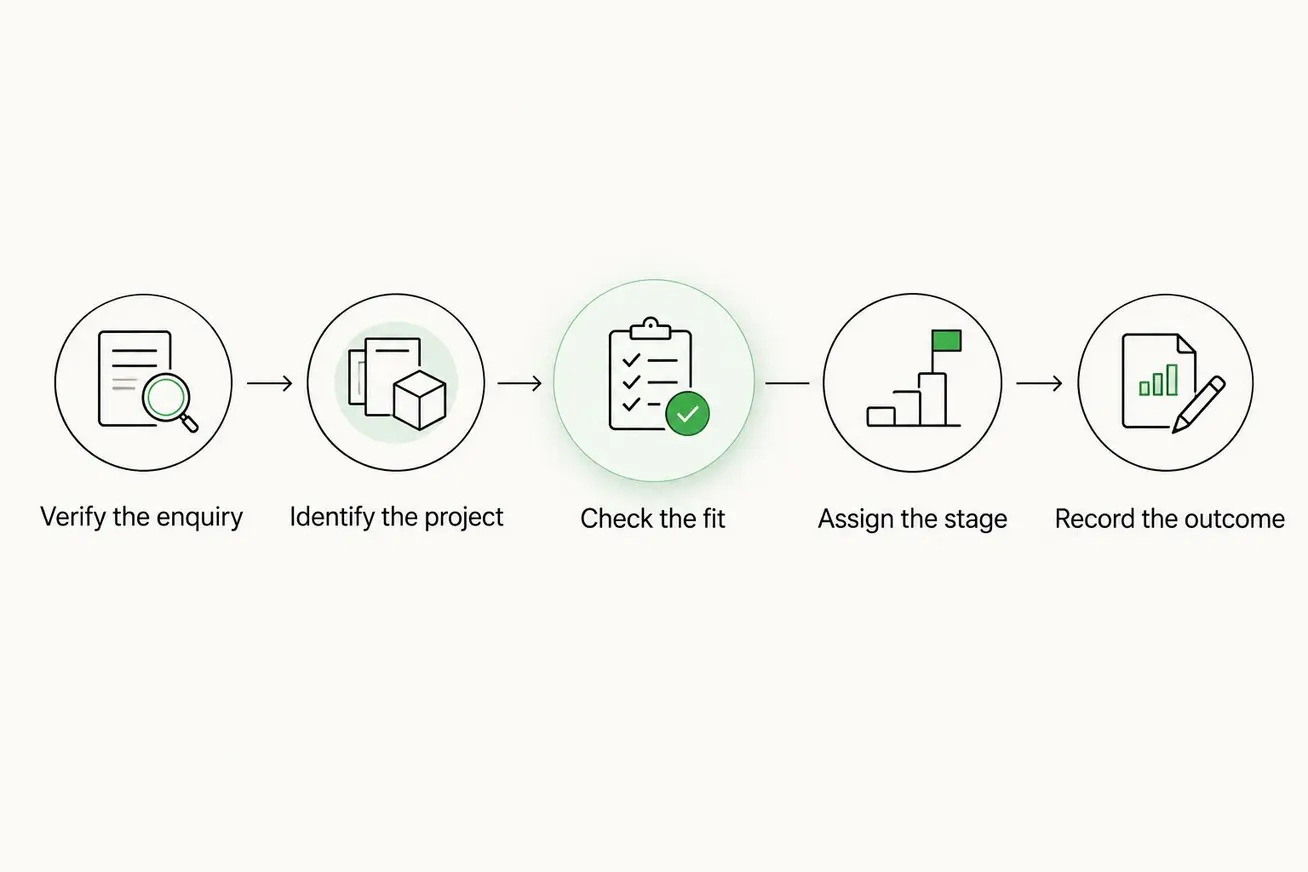
Verify the enquiry before qualification, and keep updating its sales outcome.
Agree on the counting unit
Decide whether your report counts people, companies or project opportunities. For construction sales reporting, a project opportunity is a useful unit because several people can contact you about the same job.
A homeowner submitting a form and later calling about the same renovation remains the same opportunity. A property manager enquiring about distinct projects can represent separate opportunities. Document the rule and apply it consistently rather than changing it to improve a monthly total.
Which enquiries belong in each reporting category?
Use explicit categories instead of forcing every contact into a single lead total. The following is a reporting model to agree with your agency, not a claim that every construction business uses identical sales stages.
Recorded action
- What belongs here: A tracked form submission or call event
- Reporting value: Shows that a contact action occurred
- Limitation: Does not confirm genuine project interest
Valid enquiry
- What belongs here: An identifiable contact asking about construction work
- Reporting value: Establishes genuine demand
- Limitation: Fit and readiness remain unconfirmed
Qualified lead
- What belongs here: An enquiry meeting your agreed project criteria
- Reporting value: Supports sales prioritisation
- Limitation: Does not guarantee a quote or sale
Quoted opportunity
- What belongs here: A qualified project with an issued estimate or proposal
- Reporting value: Shows progress towards a commercial decision
- Limitation: The customer has not accepted
Won job
- What belongs here: A project accepted under your agreed sales process
- Reporting value: Connects marketing to booked work
- Limitation: Booked value is not collected revenue or profit
Excluded contact
- What belongs here: Spam, recruitment, supplier pitches or duplicate enquiries
- Reporting value: Keeps new-lead reporting clean
- Limitation: Needs a recorded reason to support review
Keep the original enquiry count visible alongside qualification. Removing every poor-fit enquiry from the report conceals evidence that targeting, search terms or website messaging need attention.
Valid enquiries: genuine interest, unconfirmed fit
A valid enquiry deserves a response, but it is not automatically estimator-ready. Someone asking whether you handle a particular renovation has expressed interest even if their intended scope is unclear.
The benefit of this category is visibility: you can see demand before qualification is complete. Its limitation is uncertainty. Do not use valid-enquiry totals as a substitute for sales opportunities when assessing campaign performance.
Qualified leads: agreed fit, documented evidence
A qualified lead meets criteria your business has approved. For a Vancouver contractor, those criteria might include the municipality, the type of work and whether the prospect wants a service your team actually provides.
Choose the criteria from your own operating requirements, not an agency's default checklist. Your construction marketing brief on job quality should explain desirable projects, unsuitable enquiries and the reasons behind both.
Qualification improves prioritisation, but it also introduces judgement. Record the evidence behind the decision so an estimator and an account manager can understand the same status without guessing.
Won jobs: accepted work, not assumed profit
A won job belongs in sales reporting once the customer has accepted according to your agreed process. Define that event with your sales team and use the same rule throughout your 2026 reporting.
Keep booked work, invoiced revenue, collected payments and profit distinct. They answer different business questions. An accepted proposal does not establish that you have received payment or completed the work at the expected margin.
Why construction lead quality varies
Lead quality depends on what you ask marketing to attract and what happens after the enquiry. Agree on these factors before judging performance:
- Project type. State which services you want enquiries for and which you do not deliver. General wording leaves room for mismatched requests.
- Service area. Define the locations your team serves. A genuine project outside that area remains genuine demand, but it is not a qualified opportunity for your business.
- Scope and commercial fit. Explain the work that suits your delivery model. Record a mismatch rather than quietly discarding it.
- Buying readiness. Separate someone researching possibilities from someone seeking a site visit or proposal. Both deserve an appropriate next step, not the same sales assumption.
- Decision-making role. Establish whether the contact can commission the work, recommend a contractor or introduce the person responsible.
- Sales handling. Record unanswered calls, follow-up attempts and customer responses. An unresolved enquiry should not be labelled poor quality merely because qualification never happened.
These are diagnostic categories, not excuses. If unsuitable locations dominate, examine geographic targeting and website wording. If suitable prospects stop after receiving a proposal, review the sales conversation and offer before declaring that advertising failed.
How should calls, forms and repeat contacts be counted?
Count calls and forms as contact events first, then connect them to project records. A tracked call does not reveal its purpose by itself, and a completed form can contain spam or an existing customer's question.
Your 2026 measurement plan should preserve both views: the original contact activity and the verified project outcome. This lets you inspect tracking without confusing activity with commercial demand.
Should missed calls count as leads?
Missed calls should remain unverified contact events until you establish project intent. A voicemail requesting construction work can provide that evidence; an unexplained missed call cannot.
Keep missed calls visible in a follow-up queue. Excluding them from qualified-lead totals is correct, but ignoring them entirely prevents you from finding out whether a genuine opportunity was lost.
Should repeat enquiries count as new leads?
Repeat enquiries about the same project should not count as new leads. Add the interaction to the existing opportunity so your team can follow the conversation without inflating demand.
If a past customer enquires about a different project, record a new opportunity and identify it as returning-customer work. That distinction helps separate new customer acquisition from repeat business.
Should an early-stage researcher count as a qualified lead?
An early-stage researcher is not automatically a qualified lead. Record the enquiry, clarify the project and assign an appropriate follow-up stage rather than marking it ready for a quote.
Early research can become useful work later. The immediate decision is whether the prospect fits your business and what they need next, not whether you can force the enquiry into this month's sales pipeline.
What should the agency report each month?
A useful 2026 report connects the source of an enquiry to its current sales outcome. It should also show where information remains unresolved, so you know whether to adjust marketing or complete qualification.
Ask for these fields in the underlying records:
- Enquiry date, source and original contact method.
- Project identifier and the responsible salesperson.
- Requested service, location and relevant scope details.
- Qualification status and the reason for disqualification.
- Next action, proposal status and final sales outcome.
- Booked value where recorded, clearly separated from collected revenue.
Review source information with care. A prospect can encounter your business through search, advertising and referrals before making contact; the recorded source is a measurement convention, not proof that a single channel caused the sale.
Compare qualified opportunities with campaign spending, then examine quotes and wins as they develop. Keep estimates separate from actual results. Construction projects still awaiting a decision should stay open rather than being treated as losses simply because the reporting month ended.
Put the definition in writing before delivery
Give your agency and sales team the same short lead policy. Include what counts, what does not, who qualifies each enquiry and how disagreements are resolved. Review sample records together rather than debating a dashboard total without context.
Setsail Marketing suits construction businesses seeking a documented marketing plan before ongoing delivery. Its subsequent Growth Strategy engagement includes customer research, sourced market demand, channel priorities and a fixed 90-day plan. The client keeps the strategy whether or not they continue; projected returns and payback remain estimates, not guarantees.
That approach requires your operational input. An agency cannot determine whether a project suits your crew, schedule or commercial requirements without clear direction from your business.
Book a Growth Strategy call to discuss that fit. The call is free, lasts 30 minutes and carries no commitment; the subsequent researched Growth Strategy is a separate paid engagement.
Book a Growth Strategy call
Discuss your goals and lead-quality challenges in a free, 30-minute call with no commitment.
FAQ
What should a construction marketing agency count as a lead?
A construction marketing agency should count a genuine enquiry from an identifiable contact about potential construction work. Qualification is a separate stage that checks the project against agreed business requirements.
Does every website form submission count as a construction lead?
No. A form submission is a recorded action until its content establishes genuine project interest. Exclude spam and attach repeat messages about the same project to the existing opportunity.
Should calls from existing customers count as new leads?
Existing-customer calls count as new opportunities only when they concern a distinct potential project. Questions about ongoing work belong with that existing job, not new-lead reporting.
What is the difference between a lead and a qualified construction lead?
A lead expresses genuine project interest; a qualified construction lead also meets your agreed fit criteria. Those criteria should cover the work, location, scope and relevant buying requirements.
Should an agency remove poor-quality enquiries from its report?
An agency should classify poor-fit enquiries rather than hide them. Keep valid enquiries visible, report qualified leads separately and record why contacts were disqualified.
How do I know whether construction marketing is producing sales?
Connect enquiry records to qualified opportunities, proposals and won jobs. Separate booked value from collected revenue and profit, and keep unresolved opportunities open until their outcome is known.
Is the Growth Strategy call the same as the paid strategy?
No. Setsail Marketing offers a free, 30-minute Growth Strategy call with no commitment. The subsequent researched Growth Strategy is a separate paid engagement with a documented plan.
One last thing
Before increasing your 2026 advertising budget, read the actual enquiries behind the lead total. Check whether suitable projects were contacted, qualified and given a clear next step.
The most useful correction is not always more traffic. Fix an unclear definition or an unresolved sales handoff before paying to send more enquiries through it.