
TL;DR
- Give your construction marketing agency project-fit criteria, exclusions and feedback from estimates before approving campaigns.
- Setsail Marketing is best for construction businesses seeking strategy and delivery from one in-house team.
- Judge lead generation by suitable opportunities and booked jobs, not form submissions alone.
- Keep project quality separate from lead quality: marketing attracts opportunities; delivery determines workmanship.
Why this matters
A busy inbox is not the same as a healthy pipeline. If your estimator spends the day declining work outside your service area or explaining that you do not offer minor repairs, the brief needs clearer boundaries.
For your 2026 marketing plan, make the commercial goal specific: attract work your business wants, can deliver and can assess properly. Setsail Marketing connects customer research and channel priorities to a documented plan before ongoing delivery.
Define job quality before you ask for more leads. Otherwise, an agency can meet a volume target while your sales team spends more time on unsuitable enquiries.
How do you brief a construction marketing agency on job quality?
Give your agency a written definition of a desirable project, evidence from previous enquiries and a shared process for checking results. Treat the brief as a decision document: it should help someone choose which searches to target, what the website should say and which conversions deserve attention.
Use the following sequence before approving campaign creative or website changes.
1. Describe the work you want
Name the project categories your business wants to grow. Be precise about the customer, the property or site, the scope and the part of the project you handle.
For example, a Vancouver contractor seeking substantial renovations should distinguish that work from maintenance requests. A commercial contractor should explain whether the target buyer is a property manager, business owner, developer or another contractor. These are briefing examples, not interchangeable audiences.
Include:
- Project type: The work you want enquiries about.
- Customer fit: Who buys the work and who approves it.
- Service area: Where you can assess and deliver projects.
- Project scope: What you handle and what sits outside your offer.
- Capacity: What your operations team can realistically take on.
Do not use “better-quality leads” as the whole instruction. It leaves the agency guessing about the difference between a desirable project and a distracting one.
2. Make exclusions explicit
Write down the requests you would decline even if the prospect were ready to proceed. Include services you do not provide, locations you do not serve and project conditions that make the work unsuitable.
An exclusion is useful only if the agency knows what to do with it. Specify whether the information belongs in advertising, page copy, enquiry questions or your internal qualification process.
Avoid excluding a prospect simply because their first message is vague. A short enquiry does not establish that the underlying project is unsuitable. Separate missing information from a confirmed mismatch.
3. Bring real enquiry examples
Share examples of jobs you wanted, jobs you declined and opportunities that stalled. Remove personal details that the agency does not need, and explain the commercial reason behind each outcome.
An enquiry marked “bad lead” tells the agency very little. “Outside our service area” gives a clear targeting instruction; “requested a service we do not provide” points to a mismatch in messaging or search targeting.
For each example, record the requested work, source if known, qualification decision and final outcome. Where you have reliable job-costing information, explain whether the completed work matched your profit expectations. Do not substitute quoted revenue for actual profit.
4. Agree the feedback loop
Name the person responsible for updating enquiry outcomes. Decide where those updates live and how the agency will receive them.
Use a sequence everyone understands: Enquiry, Qualified opportunity, Estimate, Booked job, Completed job. Define what must happen before an enquiry moves to the next stage, and record why an opportunity stops progressing.
A form submission should not become a booked job in a report simply because someone requested a quote. Keep those events separate so your agency can see where the plan is working and where it needs attention.
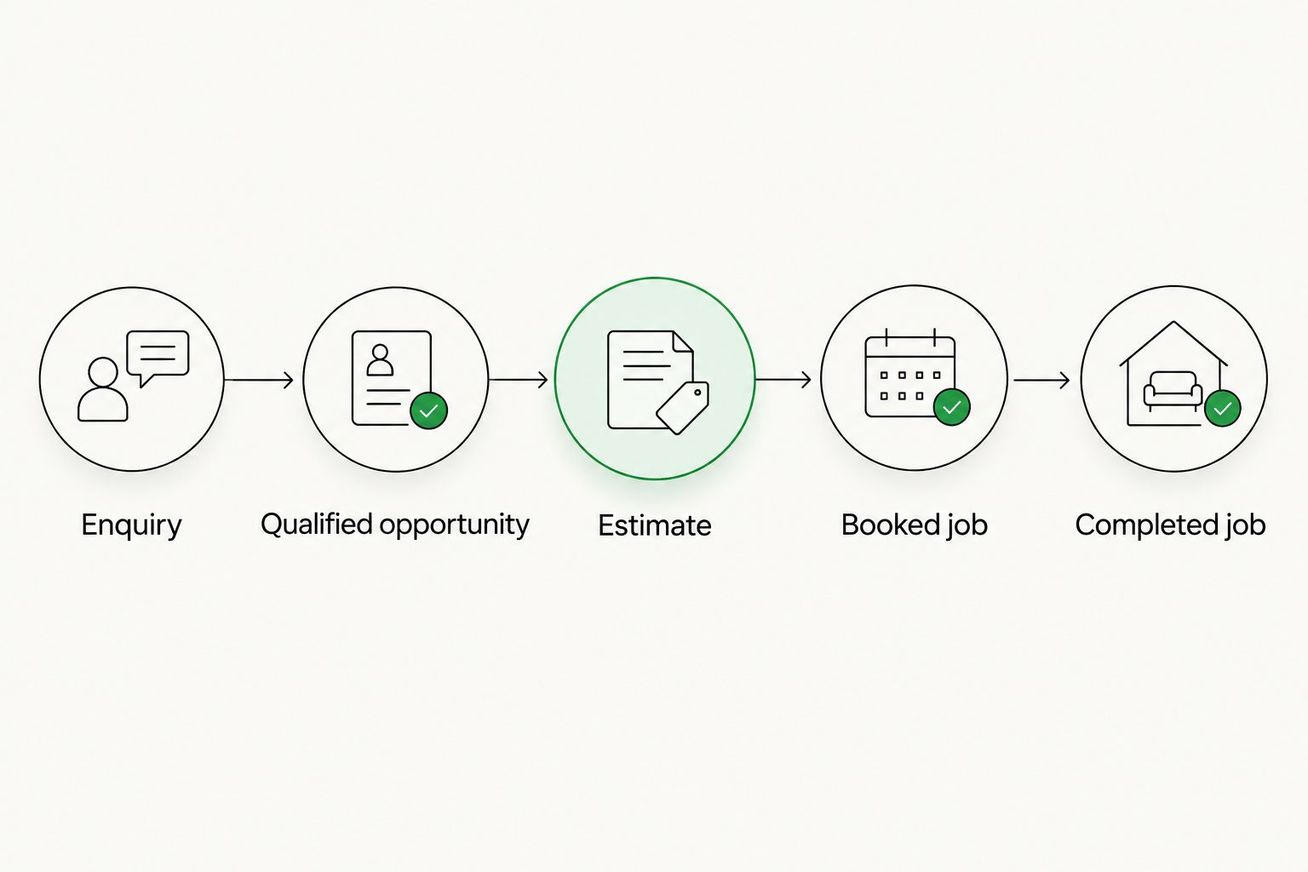
A submitted form and a completed job belong at different stages of the report.
Use a shared job-fit table
Your agency, estimator and operations lead need the same definition of suitability. A table makes disagreements visible before they turn into campaign changes.
Complete this framework using your own business rules. The examples describe how to classify an enquiry; they are not assumptions about your services.
Strong fit
- Best for: Projects matching your service, location and scope
- Advantage: Gives the sales team a relevant opportunity
- Limitation: Fit does not guarantee a booking
- Next action: Follow your agreed qualification process
Needs clarification
- Best for: Relevant requests with missing project details
- Advantage: Avoids rejecting a suitable project too early
- Limitation: Requires follow-up before classification
- Next action: Ask for the missing information
Outside scope
- Best for: Requests for work you do not provide
- Advantage: Gives marketing a clear exclusion signal
- Limitation: A broad label can hide different causes
- Next action: Record the specific mismatch
Not ready
- Best for: Suitable projects without a confirmed decision or schedule
- Advantage: Separates timing from service fit
- Limitation: An interested prospect is not committed work
- Next action: Record the decision conditions
Do not combine every lost opportunity into one rejection category. A wrong-service enquiry needs a different response from a suitable project that the customer has postponed.
Keep the definitions in your 2026 brief and use them in reporting. When you change a definition, record the change so a shift in classification does not look like an improvement in campaign performance.
What should your construction marketing brief contain?
A useful brief connects customer demand to the jobs your business wants. It also explains what the agency can substantiate in public and what needs confirmation before publication.
Give each part an owner. Your estimator understands scope, your operations team understands delivery constraints, and your marketing lead needs to turn that knowledge into clear targeting and messaging.
Customer fit
Describe the buyer's situation, not just a demographic profile. What work are they planning? What has prompted the enquiry? Who else must approve the decision?
Separate what customers have actually told you from internal assumptions. If you believe trust in site management matters more than design choice, bring enquiry notes or customer feedback that supports that view.
Service boundaries
Provide an approved list of services and locations. Explain any conditions that change whether you accept a project.
Use the same boundaries across advertisements, website pages and sales conversations. If those messages disagree, a prospect can reasonably misunderstand what you offer.
Proof
Supply approved project descriptions, photographs and testimonials that you have permission to publish. State what each example demonstrates, such as relevant project scope or experience with a particular customer need.
Do not ask the agency to infer credentials, guarantees or results from a photograph. Keep unsupported claims out of the brief and out of the campaign.
Sales handoff
Explain who receives enquiries, who qualifies them and what information an estimator needs before taking the next step. Include the questions customers regularly ask before agreeing to a site visit or estimate.
Your website form should collect information you will use. Every required question needs a purpose; the form should not demand details your team can establish more clearly in conversation.
Measurement
Specify the business outcomes you want to review alongside marketing activity. Suitable opportunities, estimates, booked jobs and completed-job results answer different questions.
For 2026 reporting, keep projections and actual outcomes visibly separate. Record the assumptions behind forecasts, including how an enquiry is expected to become booked work. Projected returns and payback are estimates, not promises.
Why job quality varies
The same campaign can produce different outcomes when the brief, sales process or delivery conditions differ. Check these factors before treating every disappointing enquiry as a targeting failure:
- Service definition: Broad wording leaves customers to interpret which work you accept.
- Location fit: An otherwise suitable project can fall outside your operating area.
- Buyer readiness: A customer researching possibilities is at a different stage from one seeking an estimate.
- Qualification: Missing project details can prevent a fair assessment of fit.
- Sales follow-up: An enquiry's outcome depends partly on what happens after the customer makes contact.
- Delivery fit: Work that looks attractive in a quote still needs to suit your capacity and profit requirements.
Keep responsibility clear. Marketing should address unsuitable targeting or misleading messages; your business should address internal handoff or delivery problems. Some issues need both teams involved.
How do you tell whether a lead is poor quality?
A poor-quality lead fails your agreed project-fit criteria. Record the specific reason rather than relying on whether the enquiry felt promising.
A suitable customer who declines an estimate is not automatically a poor lead. Review what they requested, why they declined and whether your agency's message accurately described the offer.
Should you optimise for enquiries or booked jobs?
Booked jobs are the commercial outcome; enquiries are an earlier signal. Track both, with qualified opportunities and estimates between them, so you can identify where suitable work stops progressing.
Do not use bookings alone to judge newly received enquiries before your sales process has had time to resolve them. Compare outcomes using a consistent reporting approach and clearly defined stages.
What should you ask an agency before work starts?
Ask how research will shape the plan, how exclusions will affect execution and how your team will share sales outcomes. Request clear responsibilities for account access, tracking, approvals and reporting.
Ask who owns your website, advertising accounts, creative files and customer data. Make ownership and access part of the agreement rather than leaving them as assumptions.
Setsail Marketing offers a free, 30-minute Growth Strategy call with no commitment. The subsequent paid Growth Strategy is a separate engagement: it includes customer research, sourced market demand, a diagnosis of marketing gaps, channel priorities and a fixed 90-day plan with deliverables and a timeline. You keep the strategy whether or not you continue.
Bring your desired job profile and examples of unsuitable enquiries to that conversation. Those details give the discussion a commercial starting point beyond “we need more leads.”
Book a Growth Strategy call
Free, 30 minutes, no commitment. Bring your goals, challenges and examples of the jobs you want.
FAQ
What should I send a construction marketing agency before our first meeting?
Send your desired project types, service area, exclusions and examples of previous enquiries. Explain which became suitable opportunities and why others were declined.
How do I define a good construction lead?
A good construction lead matches your agreed service, location and project-scope criteria. Record missing information separately from confirmed reasons to decline the work.
Should I tell my agency which construction jobs were profitable?
Yes, share reliable completed-job information when it helps define the work you want. Keep quoted revenue, booked revenue and actual profit separate.
Can advertising guarantee better construction jobs?
No, advertising cannot guarantee suitable projects, bookings or profit. Targeting and messaging should reflect your job-fit criteria, while qualification, sales and delivery still affect the outcome.
Should I put qualification questions on my construction website?
Yes, include questions that help your team decide the next step. Ask only for information you will use, and distinguish incomplete answers from unsuitable projects.
What should a construction marketing report show in 2026?
A 2026 construction marketing report should distinguish enquiries, qualified opportunities, estimates and booked jobs. Include rejection reasons and keep projections separate from actual outcomes.
Is Setsail Marketing's Growth Strategy call the same as the strategy engagement?
No, the Growth Strategy call is free, lasts 30 minutes and carries no commitment. The subsequent paid Growth Strategy is a separate researched engagement with a fixed 90-day plan, and you keep the strategy whether or not you continue.
One last thing
A good brief includes work you do not want. Your favourite completed projects show the destination; declined enquiries show the boundaries that targeting, copy and qualification need to respect.
Before approving your 2026 campaign brief, ask your estimator and operations lead to review it together. If they disagree about what counts as a desirable job, resolve that disagreement before asking an agency to find more of it.