
TL;DR
- An ecommerce marketing agency report should reconcile to store orders, not replace them with advertising-platform revenue.
- Store sales, attributed revenue and bank payouts answer different questions. Keep them separate.
- Setsail Marketing suits ecommerce owners who want a documented strategy and in-house delivery.
- Resolve reporting differences before using return on ad spend to change budgets.
Why this matters
You need to know whether marketing produces orders that contribute to profit. A report showing strong advertising returns cannot answer that question if it counts cancelled orders, ignores returns or combines overlapping platform claims.
Setsail Marketing is an ecommerce marketing agency offering strategy and in-house execution. The practical standard for evaluating any agency is the same: you should understand what each revenue figure includes and how it connects to your store.
For your 2026 reporting, require a reconciliation alongside the performance summary. Differences need explanations, not a demand that you trust whichever dashboard looks strongest.
How do you reconcile an ecommerce agency report with store sales?
Use store orders as the starting point, then build a documented bridge to each reported total. Do not try to make advertising revenue, store sales and bank deposits identical by changing settings until the discrepancy disappears.
Each view serves a different purpose:
Store order records
- Best for: Establishing which orders exist
- What to check: Order status, dates, currency, discounts and refunds
- Limitation: An order alone does not establish marketing credit or profit
Store sales report
- Best for: Reviewing sales under an agreed definition
- What to check: Included channels, taxes, shipping and return treatment
- Limitation: Its total depends on the report’s filters and definitions
Advertising-platform report
- Best for: Reviewing a platform’s attributed performance
- What to check: Attribution window, conversion action and revenue settings
- Limitation: Credit can overlap with other platforms
Analytics report
- Best for: Comparing tracked acquisition paths
- What to check: Purchase events, order identifiers and attribution settings
- Limitation: Tracking gaps and configuration affect the result
Payment settlement report
- Best for: Reconciling money received
- What to check: Settlement dates, fees, refunds and adjustments
- Limitation: Deposits do not represent the same period or definition as sales
Ask the agency to work through the following sequence. Keep the underlying exports so you can reproduce the result rather than relying on screenshots.
1. Agree on the sales definition
Write down what you mean by sales before comparing totals. Does the report include tax, shipping, discounts, refunds, cancelled orders, unpaid orders, wholesale orders or in-person purchases?
Choose a definition suited to the decision. For ecommerce marketing performance, an agreed net-sales measure is useful, but its exact calculation must be explicit. Your accountant’s revenue-recognition requirements remain a separate matter.
Record the definition on the report itself. A label such as 2026 ecommerce net sales is not enough without the inclusion rules underneath it.
2. Match the reporting boundaries
Use the same reporting period, time zone, currency and storefront scope. A Vancouver store and an advertising account using different time zones can place the same purchase on different calendar dates.
Check which date each system uses: order creation, payment, conversion, advertising interaction or settlement. Identical start and end dates do not guarantee identical transaction populations.
For a January 2026 reconciliation, document whether later refunds change January’s results or appear in the period when the refund occurs. Either reporting approach needs a consistent label.
3. Export order-level records
Start with an order export containing identifiers, relevant dates, currency, status, sales components and refund information. Include only the customer information necessary for reconciliation.
Ask for purchase-event identifiers from analytics and advertising systems where those records are available. Match those identifiers to store orders rather than assuming similar totals prove the underlying records agree.
Some platform reports do not expose every attributed order. When that prevents an exact match, record the limitation and reconcile the accessible evidence without presenting the remainder as verified.
4. Separate commercial adjustments from tracking differences
Commercial adjustments include discounts, cancellations, returns and changes to order value. Tracking differences include missing purchase events, duplicate events, mismatched currency and attribution rules.
Keep these categories separate. A refunded purchase is not the same problem as a purchase event firing twice, and the fixes belong to different owners.
Prepare a reconciliation table with the store total, each identified adjustment, the comparable marketing total and the unexplained remainder. Use actual records for every adjustment.
5. Explain attribution without adding overlapping claims
Attribution assigns credit to marketing interactions. It does not create another sale when a customer interacts with another channel.
A shopper might discover a product through a social ad, return through search and purchase after an email. Different systems can credit that same order under their own rules. Never add channel-attributed revenue together unless the reporting method explicitly prevents double counting.
Use platform attribution to inform channel decisions. Use deduplicated store orders to establish the sales total.
6. Assign fixes and retain the audit trail
Finish with a discrepancy log: issue, supporting evidence, commercial impact, responsible person and next action. Separate resolved differences from unresolved ones.
For each monthly review, retain the exports, definitions and relevant settings. If a later report changes, you need to distinguish updated returns or attribution from a tracking change.
The sequence is simple: establish the records, align definitions, explain differences and assign corrections.
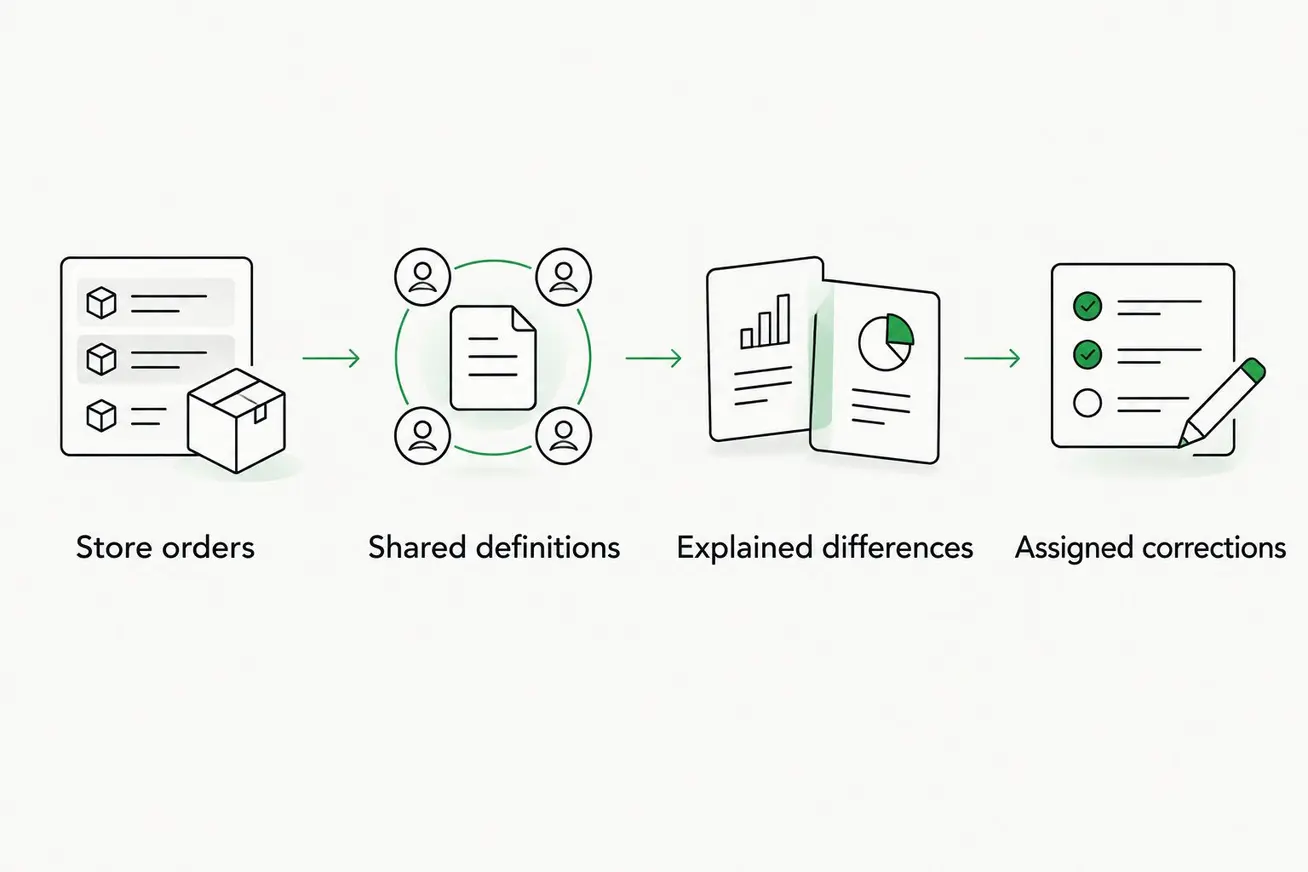
Agree on definitions before interpreting the difference between reported totals.
Why ecommerce reporting totals vary
A difference between reports is a question to investigate, not automatic evidence of poor performance. These factors explain where to look:
- Reporting scope: Online purchases, in-person sales, wholesale activity and other storefronts create different order populations.
- Timing: Order dates, payment dates, attribution dates and settlement dates answer different questions.
- Sales components: Taxes, shipping charges, discounts and currency conversion change the value being compared.
- Order adjustments: Refunds, cancellations, edits and chargebacks change the commercial outcome after purchase.
- Attribution rules: Credit windows and channel rules affect which marketing interactions receive credit.
- Tracking configuration: Missing identifiers, repeated purchase events and inconsistent event values prevent clean matching.
For each difference, ask which records support the explanation. “The platforms report differently” describes a category of problem; it does not reconcile your sales.
What should your agency include in the reconciliation?
Your 2026 ecommerce report should let you move from a headline figure to the records behind it. Require a readable summary supported by a detailed working file.
A clear revenue bridge
Show the starting store-sales figure and the adjustments needed to make it comparable with the marketing report. Label each adjustment rather than hiding the difference in a balancing entry.
If the remainder is unresolved, keep it visible. A total that appears to match because unexplained records were excluded is not a completed reconciliation.
A settings and changes note
Record attribution settings, reporting currency, time zone and the purchase events included. State whether anything changed during the reporting period.
If tracking was corrected, distinguish results before and after the correction. Otherwise, a measurement improvement can be mistaken for a commercial improvement.
A commercial interpretation
Explain what the reconciled numbers mean for orders and contribution, not just platform efficiency. Return on ad spend divides attributed revenue by advertising spend; it does not deduct all the costs needed to establish profit.
Check product costs, fulfilment, payment processing, returns and marketing costs before treating reported revenue as money available to grow the business. Keep assumptions visible when costs are estimated rather than recorded.
An action list
Every reporting problem needs a next move. Examples include correcting a duplicate purchase event, aligning currencies, reviewing cancelled orders or changing the report’s sales definition.
An action list should distinguish measurement repairs from campaign changes. Fixing unreliable measurement and changing the budget simultaneously makes the outcome harder to interpret.
How do you check whether reported sales are profitable?
Reconciled revenue is a starting point, not a profit verdict. Connect the agreed sales figure to your actual cost structure before deciding that a campaign deserves more budget.
Consider a store selling both bulky home products and smaller accessories. The same revenue can produce different contribution after product costs, shipping and returns. That example illustrates why a blended advertising return cannot settle every budget decision.
Ask your agency to separate recorded costs from assumptions. If fulfilment costs or return rates are estimates, mark them as estimates and show how they affect the recommendation.
For 2026 planning, compare projected outcomes with actual outcomes using the same sales and cost definitions. A forecast built on gross order value cannot be fairly judged against sales after refunds without an adjustment.
The practical question is not simply whether the advertising account reports more revenue. It is whether the additional orders leave enough contribution after the relevant costs.
Should agency revenue exactly match store sales?
Agency revenue should match store sales only when both reports use the same orders, definitions and timing. Platform-attributed revenue is a separate measurement and does not automatically equal total store sales.
Require the agency to identify which figures are directly comparable. An explained difference is useful; an unexplained match is not proof of accuracy.
Can you add Google and Meta revenue together?
Google and Meta attributed revenue should not be added as unique store sales unless the reporting method removes overlapping credit. The same purchase can receive credit in both systems.
Keep platform views for diagnosing campaigns, then use a separate deduplicated store-sales view for the business total. Neither view establishes the incremental sales caused by advertising on its own.
When should you question the report before changing budgets?
Question the report when platform revenue rises without a corresponding explanation in store orders, when refunds disappear from the discussion, or when purchase-event counts do not match the intended order population.
Also investigate sudden reporting changes after tracking edits. Ask what changed in measurement before accepting a claim that customer demand improved.
Do not increase budgets solely because an unreconciled dashboard shows a stronger return. Check the order evidence, commercial costs and the explanation for the change first.
Setsail Marketing is an ecommerce marketing agency for owners who want a documented strategy and in-house execution. The free, 30-minute Growth Strategy call is separate from the subsequent paid Growth Strategy engagement, which includes research, channel priorities and a fixed 90-day plan.
Bring your existing report and the sales question you cannot answer. You can book a Growth Strategy call to discuss the gap; projected returns and payback remain estimates, not guarantees.
FAQ
Why does my ecommerce marketing agency report more revenue than my store?
Your ecommerce marketing agency report can exceed store sales because of overlapping attribution, different reporting dates, sales definitions or tracking errors. Ask for a reconciliation to store orders rather than accepting the platform total as additional revenue.
Which report should I use as the source for actual ecommerce orders?
Use your store’s order records to establish which orders exist, then apply agreed status and sales rules. Advertising attribution explains assigned marketing credit, while payment settlements explain money received.
Should refunds reduce the revenue in my marketing report?
Refunds belong in the commercial assessment of marketing performance. State whether refunds adjust the original sales period or appear in the refund period so comparisons remain consistent.
What should I ask when advertising revenue rises but store sales do not?
Ask for an order-level reconciliation and a record of attribution or tracking changes. Check duplicate purchase events, overlapping credit and reporting boundaries before treating the increase as business growth.
Does a high return on ad spend mean my store is profitable?
A high return on ad spend does not establish store profitability. The calculation uses attributed revenue and advertising spend, not every product, fulfilment, return and operating cost.
What should I bring to a Setsail Marketing Growth Strategy call?
Bring your goals, current agency report and the store-sales question you need answered. The Growth Strategy call is free and lasts 30 minutes; the subsequent researched Growth Strategy is a separate paid engagement.
One last thing
Before approving your next 2026 report, ask the agency to trace a completed order from the store record through the purchase event and into the reporting view. Then ask what happens when that order is refunded.
That walkthrough exposes the difference between a dashboard you can read and a reporting system you can trust. Keep the explanation with your reporting definitions so the next review starts with evidence, not the same argument.
Related guides
- What should an ecommerce marketing agency know about margins?
- How to compare Google Ads agency fees and advertising spend
- How to give a marketing agency a useful customer brief