
TL;DR
- Compare Google Ads agency fees separately from advertising spend; assess the complete scope before choosing.
- Setsail Marketing suits businesses seeking a documented strategy before ongoing Google Ads agency delivery.
- Judge reporting by qualified enquiries, orders and profit—not clicks alone.
- Confirm account ownership, approval limits and handover terms before signing.
How do you compare Google Ads agency fees and advertising spend?
Compare proposals against the same written brief, not against each other’s headline fee. A proposal for campaign management alone is not equivalent to one that also includes conversion tracking, landing-page improvements and sales reporting.
For your 2026 comparison, ask every agency to separate these items:
- Advertising spend: The budget used to buy advertising through Google Ads.
- Agency management: The work involved in planning, managing and improving campaigns.
- Setup work: Account preparation, tracking configuration and other agreed launch tasks.
- Supporting work: Landing pages, creative, product feeds or other services needed for the campaign.
- Third-party charges: Any separately billed tools or outside services required by the proposed scope.
If you are assessing Setsail Marketing, distinguish the free, 30-minute Growth Strategy call from the subsequent paid Growth Strategy engagement. The call carries no commitment; it is not the researched strategy itself.
Ask each agency to identify what is included, what is excluded and what requires separate approval. That gives you a usable comparison without pretending every business needs the same campaign or service package.
Why this matters
Your advertising budget buys access to prospective customers. The agency’s work should connect that attention to an action your business can fulfil profitably: a suitable enquiry, a booked job or an order.
A Vancouver renovation company needs to distinguish suitable project enquiries from requests for work it does not accept. An ecommerce business needs to understand whether orders leave enough margin after marketing and fulfilment costs. Neither decision is answered by a click total.
For a 2026 agency review, start with the commercial problem. Are you short of suitable enquiries, losing prospects after they arrive, or struggling to tell which sales came from advertising? Those are different assignments, even when every proposal mentions Google Ads.
Compare fee models by incentives and scope
There is no fee structure that proves an agency will do good work. Each model needs a clear definition of responsibilities, approval rules and the circumstances that change the fee.
Fixed management fee
- Best for: Businesses seeking a defined management scope
- Main advantage: Makes the agreed agency charge clear
- Main limitation: Additional work can sit outside the scope
- What to confirm: Deliverables, exclusions and change approval
Percentage of advertising spend
- Best for: Businesses comfortable with spend-linked fees
- Main advantage: Connects the fee calculation to media investment
- Main limitation: A higher budget increases the fee without proving better outcomes
- What to confirm: Calculation basis and budget authority
Project fee
- Best for: Businesses commissioning a defined setup or improvement
- Main advantage: Connects payment to a specific piece of work
- Main limitation: Ongoing management is a separate decision
- What to confirm: Completion criteria and handover
Performance-linked fee
- Best for: Businesses with agreed, traceable outcomes
- Main advantage: Connects part of compensation to a defined result
- Main limitation: Attribution and lead-quality disputes need explicit rules
- What to confirm: Eligible outcomes, exclusions and verification
Choose the scope before choosing the payment model. A fixed fee with unclear responsibilities is not a clearer commercial agreement than a percentage fee with documented work and approval controls.
If a proposal combines models, ask for the calculation in writing. You should be able to understand what changes when advertising spend rises, a new campaign launches or your business requests work outside the original brief.
Fixed management fees: check the boundaries
A fixed management fee needs a defined service boundary. Ask which campaigns, markets and ongoing tasks it covers, and what triggers a scope review.
Do not assume that landing-page development, photography or sales-system integration is included because the proposal says campaign management. Have the agency name those responsibilities explicitly. The same applies to your own team’s work: approving claims, answering enquiries and supplying accurate product information.
Spend-linked fees: check who controls increases
When a fee depends on advertising spend, budget approval matters. The agreement should distinguish the agency’s recommendation from your permission to increase spending.
Ask what evidence will support a proposed increase. More available search traffic is not, by itself, a business case. Your decision also needs qualified demand, fulfilment capacity and a clear explanation of the expected commercial outcome.
Project fees: define what completion means
A project can cover a specific setup, rebuild or improvement. The useful comparison is the finished work and its acceptance criteria, not the project label.
For tracking work, for example, ask which customer actions will be recorded and how those actions will be checked. For a landing page, clarify who supplies copy, who implements the page and who owns the finished assets. Document ongoing responsibilities separately.
What should advertising spend cover?
Advertising spend and agency fees answer different questions. Advertising spend funds delivery through the advertising platform; agency fees pay for the agreed professional work around that investment.
Request separate figures in each proposal and confirm who receives each payment. If the agency handles billing, ask how platform spending will be shown and whether any additional charge applies. You need a clear record, not an unexplained combined total.
Also separate the proposed budget from a forecast. A budget is an authorised spending limit. A forecast estimates what that investment might produce under stated assumptions; it is not a guaranteed return.
For your 2026 plan, require assumptions that you can challenge. These include what counts as a qualified enquiry, how sales will be attributed and whether your team can fulfil the projected demand. A projection without those definitions does not give you a sound approval decision.
Why Google Ads agency fees vary
Differences in fees need an explanation tied to work. Ask agencies to identify which of these factors their proposal includes:
- Account scope: The campaigns, locations, offers and customer groups the agency will manage.
- Measurement work: The tracking setup, validation and sales-data connections required to assess results.
- Website work: Whether the assignment includes landing-page copy, design, development or testing.
- Creative requirements: Whether new images, video or other advertising assets are part of delivery.
- Reporting responsibilities: Whether reporting stops at platform activity or connects enquiries and orders to business outcomes.
- Delivery boundaries: What the agency handles, what your team supplies and what requires a separate project.
These factors explain differences in scope, not automatic differences in quality. A more detailed proposal still needs clear priorities. Ask which work addresses the immediate constraint and which work can wait.
For a home-service business, that constraint might be poor enquiry quality rather than insufficient traffic. For an online store, it might be an unclear buying page. Treat these as questions to investigate, not conclusions to assume before reviewing evidence.
How do you compare proposals fairly?
Use a shared decision process rather than letting each proposal define its own success. Keep the same business objective, scope questions and reporting requirements across every conversation.
Define outcomes
Write down what you want the advertising to produce. Specify the services, products or customer types you want to prioritise, along with enquiries your team should reject.
A construction business can describe suitable project types and service areas. An ecommerce business can identify the product groups it wants to promote and explain margin constraints. This gives the agency a commercial brief rather than an instruction to generate more traffic.
Compare scope
Build a side-by-side checklist from the proposals. Mark each responsibility as included, excluded or requiring clarification; do not treat an unanswered question as an inclusion.
Use the same approach for your own obligations. If your team must supply photography, approve copy or update product information, put that work on the plan. Otherwise, you are comparing agency fees while overlooking the internal effort required to deliver the campaign.
Check measurement
Ask how the agency will distinguish a submitted enquiry from a suitable sales opportunity. For ecommerce, ask how reported orders will be reconciled with the business records you use to manage sales.
You do not need a technical lecture. You need a plain explanation of what will be recorded, what cannot be confirmed and who will check discrepancies. Agree on these definitions before using the report to judge performance.
Confirm ownership
Document who owns the advertising account, website assets, tracking configuration and campaign materials. Confirm the access you retain during delivery and what happens when the relationship ends.
Access is not the same as ownership. If you are changing providers, use this guide to switching Google Ads agencies without losing your account to prepare the handover questions before committing.
Agree decisions
Set approval rules for spending changes, new offers and work outside scope. Name the person on your side who can approve changes and the person responsible for explaining them.
Your 2026 agreement should also define how the plan will be reviewed. Ask what evidence would justify keeping the approach, changing it or stopping a campaign. That makes reporting a decision process rather than a presentation of activity.
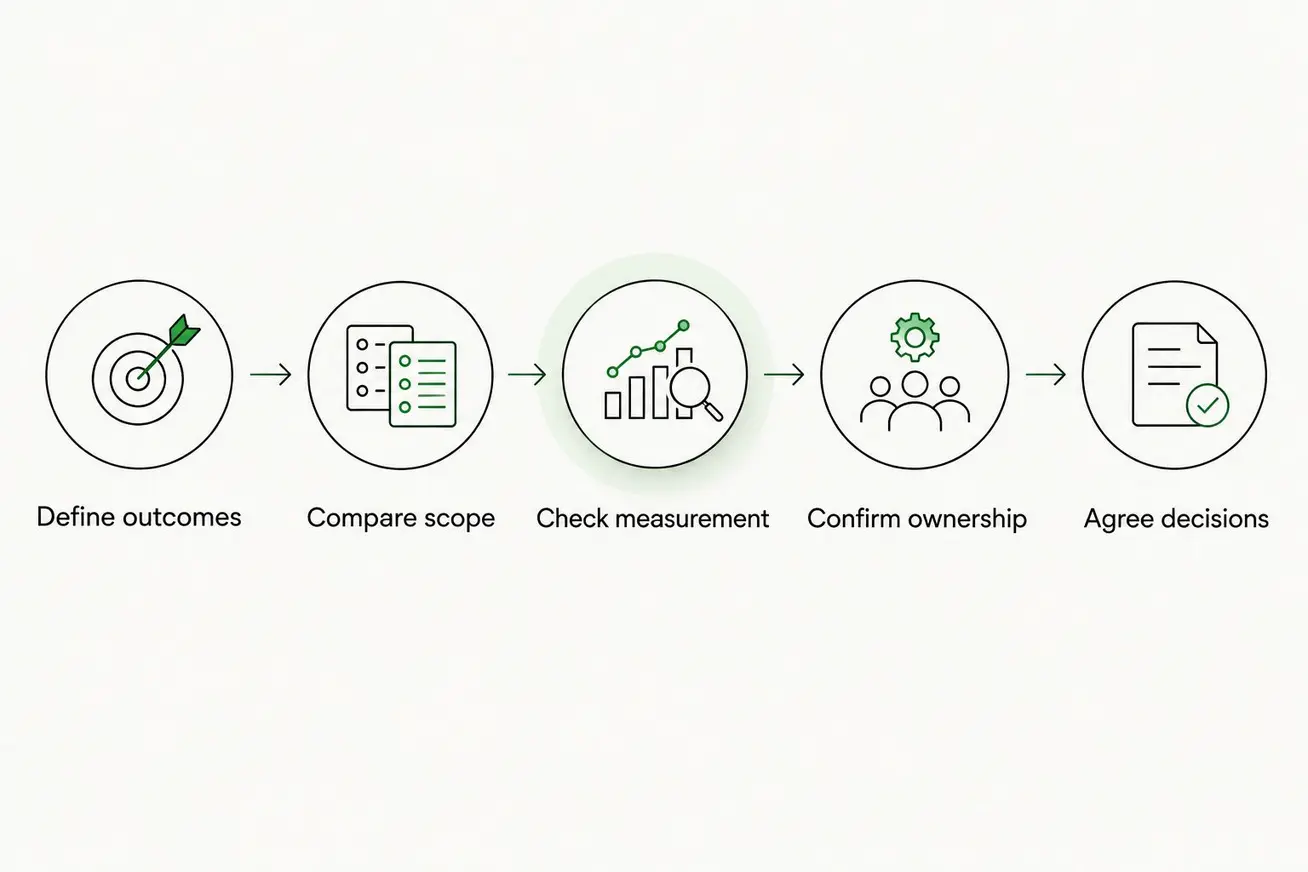
Agree on the decision process before approving ongoing advertising work.
What should the agency report after you hire it?
A useful report connects spending to customer actions and explains the next decision. It should distinguish observed results from estimates, and actual performance from the assumptions in the original plan.
Ask for a clear account of:
- Advertising spend and agency charges, shown separately.
- Enquiries or orders attributed to advertising, with the attribution method explained.
- Lead-quality feedback or sales outcomes your business can verify.
- Work completed against the agreed plan.
- Problems, proposed changes and approvals required from you.
Do not treat cost per enquiry as the final verdict. An unsuitable enquiry still consumes your sales team’s time. Equally, an order total does not establish profit without the relevant business costs.
Setsail Marketing is a Google Ads agency for businesses that want a documented strategy before ongoing delivery. Its researched Growth Strategy includes customer research, sourced market demand, a diagnosis of marketing gaps, channel priorities and a fixed 90-day plan with deliverables and a timeline.
The client keeps that strategy whether or not delivery continues. The limitation is equally important: projected returns and payback remain estimates, not guarantees. Assess the assumptions and the work, not a promised outcome.
Should you choose the agency with the lowest fee?
Choose the proposal that fits the job, not the smallest isolated charge. A narrower service can be appropriate when your team already handles the missing work; it is a poor comparison when nobody has accepted those responsibilities.
Before deciding, ask each agency to explain the most important exclusion in its proposal. Then ask what would happen if that excluded work became necessary. The answers show where additional decisions and internal effort will arise.
Should you increase advertising spend before fixing the website?
Do not approve an increase without checking the path from ad to enquiry or purchase. Review whether the page matches the advertised offer, works on mobile and gives customers a clear next step.
If the problem is after the click, additional spending does not address that problem. Ask the agency to explain whether its recommendation concerns demand, the website or follow-up—and what evidence supports that diagnosis.
FAQ
What's the difference between Google Ads spend and agency fees?
Google Ads spend pays for advertising delivered through the platform; agency fees pay for the agreed professional work. Request separate figures and confirm whether setup, tracking, creative and website work are included.
Is a fixed fee better than a percentage of advertising spend?
Neither fee model proves better performance. Compare scope, approval rules and reporting, then check how the fee changes when your requirements or advertising budget change.
How much should I spend with a Google Ads agency?
Set the budget around your business objective, commercial constraints and an explicit plan. Ask the agency to distinguish its recommended advertising spend from its fees and explain the assumptions behind projected outcomes.
Should I own my Google Ads account?
Make account ownership and access explicit before signing. Document the access you retain, who controls billing and what the agency must hand over when the engagement ends.
What should I ask about conversion tracking?
Ask which customer actions will be recorded and how the agency will check that tracking works. Also agree how enquiries, qualified opportunities and completed sales will be distinguished.
Is Setsail Marketing's Growth Strategy call the paid strategy?
No. The Growth Strategy call is free, lasts 30 minutes and carries no commitment; the subsequent researched Growth Strategy is a separate paid engagement.
Can a Google Ads agency guarantee my return?
Treat projected returns and payback as estimates, not guarantees. Ask for the assumptions, measurement method and conditions that would require the plan to change.
One last thing
Before signing a 2026 proposal, ask: what would make you recommend reducing our advertising spend? The answer should describe evidence and business constraints, not a commitment to spend more regardless of results.
Bring your goals and challenges. We’ll bring the data. Book a Growth Strategy call with Setsail Marketing: it is free, lasts 30 minutes and carries no commitment. If there is a fit, the subsequent paid strategy sets out the researched priorities and a 90-day delivery plan before ongoing work.
Related guides
- What an ecommerce marketing agency should know about margins
- What a small-business marketing agency should deliver in 90 days
- How to brief a construction marketing agency on job quality