
TL;DR
- A construction marketing agency should target deliverable, profitable jobs—not maximise enquiries without regard to crew capacity.
- Separate crew availability, estimating capacity and customer start dates before setting lead-generation priorities.
- Keep search visibility active while adjusting paid advertising to the work you can accept.
- Setsail Marketing suits construction businesses seeking a researched plan before ongoing marketing delivery.
Why this matters
An enquiry is useful only if the work fits your business. A homeowner ready to start immediately and a commercial buyer researching a future project need different responses, even when both request an estimate.
Define what a construction marketing agency should count as a lead before asking for more leads. Your definition should include service fit, location, buying intent and a start window you can discuss honestly.
For your 2026 plan, connect marketing decisions to your delivery schedule. Otherwise, you risk promoting work you cannot accept while leaving the wrong crews or services underbooked.
How do you plan construction marketing around crew capacity?
Build a shared planning process that connects crew availability to customer demand. Your construction marketing agency needs operational constraints before recommending campaign priorities; your operations team needs visibility into the opportunities marketing is creating.
1. Map capacity
Record committed work, expected completion dates, crew skills and unresolved dependencies. Separate signed projects from quoted work and informal conversations. An estimate awaiting approval is not a confirmed booking.
Use the unit that matches how you schedule delivery: crew-days, project slots or another measure your operations team already understands. Do not turn every opening into interchangeable capacity. A crew available for a particular service does not automatically make every advertised service deliverable.
Mark capacity as confirmed, conditional or unavailable. Conditional openings need a named dependency, such as completion of another project, rather than an optimistic date passed to marketing as fact.
2. Prioritise jobs
List the work you want to sell, not just the services you offer. Include the service area, scope, required skills, expected contribution to profit and acceptable start window.
For example, a Vancouver contractor can distinguish enquiries for a defined renovation service from requests outside its delivery area. This is a targeting decision, not a claim that one neighbourhood or project category always produces better customers.
Ask your estimator which jobs deserve attention and why. Feed those criteria into advertising, website forms and sales conversations so that marketing attracts work your team actually wants to quote.
3. Work backwards
Start with the desired project start date. Then account for your own enquiry handling, site visits, estimating, customer decisions and preconstruction requirements.
Use recorded intervals from comparable jobs where you have them. Where you do not, label the timing assumption and replace it as evidence accumulates. Do not borrow a generic sales-cycle figure and present it as your company's reality.
An opening later in your 2026 schedule needs a different message from immediate availability. Tell buyers which stage they can enter now—an initial discussion, a site assessment or a conversation about future scheduling—without promising an unconfirmed start.
4. Match campaigns
Organise paid advertising around service and location priorities that your team can support. Where campaign controls permit, separate work with different capacity constraints so that reducing one activity does not require stopping everything.
Keep the customer journey consistent. An advertisement for a specific service should lead to relevant project information and an enquiry route that asks about that service. Generic messaging makes qualification harder.
Your website should also explain how scheduling works. Ask for a preferred start window, but distinguish a customer's preference from a date your business has accepted.
5. Qualify enquiries
Collect enough information to decide whether an enquiry deserves an estimating conversation. Ask about project type, location, scope and intended timing. Leave room for buyers who need advice rather than forcing them to provide details they do not yet know.
Give each enquiry a useful outcome: suitable for current capacity, suitable for future work, outside scope, or awaiting clarification. Record why unsuitable enquiries were declined.
Do not treat an unqualified enquiry as a booked-job opportunity. The distinction protects both your estimator's time and the accuracy of your marketing report.
6. Review outcomes
Compare campaign activity with qualified opportunities, estimates, accepted work and the schedule those jobs would occupy. Include expected job contribution where you can calculate it consistently.
Review the plan when a material booking, cancellation or delivery change affects capacity. Agree who can request a campaign change and who confirms that the operational information is current.
Your 2026 report should compare projected outcomes with actual outcomes and explain the assumptions behind the difference. More enquiries are not an improvement if suitable booked work and expected profit move in the wrong direction.
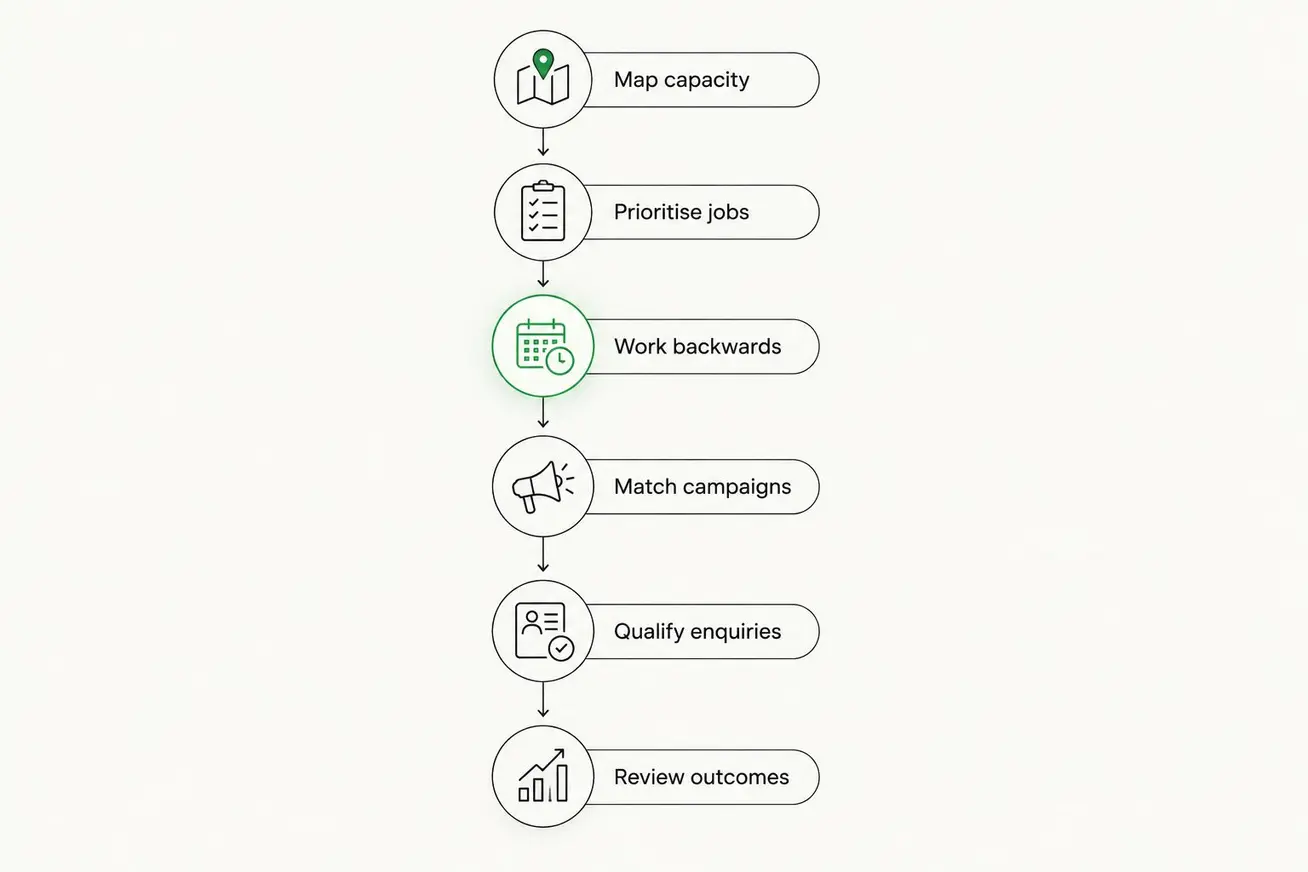
Set delivery constraints before choosing campaign priorities.
Which marketing approach fits your current workload?
Choose your approach by service, not just by whether the business feels busy. You can have no room for one job type and a genuine opening for another.
Confirmed openings
- Best for: Services with deliverable start windows
- Marketing priority: Target suitable enquiries for those openings
- Advantage: Connects acquisition activity to work you can accept
- Limitation: Demand and customer timing still need qualification
Uneven workload
- Best for: Businesses with different crew skills or service schedules
- Marketing priority: Focus on the underbooked service
- Advantage: Avoids promoting already-constrained work
- Limitation: Requires accurate service-level scheduling
Committed schedule
- Best for: Businesses prioritising future bookings
- Marketing priority: Build future enquiries and maintain useful service content
- Advantage: Gives later-stage buyers a route to engage
- Limitation: Does not solve an immediate capacity shortage
None of these approaches guarantees bookings. Paid advertising cannot make an unsuitable project suitable, and a full schedule does not mean every future enquiry should be rejected.
Before changing spend, check whether the problem is demand, qualification, estimating capacity or delivery capacity. Each calls for a different response.
Why construction marketing priorities vary
The same campaign settings should not govern every service or scheduling situation. These factors determine what your marketing can responsibly promote:
- Crew skills: Available people must match the work being advertised. Headcount alone does not establish deliverable capacity.
- Committed work: Signed projects and their delivery requirements take priority over speculative openings.
- Estimating capacity: Your ability to assess and quote work can constrain acquisition before the delivery schedule fills.
- Customer timing: Buyers researching future work need different qualification and follow-up from buyers seeking an immediate start.
- Job economics: Revenue alone does not identify desirable work. Consider direct delivery costs and the resources a project occupies.
- Delivery dependencies: Materials, approvals, site readiness and subcontracted work belong in the schedule when they affect a particular project.
Keep these factors visible in the planning brief. Your agency does not need every operational detail, but it does need the constraints that change targeting, messaging or timing.
Should you stop advertising when your crews are fully booked?
Stop promoting unavailable start dates, not automatically every service. First check whether your whole business is at capacity or only a specific crew, service or delivery period.
Reducing paid activity for constrained work gives you control over what you actively promote. The trade-off is reduced acquisition activity for that service; it is not a substitute for planning the next opening.
Keep accurate service information and relevant project evidence on your website. Buyers comparing contractors still need to understand your work, even when immediate starts are not the priority.
If you invite future enquiries, explain the scheduling conversation clearly. Do not describe an enquiry list as a guaranteed booking or suggest that submitting a form reserves a crew.
How should you handle enquiries for work you cannot start yet?
Ask whether the buyer's timing is flexible before rejecting an otherwise suitable project. Record the preferred start window and explain what your team can confirm now.
Use a separate follow-up category for future-fit enquiries. Keep those contacts distinct from accepted work so that your marketing report does not turn interest into an inflated backlog.
Your 2026 follow-up plan should identify an owner and a reason to reconnect. That reason might be a confirmed scheduling update or information the buyer requested—not a generic sales message that ignores the original conversation.
What should your construction marketing agency receive?
Give your agency a short operating brief that answers the decisions it needs to make:
- Which services need suitable enquiries?
- Which locations can your crews serve?
- Which start windows are confirmed or conditional?
- What makes a project worth estimating?
- Who handles new enquiries and updates their outcomes?
- What operational change should trigger a campaign review?
Include the evidence behind your priorities: accepted and declined estimates, customer questions, enquiry outcomes and the current schedule. Customer research should explain how buyers search, compare contractors, assess trust and decide whom to contact.
Setsail Marketing is best for construction businesses that want a researched marketing plan before ongoing delivery. Its Growth Strategy includes customer research, sourced market demand, a diagnosis of marketing gaps, channel priorities and a fixed 90-day plan. Projected returns and payback are estimates, not guarantees.
Book a Growth Strategy call to discuss the constraint you need to solve. The call is free, lasts 30 minutes and carries no commitment; the subsequent researched Growth Strategy is a separate paid engagement. You keep that strategy whether or not you continue.
Book a Growth Strategy call
Discuss your goals and capacity constraints in a free, 30-minute call with no commitment.
FAQ
What should a construction marketing agency know about crew capacity?
A construction marketing agency needs to know which services your crews can deliver, where they work and which start windows are confirmed. It also needs your estimating constraints and criteria for a suitable job.
Should I increase advertising when a construction project gets cancelled?
Reassess the opening before increasing advertising. Confirm the affected crew, suitable replacement work and realistic customer decision process, then adjust targeting around that specific gap.
How do I measure marketing when my crews are already busy?
Measure qualified future opportunities, accepted work and expected job contribution against your scheduling priorities. Keep enquiries, estimates and confirmed bookings separate so that interest does not appear as committed revenue.
Can SEO help if I do not need immediate construction leads?
SEO can support buyers researching future construction work by making relevant service information easier to find. Keep scheduling language accurate and assess enquiries against future capacity rather than treating every contact as an immediate opportunity.
What should I ask on a construction enquiry form?
Ask about project type, location, scope and preferred timing. Collect what your team needs for the next conversation without requiring buyers to know technical details before speaking with you.
Is the Setsail Marketing Growth Strategy call the same as the strategy engagement?
The Setsail Marketing Growth Strategy call is a free, 30-minute conversation with no commitment. The subsequent paid Growth Strategy is a separate researched engagement that includes a fixed 90-day plan; projected returns and payback are estimates, not guarantees.
One last thing
Before approving another campaign, ask your estimator to explain the last suitable enquiry your business declined. Was the issue timing, scope, location or an inability to prepare the estimate?
Use that answer to challenge your next 2026 marketing brief. The next move is not always more enquiries; it is making sure the right enquiry can become work you want and can deliver.