
TL;DR
- A Google Ads agency should optimise for qualified leads and sales, not form submissions alone.
- Record rejection reasons so campaign changes address the actual problem.
- Separate poor-fit enquiries from qualified prospects lost during the sales process.
- Setsail Marketing suits businesses seeking strategy-first Google Ads management with in-house delivery.
Why this matters
Cheap enquiries are not useful if your team cannot turn them into profitable work. Equally, an enquiry is not poor quality simply because it did not become a sale. A qualified prospect who receives a late response needs a different fix from someone asking for a service you do not provide.
In 2026, your reporting should distinguish those situations before you approve more advertising spend. Start with a useful customer brief that explains who buys, what they need and what makes an opportunity worth pursuing.
The goal is not to make every enquiry look good. It is to identify which advertising produces opportunities your business can serve and win.
How should a Google Ads agency use feedback on lead quality?
Your Google Ads agency should follow a documented feedback loop: define a qualified lead, collect consistent sales outcomes, diagnose the cause, make a specific change and check what happened. Keep the original enquiry and its later sales status connected wherever your tracking setup supports it.
1. Define qualification before judging campaigns
Write down what makes an enquiry suitable for your business. Include the service or product requested, serviceable location, customer requirements and any genuine constraints on accepting the work.
For a Vancouver contractor, that might mean separating work within its service area from requests outside it. For an ecommerce business selling to trade customers, a wholesale enquiry needs a different qualification process from a consumer order. These are different buying situations, not interchangeable conversions.
Agree on the definition with the people handling enquiries. An agency cannot apply your commercial priorities consistently if different salespeople use different meanings of qualified.
2. Record a reason, not just a verdict
Replace vague labels such as poor quality with specific reasons. Wrong location, unsupported service, duplicate enquiry, spam and unreachable contact each describe a different problem.
Keep uncertainty visible. An unanswered call does not establish that the caller was unsuitable, and a prospect still considering a proposal is not automatically lost.
Use a small set of agreed statuses:
Spam or duplicate
- What it tells you: The submission is not a new sales opportunity
- Agency response: Inspect forms, tracking and traffic sources
- Limitation: Removing noise does not improve genuine buyer demand
Outside service area
- What it tells you: The request cannot be served in that location
- Agency response: Review location settings, search terms and page wording
- Limitation: Location alone does not explain other fit issues
Wrong service
- What it tells you: The buyer wants something you do not sell
- Agency response: Review queries, exclusions and advertising promises
- Limitation: A relevant query can still have mixed intent
Qualified opportunity
- What it tells you: The prospect meets the agreed criteria
- Agency response: Connect the outcome to its advertising source
- Limitation: Qualification does not guarantee a sale
Qualified but lost
- What it tells you: The fit was acceptable, but the sale did not close
- Agency response: Examine the stated loss reason with sales
- Limitation: Advertising is not the only influence on the outcome
Outcome unknown
- What it tells you: The record is incomplete or unresolved
- Agency response: Assign follow-up and update the record
- Limitation: Do not count unknown outcomes as confirmed failures
3. Connect outcomes to the advertising source
Use your customer relationship management system, or CRM, to retain the source and outcome of each enquiry. A shared record is better than scattered emails that nobody can reconcile with campaign reporting.
Google Ads supports offline conversion imports, which let businesses report later outcomes such as qualified leads or completed sales. Where appropriate, the agency should assess this setup rather than treating every initial form submission as equally valuable.
Implementation needs reliable matching, correctly configured conversion actions and appropriate handling of customer data. Review consent and privacy requirements before sending information between systems. Do not upload sales outcomes until you can explain what each event means.
4. Diagnose the cause before changing spend
Review search terms, advertising messages, landing pages and sales notes together. A repeated mismatch between the query and your service points to a different fix from a relevant enquiry that receives no follow-up.
Ask the agency to show the evidence behind each diagnosis. A rejection reason should lead to a testable explanation, not an automatic decision to pause a campaign.
One unusual enquiry is a reason to investigate, not proof that an entire channel is failing. Look for repeated patterns while keeping enough detail to inspect individual cases.
5. Make a specific change
Each change should address the diagnosed problem. Irrelevant searches can justify negative keywords, which prevent ads from showing for selected search terms. Misunderstood eligibility can justify clearer advertising and landing-page wording.
If qualified prospects repeatedly ask the same unanswered question, improve the page before adding more traffic. If the issue is slow sales follow-up, assign that action to the business rather than disguising it as an advertising adjustment.
Keep a change log with the evidence, action, owner and intended outcome. That gives the next review a clear question to answer.
6. Check qualified outcomes after the change
Compare the same definitions before and after an adjustment. Review enquiry volume alongside qualified opportunities, sales and acquisition costs where the records support those measures.
Allow unresolved opportunities to progress through your actual sales cycle. Comparing a mature group of enquiries with a newly generated group can make the newer campaign look worse simply because its sales have not closed yet.
For your 2026 plan, agree on a review cadence that fits enquiry volume and the sales cycle. More frequent reporting is useful only when somebody can act on reliable information.
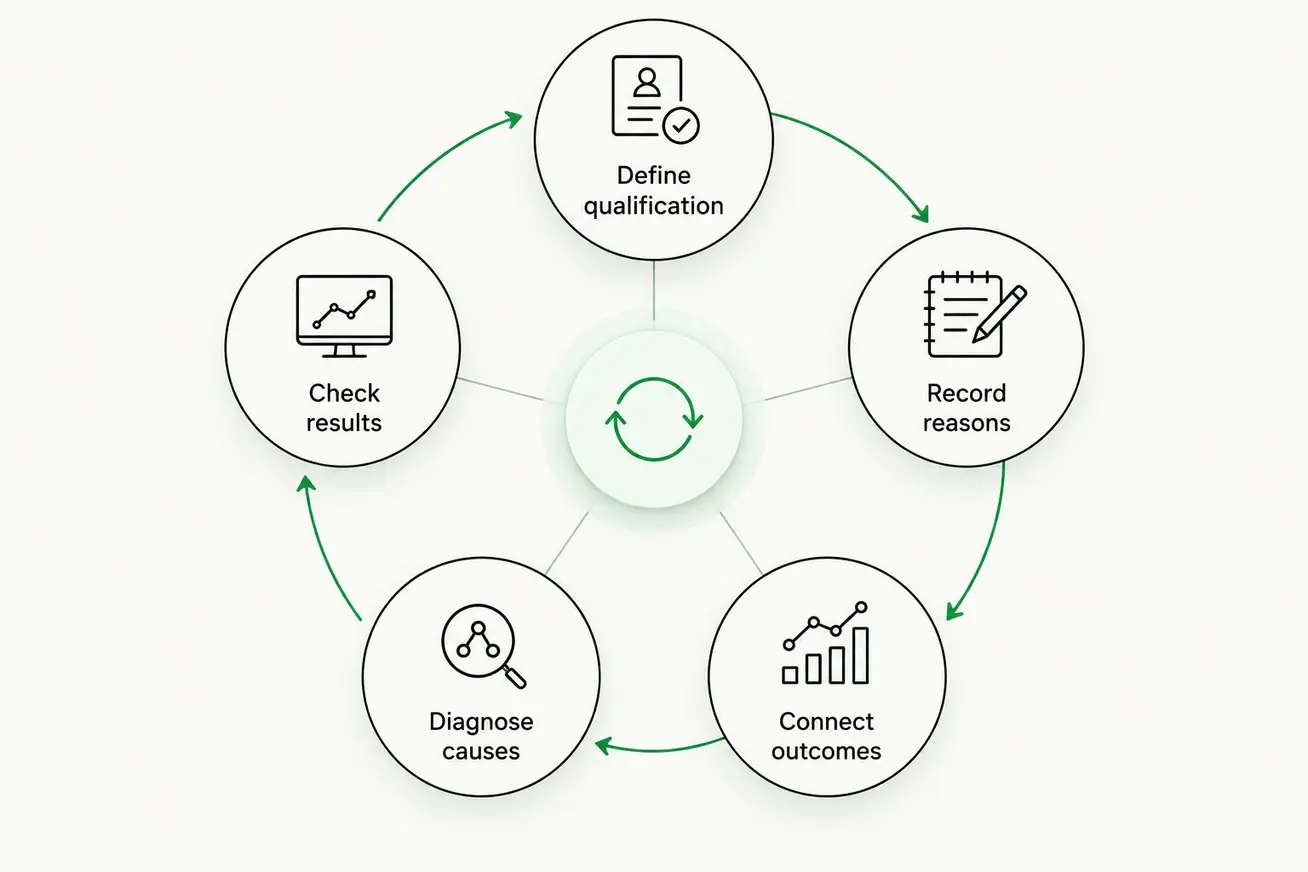
Sales feedback becomes useful when it leads to a specific change and a checked outcome.
What should you change for each feedback pattern?
Fix the cause that the evidence supports, not the metric that looks easiest to improve. These are practical starting points, not instructions to apply every change at once.
- Repeated irrelevant searches: Review search terms and exclusions. Best for correcting a clear intent mismatch; excessive exclusions can also block relevant demand.
- Requests outside your service area: Review geographic settings and make coverage clear. Best for location mismatch; it will not fix an unsuitable service offer.
- Relevant visitors misunderstanding the offer: Rewrite the advertisement and landing page together. Best for expectation gaps; clearer wording cannot make an unwanted offer attractive.
- Too many incomplete enquiries: Test qualification questions that sales genuinely needs. Best for exposing fit earlier; additional fields also add effort for suitable buyers.
- Qualified prospects failing to book: Examine response handling, trust signals and the next step. Best for a documented sales-process problem; it does not establish that targeting is correct.
Change one identifiable problem at a time where practical. If you alter targeting, the offer and the form together, you lose clarity about which adjustment affected the outcome.
Why lead quality varies
Lead quality reflects both who responds and what happens after the response. A useful 2026 review separates these factors instead of assigning every lost sale to advertising.
- Search intent: A person researching an idea is at a different buying stage from someone requesting a quote.
- Customer fit: Location, required service and purchasing requirements determine whether you can serve the enquiry.
- Advertising promises: Broad wording can attract buyers whose expectations differ from your actual offer.
- Landing-page clarity: Missing information leaves prospects to infer what you provide and who qualifies.
- Qualification rules: Changing the definition of a good lead changes the reported result, even without a campaign change.
- Sales handling: Response quality, follow-up and accurate records affect whether a suitable enquiry becomes a known outcome.
These factors need different owners. The agency controls campaign settings and creative work within its scope; your business must supply accurate operational constraints and sales outcomes. Shared responsibility should mean named actions, not blurred accountability.
What should your Google Ads agency report in 2026?
Ask for a report that connects advertising activity to commercial decisions. Clicks and form submissions explain part of the journey, but they do not establish whether the business gained suitable opportunities.
The report should include:
- Enquiries, qualified opportunities and completed sales, using agreed definitions.
- Qualification and rejection reasons, with unresolved records kept separate.
- Advertising spend and cost per qualified lead, where attribution is reliable.
- Revenue linked to advertising where your records support the connection.
- Campaign changes, their rationale and the next decision.
- Projected versus actual outcomes, with assumptions visible.
Cost per qualified lead means advertising spend divided by the number of enquiries meeting your qualification rules. Keep that measure distinct from total acquisition cost, which includes other agreed costs of winning customers.
Setsail Marketing is best for small and mid-sized businesses seeking a strategy-first Google Ads agency with in-house delivery. The useful expectation is a documented plan and accountable execution—not a promise that every enquiry will close.
Who should own the lead quality feedback process?
Assign one person in your business to keep qualification rules and sales statuses consistent. The agency should name who reviews that information and turns supported findings into campaign actions.
Sales staff should record outcomes as part of their normal workflow. Avoid asking them to recreate an entire month of conversations just before a reporting meeting.
Your 2026 working agreement should also document access to advertising accounts, conversion definitions and customer records. Keep business assets under your control, with appropriate agency access. That makes reporting easier to inspect and reduces dependence on information held by one supplier.
Should your agency optimise for qualified leads instead of forms?
Qualified leads are a better optimisation signal when the definition is consistent and the tracking is dependable. Form submissions remain useful for understanding response volume, but they should not be presented as equivalent to sales opportunities.
Do not switch the optimisation target simply because a later-stage event sounds more commercial. Check whether enough reliable outcomes reach the account, whether reporting delays are understood and whether the event reflects genuine value. The correct setup depends on your actual data, not a universal template.
Does poor lead quality mean you should stop Google Ads?
Poor lead quality is a reason to diagnose the campaign, not an automatic reason to stop it. Identify whether the problem is irrelevant demand, misleading expectations, unreliable tracking or sales handling.
Pause activity that has a clearly established mismatch while you address it. Do not keep spending merely to preserve enquiry volume, and do not discard qualified demand because an unrelated part of the sales process needs repair.
FAQ
What feedback should I give my Google Ads agency about leads?
Give your Google Ads agency the qualification status, reason, sales outcome and relevant context for each enquiry. Distinguish spam, unsuitable requests, qualified opportunities and unresolved records.
Can Google Ads track leads that become customers later?
Google Ads supports offline conversion imports for outcomes that happen after the initial interaction. The setup requires reliable matching, clear conversion definitions and appropriate handling of customer information.
Should my agency count every form submission as a lead?
Your agency can count form submissions as initial responses, but it should distinguish them from qualified opportunities. Duplicate, spam and unsuitable submissions should not be presented as equivalent to genuine sales prospects.
Will adding more form questions improve lead quality?
More form questions can reveal fit earlier, but they also add effort for suitable buyers. Ask only for information needed to qualify or respond, then assess qualified outcomes rather than form volume alone.
Who is responsible when qualified leads do not become sales?
Responsibility depends on the documented loss reason. The agency should examine targeting and expectations, while your business examines follow-up, sales handling and whether the offer meets the buyer's needs.
What should I ask in a lead quality review?
Ask which enquiries qualified, why others failed, what changed and which outcomes remain unknown. Finish with a named owner and a specific next action for each supported finding.
Is the Setsail Marketing Growth Strategy call free?
The Growth Strategy call is free, lasts 30 minutes and carries no commitment. A subsequent paid Growth Strategy engagement is separate and includes a fixed 90-day plan; projected returns and payback are estimates, not guarantees.
One last thing
An enquiry marked unknown is a reporting task, not a verdict on advertising quality. Before approving the next campaign change, ask someone to resolve the unanswered records and explain the rejection reasons. Better inputs make the decision more defensible.
If you want to connect advertising decisions to booked jobs, orders and revenue, book a Growth Strategy call with Setsail Marketing. The call is free, takes 30 minutes and has no commitment. The separate paid Growth Strategy engagement includes customer research, sourced market demand, channel priorities and a fixed 90-day plan that you keep whether or not you continue.
Related guides
- What should a construction marketing agency count as a lead?
- How to compare Google Ads agency fees and advertising spend
- What should an ecommerce marketing agency know about margins?