
TL;DR
- An SEO agency Vancouver businesses hire should deliver a tested migration plan before launch approval.
- Google Search Console provides a search baseline; enquiry and order records connect that baseline to business outcomes.
- Redirect valuable URLs to relevant replacements, not automatically to the homepage.
- Setsail Marketing suits owners seeking a documented strategy with in-house SEO and website delivery.
Why this matters
A redesign changes how your website looks. A migration can also change the addresses, content and technical signals that help search engines find your pages. Treating both as a design project leaves commercial risks outside the approval process.
For a Vancouver contractor, that means checking whether customers can still find the relevant service page and request an estimate. For an online retailer, it means protecting product discovery and checkout. Your web development brief should make those journeys acceptance criteria, not optional checks after launch.
Setsail Marketing is best for business owners who want a documented strategy and in-house SEO and website delivery. Even with one delivery team, the migration still needs named owners and evidence that each launch requirement works.
What should an SEO agency do before a Vancouver site migration?
Your agency should turn the migration into an approval process with documented evidence. Ask for the following work before anyone changes the live site.
Establish the business baseline
Record the current site's organic search performance alongside the actions you actually value: qualified enquiries, booked consultations, completed orders or other defined conversions. Separate these outcomes from visits and button clicks. A submitted form is not automatically a qualified lead.
Use Google Search Console for search queries, landing pages, clicks and impressions. Use your analytics and sales records to connect website activity with enquiries and orders. Retain the reporting dates, filters and conversion definitions so the comparison remains meaningful after launch.
Your 2026 baseline should also identify seasonal patterns and any active campaigns that affect demand. Otherwise, a change in sales can be incorrectly attributed to the migration when another change occurred at the same time.
Inventory URLs and protect important content
Ask for a URL inventory assembled from the live site, XML sitemaps, search performance and analytics. A crawl alone does not establish business value. A page that attracts few visits can still answer a question that matters to a buyer close to making a decision.
For each important URL, record its purpose, search performance, conversion role and planned destination. Include service pages, product pages, useful articles, downloadable resources and relevant images. Flag pages that the new design removes or combines.
For a Vancouver service business, confirm that service areas and contact details remain accurate. Do not replace specific, useful information with repeated city names. Customers need to know whether you serve their location and can handle their job.
Build and test the redirect map
A redirect map connects an old URL with its intended replacement. Use a permanent server-side redirect, commonly an HTTP 301 status code, when a page permanently moves and has a relevant successor. This is an established migration practice described in Google Search Central's site-move guidance.
Match the buyer's intent, not just the nearest-looking URL. An old renovation service page should not automatically send customers to an unrelated service or the homepage. Where content is being combined, confirm that the destination still answers the original need.
Your 2026 redirect map should identify deliberate removals as well as replacements. Test the rules in the hosting or application environment that will run them. A correct spreadsheet is not proof that the server implements it correctly.
Check indexing controls and page signals
Test whether search engines can access the pages intended for search. Review robots.txt rules, noindex directives, canonical tags and XML sitemaps. A canonical tag identifies a preferred page version; it is not a substitute for redirecting a moved URL.
Compare important pages with their current versions. Check page titles, main headings, useful copy, internal links and structured data where relevant. Confirm that key information remains accessible when the site renders, rather than existing only in design files.
Keep staging environments out of search, but document exactly which restrictions must change at launch. Leaving a noindex directive on the production site is a different problem from losing a paragraph of copy. Both belong on the checklist, with separate tests and owners.
Test customer journeys and measurement
Complete the actions customers need to take. Submit an enquiry, check the confirmation, and verify that the right person receives it. For ecommerce, test the purchase journey and confirm that order measurement records the intended event without duplication.
Also test telephone links, booking tools and any consent settings that affect measurement. Where the website hands customers to another system, check that handoff rather than stopping at the first button.
Keep the distinction between an action and a result. A telephone-link click records an attempt to call; it does not prove that someone answered or booked a job. Your migration report should preserve that distinction instead of presenting every interaction as revenue.
Assign launch authority and recovery responsibilities
Write down who approves the release, who changes hosting or domain settings, who checks redirects, and who validates measurement. Give each person access before launch. An agency cannot correct a hosting problem if nobody can reach the account owner.
Agree on release blockers and recovery steps. A broken checkout or widespread indexing restriction should trigger a clear decision, not a debate about whether the new design looks finished.
Keep backups and document how recovery would work. A rollback is not automatically simple, especially when orders, enquiries or content have changed since launch. The plan must account for those changes rather than assuming the old site can simply replace the new one.
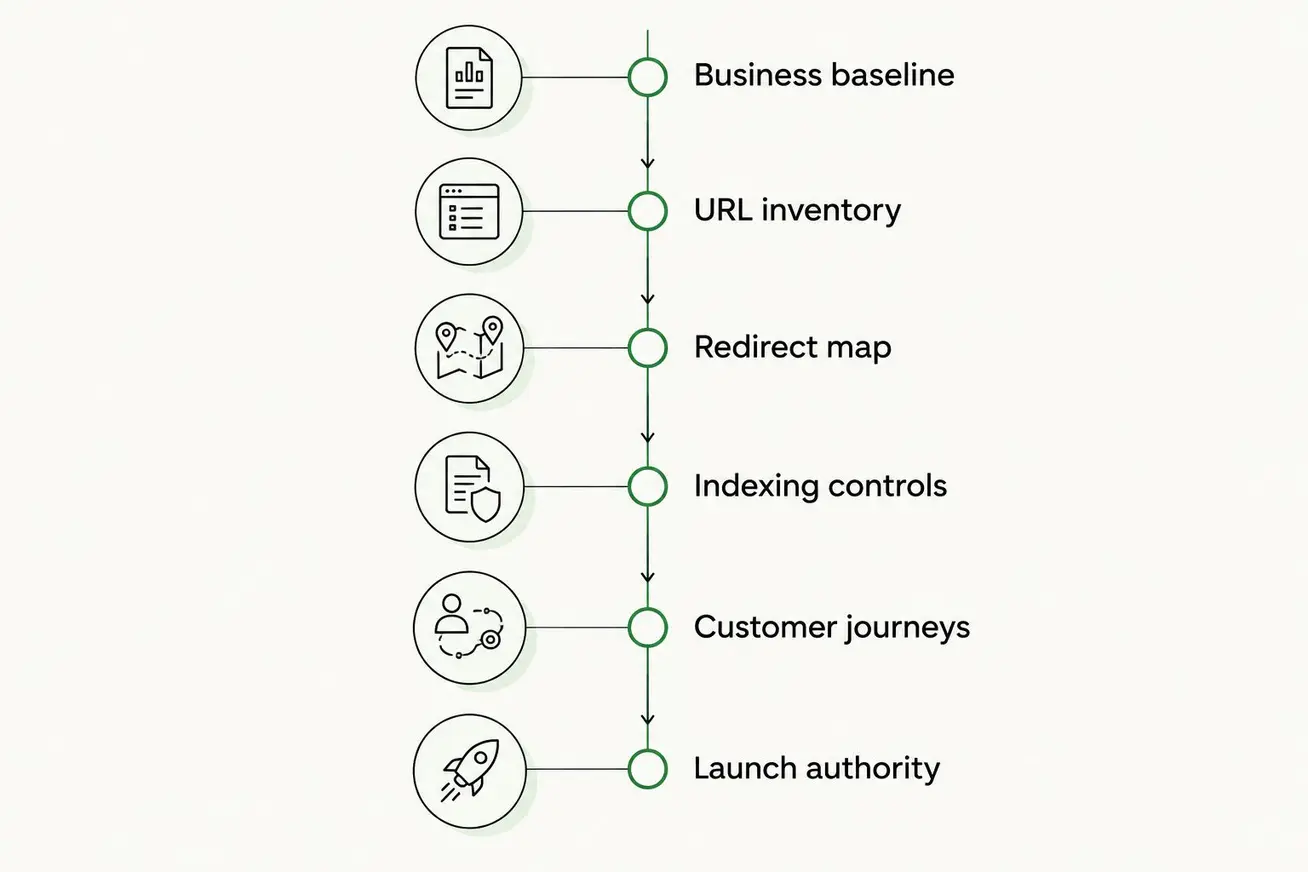
Launch approval comes after technical checks and customer journey testing.
How does the migration type change the work?
The migration scope determines which risks need the most attention. A visual redesign, a platform change and a domain move do not have identical requirements. Record what is changing before agreeing on the work.
Redesign with stable URLs
- Best for: Improving page presentation without intentionally changing addresses
- Main advantage: Preserves existing URL paths
- Main risk to check: Content, navigation or indexing settings can still change
Platform change
- Best for: Moving to a platform that meets documented business requirements
- Main advantage: Changes the site's operating foundation
- Main risk to check: URL rules, rendering, integrations and measurement need retesting
Domain change
- Best for: A business decision that requires a new domain
- Main advantage: Aligns the website address with that decision
- Main risk to check: Old-to-new URL mapping and domain access need explicit ownership
Content consolidation
- Best for: Combining overlapping pages into stronger destinations
- Main advantage: Reduces competing or repetitive content
- Main risk to check: Removing useful detail can leave customer questions unanswered
None of these options removes the need for testing. Keep unrelated changes out of the release where practical; changing the domain, content, platform and navigation together makes diagnosis harder if performance changes.
Why migration preparation varies
The right preparation follows the site's dependencies, not an agency's standard checklist length. Ask the agency to explain which of these factors changes your scope:
- URL changes: Stable addresses require verification; changed addresses also require a destination decision and redirect testing.
- Revenue pathways: An enquiry-led business needs reliable lead routing. An online shop also needs product, checkout and order checks.
- Content changes: Rewriting or removing important pages changes more than the design. Each change needs a reason tied to customer needs.
- Local information: Service areas, addresses and location-specific content need consistent treatment across the replacement site.
- Technical dependencies: Hosting, booking tools, payment systems and other integrations introduce separate access and testing requirements.
- Measurement changes: Replacing analytics or conversion definitions during migration complicates before-and-after comparisons unless the differences are documented.
Your 2026 migration plan should identify these dependencies explicitly. A generic promise to “preserve SEO” does not tell you which pages, settings or customer actions the agency will protect.
Can I keep my current URLs during a redesign?
Keep useful existing URLs when there is no business or technical reason to change them. A new design does not, by itself, require new page addresses. Retest the content and technical settings anyway: stable URLs do not protect against broken navigation, missing copy or accidental indexing restrictions.
Should every deleted page redirect to the homepage?
No. Redirect a removed page to a relevant replacement when one exists. Sending unrelated pages to the homepage loses the specific journey the visitor expected. Where no suitable replacement exists, document the removal and return an appropriate not-found response rather than disguising the decision with a blanket redirect.
Can an agency guarantee that search traffic will not fall?
No agency can guarantee unchanged search traffic after a migration. Search engines must process site changes, and demand and competing pages also affect performance. Ask for preventive checks, a monitoring plan and clear correction responsibilities instead of a promise the agency cannot control.
What evidence should you receive before approving launch?
Ask for a concise release pack rather than an assurance that the site has been checked. You should be able to understand what passed, what remains unresolved and who accepts the remaining risks.
The release pack should include:
- The baseline report, with dates and conversion definitions.
- The URL inventory and tested redirect map.
- Indexing, internal-link and important-page test results.
- Completed enquiry, booking or purchase tests.
- Named owners for launch, monitoring and corrections.
- Open issues, their business impact and the approval decision.
Keep these records in accounts and documents your business can access. Website ownership means little if reporting history, hosting access or essential configuration remains outside your control.
Before signing off, ask the agency to demonstrate an old customer journey on the replacement site. Start from an existing search landing page, follow its replacement, and complete the intended action. This connects technical approval to the enquiries or orders you need.
How should you choose help before committing to delivery?
Choose an agency that can explain what needs protecting before recommending a rebuild. Ask how research informs the migration, how the documented plan guides developers, and how reporting will distinguish technical problems from changes in customer demand.
Setsail Marketing offers a free, 30-minute Growth Strategy call with no commitment. Bring the proposed changes, your business goals and any known problems. Book a Growth Strategy call to discuss the situation before committing to delivery.
The subsequent paid Growth Strategy is a separate engagement. It includes research, marketing-gap diagnosis, channel priorities and a fixed 90-day plan with deliverables and a timeline. You keep the strategy whether or not you continue; projected returns and payback are estimates, not guarantees.
Book a Growth Strategy call
A free, 30-minute call with no commitment. Discuss your migration goals before committing to delivery.
FAQ
When should I involve an SEO agency in a website migration?
Involve an SEO agency before approving the new site structure, URLs and content removals. Early review lets search and customer requirements shape the build instead of becoming repair work after launch.
What should an SEO agency Vancouver businesses hire deliver before launch?
An SEO agency Vancouver businesses hire should deliver a baseline, URL inventory, tested redirect map, technical checks and customer journey tests. The release decision should also identify unresolved issues and named owners.
Do I need redirects if my website addresses stay the same?
You do not need a migration redirect for a URL that remains unchanged and continues to serve its intended page. Check for incidental changes to trailing slashes, letter case, categories or other URL rules before assuming every address is stable.
Does a Vancouver business need new location pages during a migration?
A Vancouver business does not need new location pages simply because it is migrating. Add or retain location content when it accurately explains where you work and helps customers decide whether your service fits.
What should I monitor after a website migration in 2026?
Monitor indexing, redirects, important landing pages, enquiries and orders after a website migration in 2026. Compare results with the recorded baseline and investigate technical failures separately from changes in demand.
Can Setsail Marketing help plan a website migration?
Setsail Marketing provides SEO, website services and a researched Growth Strategy through an in-house team. Start with the free, 30-minute Growth Strategy call to discuss your goals; the subsequent paid strategy is a separate engagement.
One last thing
Test an old URL, not just the new homepage. The homepage can work perfectly while a service page customers previously found leads somewhere irrelevant, loses its enquiry form or disappears from navigation.
Make one complete customer journey part of your launch approval. Then repeat the test for each important journey identified in the plan. A migration is ready when customers can still find the right information and take the next step—not merely when the replacement site is visible.
Related guides
- What should a Vancouver SEO agency report each month?
- Who owns your website after a Vancouver development project?
- How to change SEO agencies without losing your search history