
TL;DR
- A Google Ads agency should verify sales goals, conversion tracking and landing pages before spending your advertising budget.
- Approve qualified-enquiry and order definitions before approving campaign settings.
- Keep business control of advertising accounts, billing and measurement access.
- Setsail Marketing suits businesses that want a documented strategy before Google Ads delivery.
Why this matters
A campaign is not ready just because the ads are approved. You need to know whether the right customer can find the right offer, complete the enquiry or purchase, and reach someone who can fulfil it.
A Vancouver contractor needs enquiries for work the business actually wants. An online retailer needs orders that contribute to profit after product and fulfilment costs. Those are different launch requirements, even when both businesses advertise on Google.
Start with a useful customer brief. It gives the agency something more useful than a list of services: who buys, why they choose you, and what makes a sale worthwhile.
What should a Google Ads agency check before launching ads?
Before a 2026 launch, ask your agency to walk through the following checks with evidence. A completed settings screen is not enough; each check should connect to how your business earns revenue.
1. Define the business outcome
Agree on the result the campaign should support: suitable enquiries, booked jobs, completed purchases or another clearly defined commercial action. Separate that outcome from earlier actions such as viewing a page or opening a form.
For lead generation, write down what makes an enquiry qualified. Include the service requested, location, customer fit and any job requirements that affect whether your team would accept the work.
For ecommerce, establish which orders the campaign should pursue and how you will assess their contribution to profit. An order total alone does not explain whether acquiring that customer made commercial sense.
Launch evidence: a written outcome definition, clear exclusions and an agreed way to connect enquiries or orders with sales results.
2. Check customer demand and search intent
The agency should explain which searches indicate a customer is looking to buy, compare providers or gather information. Keywords belong in the plan because they match a buying situation, not simply because they describe your business.
A home-service company serving Vancouver should distinguish service enquiries from job-seeker searches and do-it-yourself research. An ecommerce retailer should distinguish searches for its products from searches for repairs, instructions or unrelated accessories.
Ask how the agency will review actual search terms and exclude irrelevant demand. Historical account activity, where available, should inform that decision rather than being discarded without review.
Launch evidence: an initial search plan, excluded themes and a clear explanation of the customer intent behind each campaign.
3. Confirm account ownership and access
Your business should retain administrative control of the advertising account and the measurement accounts connected to it. The agency needs appropriate working access, not an arrangement that leaves you dependent on someone else's login.
Confirm who controls billing, who can change access and where campaign history will remain. Use named access permissions rather than sharing passwords between staff and suppliers.
If you are replacing an agency, check the existing account before creating another one. Account history and connected measurement need a deliberate handover, not an accidental reset.
Launch evidence: confirmed business administrators, agency permissions, billing responsibility and a documented exit process.
4. Test conversion tracking against real actions
A conversion is an action recorded as valuable, such as a submitted enquiry or completed purchase. Your agency should check that the actions used to judge campaign performance match the outcomes you approved.
Complete a test enquiry and follow it through the form, confirmation, inbox and sales process. For ecommerce, test the purchase measurement and confirm that order value and currency are recorded correctly.
Check for duplicate events and misleading actions. A form opening should not be treated as equivalent to a completed enquiry, and repeated tracking should not turn a single action into several reported successes.
Launch evidence: a documented test showing what happened, where it was recorded and how your team will distinguish an enquiry from a sale.
5. Review the landing page and customer journey
The landing page should answer the question raised by the ad. Check that the advertised service or product is easy to find, the next step is clear and the page works on a phone.
Read the ad and page together. If an ad promises a particular service, the destination should explain that service rather than leaving customers to search through unrelated content.
Test forms, telephone links, checkout steps and confirmation messages. Check that customer information reaches the right person and that tracking still works through the completed journey.
Launch evidence: a working destination page, consistent claims and a tested route from ad click to business response.
6. Inspect campaign boundaries and claims
Review the locations, schedules, destinations and audience settings that define where the campaign operates. A business serving a limited area should not approve settings without checking how location targeting has been configured.
Check the final wording of ads against what your business can actually deliver. Remove unsupported promises and confirm any requirements that apply to your business category.
Agree on spending controls and who can authorise changes. The agency should explain the intended bidding approach in plain language, including which recorded actions it is designed to pursue.
Launch evidence: an approved settings summary, checked destinations, substantiated ad claims and named approval responsibilities.
7. Assign follow-up and reporting responsibility
Decide who responds to enquiries, where outcomes are recorded and how the agency receives feedback on lead quality. For orders, decide how cancellations, returns and other adjustments enter the commercial review.
The reporting plan should distinguish advertising activity from business results. Clicks explain traffic; they do not establish booked work, collected revenue or profit.
For your 2026 launch, record the starting assumptions before results arrive. Otherwise, a disappointing result becomes an argument about expectations rather than a useful diagnosis.
Launch evidence: named owners, a shared outcome record and a review plan that compares expectations with actual results.
The checks form a sequence: establish the outcome, understand demand, secure access, test measurement, then approve the customer journey and delivery plan. Do not spend money to discover whether an untested form works.
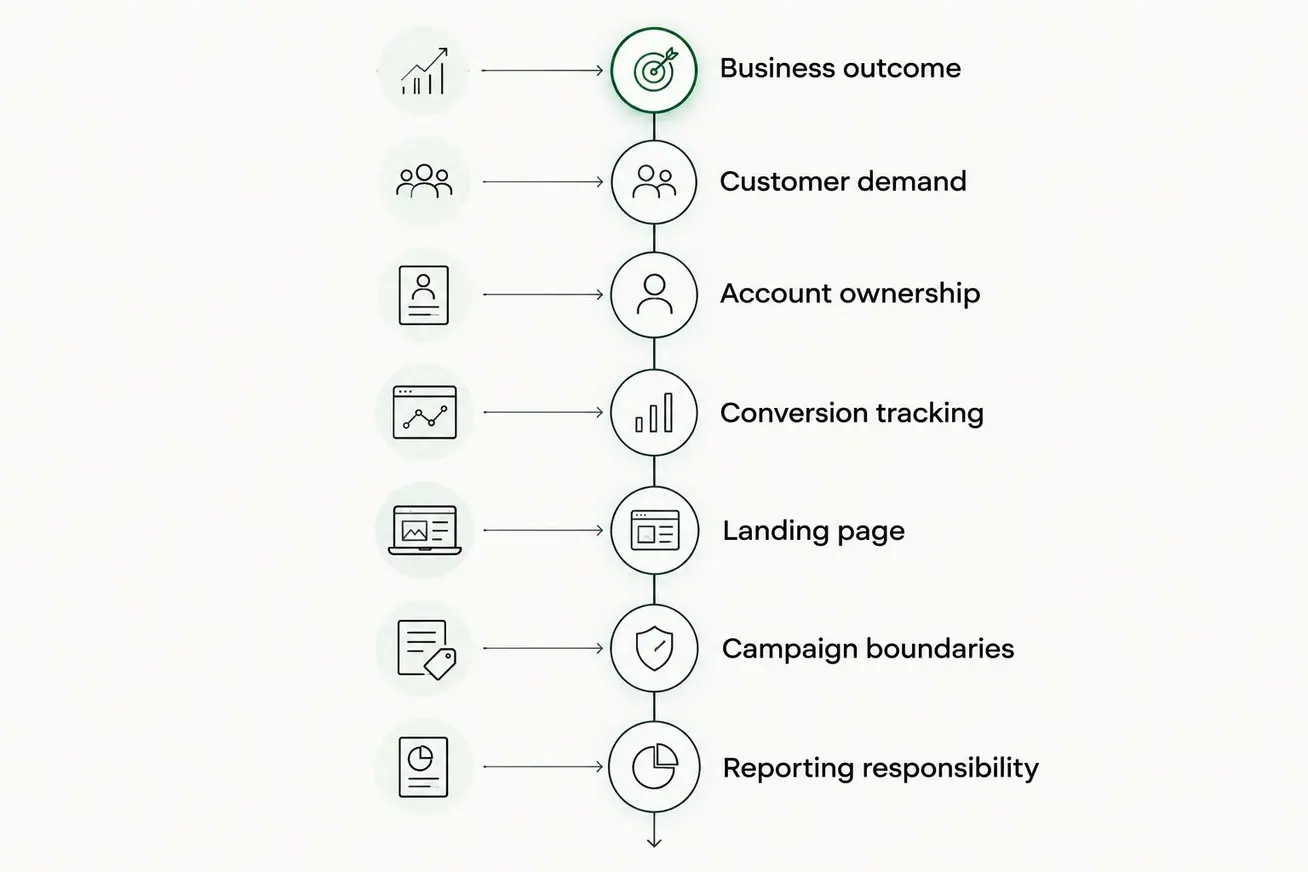
Approve the business outcome before approving the campaign settings.
Which checks change with the campaign type?
Different campaign types create different preparation work. Use this comparison to ask better questions, not to select a campaign before the agency understands your customers.
Search ads
- Best for: Matching relevant customer searches
- Useful role: Connects an ad with the service or product being searched for
- Limitation to check before launch: Ambiguous searches need careful targeting and search-term review
Shopping ads
- Best for: Retailers advertising individual products
- Useful role: Presents product information drawn from a product feed
- Limitation to check before launch: Incorrect product data can create a mismatch with the destination page
Remarketing
- Best for: Reaching eligible previous visitors
- Useful role: Keeps an offer in front of people who have already visited
- Limitation to check before launch: Requires suitable audience setup and a careful privacy review
For Search ads, inspect the connection between the search theme, ad wording and landing page. For Shopping ads, inspect product data and the path to purchase. For remarketing, inspect audience eligibility, exclusions and consent requirements.
The right campaign is the one your business can support and measure. Adding another campaign type does not fix unclear positioning, broken tracking or poor follow-up.
Why pre-launch requirements vary
There is no useful universal launch checklist that ignores how your business sells. These factors change the work your agency needs to complete:
- Sales process: An online purchase ends differently from an enquiry that needs a site visit, estimate or sales conversation.
- Customer fit: A construction business needs a definition of desirable work; an ecommerce business needs a definition of a commercially useful order.
- Service area: Local delivery and service boundaries affect targeting, ad wording and the destination page.
- Website readiness: A working checkout requires different testing from a quotation form or telephone enquiry.
- Existing account condition: An established account needs a review of history, permissions and measurement before changes are approved.
- Operational capacity: Your team needs to fulfil the orders or respond to the enquiries the campaign is intended to generate.
Make these differences explicit in the 2026 brief. The agency's recommendations should explain the connection between your situation and the proposed settings, rather than presenting the same launch plan to every business.
What should you approve before the agency switches ads on?
Approve a written launch record covering the business objective, campaign boundaries, destinations, measurement tests and responsibilities. It should be clear enough that someone outside the advertising platform can understand what is being bought and how success will be assessed.
Ask the agency to separate facts from assumptions. Existing sales records are evidence; an expected conversion rate in a forecast is an assumption. Projected returns and payback are estimates, not promises.
For a 2026 approval, ask these questions:
- What customer action are we trying to generate?
- What makes that action commercially valuable?
- What has been tested, and what remains unresolved?
- Who can authorise changes to spending or scope?
- What result would trigger a review of the plan?
Hold launch if the agency cannot show that the customer journey and measurement work. Document smaller unresolved items with an owner instead of hiding them in an email thread.
How should an agency connect strategy to launch?
Setsail Marketing is best for small and mid-sized businesses that want a documented strategy before Google Ads delivery. One in-house team plans and delivers the work, connecting research and channel priorities with execution.
The entry point is a free, 30-minute Growth Strategy call with no commitment. A subsequent paid Growth Strategy engagement is separate: it includes customer research, sourced market demand, a diagnosis of marketing gaps, channel priorities and projections with explicit assumptions.
That engagement includes a fixed 90-day plan with deliverables, timeline and price. You keep the strategy whether or not you continue, and the deposit is credited toward the project if you proceed.
The benefit is a documented basis for deciding what to do. The trade-off is that the researched strategy is a separate engagement, not something to confuse with the introductory call.
If that matches your situation, Book a Growth Strategy call. Bring your goals and challenges. We’ll bring the data.
Should I launch Google Ads before redesigning my website?
Launch only when the relevant customer journey works. You do not need to decide on a full redesign to identify a broken form, unclear service page or checkout problem that blocks the campaign.
Ask your agency to distinguish launch-blocking defects from broader website improvements. Fix the blockers first, then document the remaining work and its priority.
Can Google Ads tracking prove that my leads are good?
Tracking proves that a recorded action happened, not that the enquiry was suitable. Your sales team needs to record whether the prospect fits, progresses and buys.
Connect that feedback to campaign reporting. Otherwise, an increase in enquiries can conceal an increase in work your business does not want.
Who should own my Google Ads account?
Your business should retain administrative control of its Google Ads account. Give the agency the permissions needed to work, while preserving your ability to review access, retain history and change suppliers.
Record the ownership arrangement before launch. Waiting until an agency relationship ends makes an avoidable handover problem harder to resolve.
FAQ
What should a Google Ads agency check first?
A Google Ads agency should first establish the business outcome and define a useful enquiry or order. Those definitions guide targeting, landing pages and conversion tracking.
How do I know whether Google Ads conversion tracking works?
Complete a real test journey and check that the intended action is recorded correctly. Check for duplicate events and confirm that enquiries or orders reach the business systems your team uses.
Should my agency report clicks or sales?
Your agency should distinguish advertising activity from sales outcomes. Clicks help explain traffic, while qualified enquiries, orders and sales feedback show whether that traffic serves the business.
What should I ask before approving a Google Ads launch in 2026?
Before a 2026 launch, ask for evidence that targeting, destinations, measurement and follow-up responsibilities have been checked. Approve the business outcome and change permissions in writing.
Is the Setsail Marketing Growth Strategy call free?
The Setsail Marketing Growth Strategy call is free, lasts 30 minutes and carries no commitment. The subsequent paid Growth Strategy engagement is separate and includes a fixed 90-day plan.
Can a Google Ads agency guarantee profitable results?
Projected returns and payback are estimates, not guarantees. Ask the agency to state its assumptions and compare projected outcomes with actual business results.
One last thing
Before your 2026 launch, become your own customer. Follow the proposed ad destination, submit the enquiry or test the purchase journey, and check what happens next inside the business.
A correct tracking event cannot rescue an enquiry nobody receives. The final approval belongs to the whole customer journey, not just the advertising account.
Related guides
- How to compare Google Ads agency fees and advertising spend
- How to switch Google Ads agencies without losing your account
- What a construction marketing agency should count as a lead