TL;DR
- Google Ads CPC by marketing service varies by service, city and intent, so one national average misleads.
- Judge CPC by cost per booked lead: CPC divided by lead conversion rate.
- Pull your own 2026 CPC ranges from Google Keyword Planner, then compare against your account actuals.
- Skip any benchmark that does not state its source, period and geography.
Why this matters
CPC (cost per click) is what Google charges each time someone clicks your ad. It is a cost input, not a result. A $4 click that never calls is more expensive than a $40 click that books a project.
Marketing services are a hard category to benchmark. A buyer searching "emergency website fix" and a buyer searching "enterprise SEO agency" are different people with different budgets, and Google prices their clicks differently. Setsail starts every Google Ads plan by asking who is searching, what they are comparing and what a booked customer is worth, because the CPC only makes sense against that answer.
The short answer
Google Ads CPC by marketing service in 2026 depends on four things: how many advertisers bid on the term, how commercial the search is, your city, and your Quality Score. Services sold to high-value buyers cost more per click than services sold to one-off buyers. Broad terms cost less per click and convert worse than specific ones.
This page does not publish a single dollar figure per service. Public CPC averages differ by source, date, country and what the source counted as the category. Without all four, a number is not a benchmark. It is a guess.

The benchmark table: fill it from your own account
This is the structure to benchmark against. Fill the CPC column from Google Keyword Planner's forecast for your city, and the other columns from your own account history. Keep the same rows every quarter so you compare like with like.
SEO
- Typical searcher intent: Comparing providers, often with a budget set
- What pushes CPC up: Many agencies bidding on city plus service terms
- What pulls CPC down: Narrow niche terms, strong landing page match
- Record each month: CPC, leads, booked calls
PPC / Google Ads management
- Typical searcher intent: Active buyer, often already running ads
- What pushes CPC up: Competitor agencies bidding on brand and category terms
- What pulls CPC down: Specific terms such as an industry plus "ads management"
- Record each month: CPC, leads, booked calls
Web design
- Typical searcher intent: Project buyer, wide price range
- What pushes CPC up: Broad terms like "web design" in large metros
- What pulls CPC down: Platform or industry specific phrases
- Record each month: CPC, leads, booked calls
- Typical searcher intent: Often a tool search, not a service search
- What pushes CPC up: Software vendors bidding on the same words
- What pulls CPC down: Terms that include "agency" or "services"
- Record each month: CPC, leads, booked calls
- Typical searcher intent: Considered purchase, longer cycle
- What pushes CPC up: Competition from large studios on generic terms
- What pulls CPC down: Local plus project type terms
- Record each month: CPC, leads, booked calls
Video and photography
- Typical searcher intent: Project-based, local
- What pushes CPC up: Local studios bidding on city terms
- What pulls CPC down: Specific shoot types
- Record each month: CPC, leads, booked calls
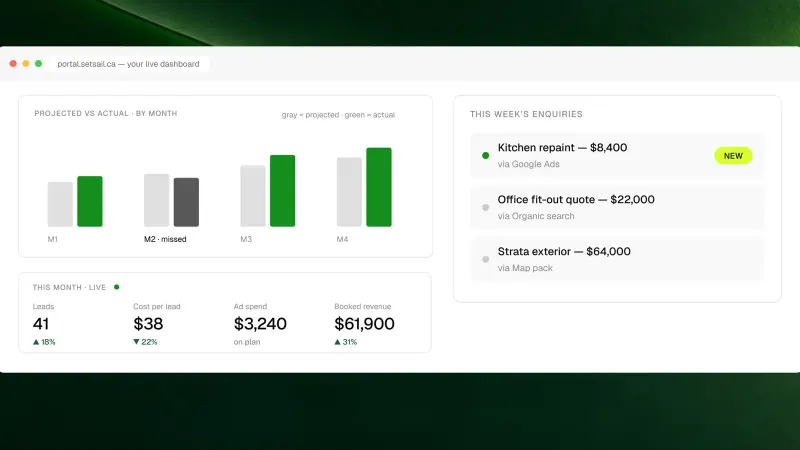
Treat the first four columns as hypotheses and the last as the proof. Setsail reports projected against actual results, including the misses, so a CPC you assumed in the plan gets checked against the CPC you paid.
Which services tend to cost more per click
The direction is predictable even when the dollar figure is not.
- Services where one client is worth a lot attract more bidders. A retained SEO or PPC client pays for months, so agencies can afford a higher CPC. Expect heavier auctions there.
- Services sold on tool comparisons pull in software vendors. Email marketing is the clearest case: a search for platforms is a different auction from a search for an agency.
- Generic head terms in big metros are the most contested. Vancouver, Toronto and other large markets see more bidders on the same words than smaller Canadian cities.
- Narrow, specific searches usually cost less per click and convert better, because the searcher already knows what they want.
That is a pattern, not a price list. Verify it against your own Keyword Planner data before you set a budget.

High and low: how to read your own table
Once the table is filled, sort it two ways. First by CPC, highest to lowest. Then by cost per booked lead, lowest to highest. The two orderings rarely match.
The service with the highest CPC is not automatically the worst. If its leads close at a higher rate or carry larger projects, it can have the lowest cost per customer. The service with the lowest CPC is often a broad term that fills the account with enquiries that never become work.
The sentence worth quoting: rank services by cost per booked lead, never by CPC alone.
Turn CPC into cost per lead
The formula is one line: cost per lead equals CPC divided by the share of clicks that become leads.
$5
- Click-to-lead rate (example): 10%
- Cost per lead: $50
$10
- Click-to-lead rate (example): 10%
- Cost per lead: $100
$10
- Click-to-lead rate (example): 5%
- Cost per lead: $200
$20
- Click-to-lead rate (example): 20%
- Cost per lead: $100
These four rows are arithmetic examples, not market benchmarks. They show why a $20 click can cost the same per lead as a $10 click when the page converts twice as well. Fix the landing page and message before you chase cheaper clicks.
Then carry it one step further: cost per lead divided by the share of leads that book into work gives cost per booked job. That is the number your owner or finance lead cares about. For trades and home services, Google Ads for home service businesses walks through this chain with the lead-quality checks that matter.

Methodology and limits
The table above is a framework built on how Google Ads auctions are priced: advertisers bid, Quality Score adjusts the price, and the click cost you see is the result. Keyword Planner forecasts are estimates for your location and settings, and they change as bidders enter and leave. Actual CPC in your account will differ.
The limitation to name plainly: no public source breaks CPC down by the exact marketing-service categories used here with a stated 2026 period and Canadian geography. That is why the CPC column is left for you to fill, rather than filled with figures that cannot be sourced.
How to use these benchmarks
- Pull a forecast per service in Keyword Planner, set to your actual city and match types. Write down the low and high range, plus the date you pulled it.
- Compare the forecast with your account actuals after 30 days of spend. A gap above the forecast usually means a weak match between ad, keyword and page.
- Set the target on cost per booked lead. Decide what a booked customer is worth, then work backwards to the CPC you can afford.
- Check the setup before blaming the market. Conversion tracking, negative keywords and location settings drive more wasted spend than the auction does. The pre-launch checklist for a Google Ads agency covers what to confirm first.
Agency fees versus ad spend
CPC is only the ad spend side. If you are paying an agency, the fee is separate, and the two get confused in reports. Keep them in separate lines so you can see what the clicks cost and what the management costs. How to compare Google Ads agency fees and advertising spend shows how to lay that out so quotes are comparable.
Tools can help with bid management and reporting, but they do not fix a weak offer. If you are weighing software, see PPC management tools for small business for the trade-offs.
Where Setsail fits
Setsail is the results marketing agency for Canadian and US businesses of all sizes, from owner-led companies to enterprises and public institutions. For paid search, the same team that builds the strategy runs the campaigns. We research how your buyers search, compare and choose, then set CPC targets from your numbers rather than an industry average. Projections carry stated assumptions, and returns and payback are estimates, not guarantees. See Setsail's marketing services for how paid advertising connects to SEO, websites and email.
Book a Growth Strategy call
Free, 30 minutes, no commitment. Bring your goals; we bring the data.
The call is free. If there is a fit, the next step is a paid, researched Growth Strategy that you keep whether or not you continue.
FAQ
What is the average Google Ads CPC for marketing services in 2026?
No single average holds up. CPC varies by service, city, match type and Quality Score. Pull a Keyword Planner forecast for your location and compare it with your own account data.
Which marketing service has the highest CPC?
Services sold to high-value, long-term clients tend to attract the most bidders, which pushes CPC up. Confirm it for your city in Keyword Planner rather than relying on a national figure.
Is a lower CPC always better?
No. A cheap click on a broad term can produce enquiries that never book. Judge CPC by cost per booked lead, not by click price.
How do I calculate cost per lead from CPC?
Divide your CPC by your click-to-lead conversion rate. A $10 CPC at a 5% rate gives a $200 cost per lead. That example is arithmetic, not a market benchmark.
How can I lower my Google Ads CPC?
Improve Quality Score by matching ads, keywords and landing page tightly, add negative keywords, and target specific terms over broad ones. Fix conversion tracking first so you optimise against real leads.
Where do I find accurate CPC data for my city?
Google Keyword Planner shows forecasts for your chosen location and match types. Your own Google Ads account shows what you actually paid. Use both and record the date.
Does Setsail guarantee a CPC or lead cost?
No. Setsail sets projections with stated assumptions, then reports projected against actual results, including shortfalls. Returns and payback are estimates, not promises.
One last thing
The most useful number on your 2026 Google Ads report is not the CPC. It is the gap between the cost per lead you projected and the cost per lead you got. Track that gap monthly and every CPC conversation becomes specific.