


Performance Marketing Funnel: How It Actually Works
Discover how the performance marketing funnel drives leads, including targeting, retargeting, attribution, and conversion optimization.

Jason Atakhanov
10 mins
August 4, 2026
If you’ve ever watched ad spend go up while pipeline stays flat, you’re not alone. Most teams don’t have a media problem; they have a performance marketing funnel problem. The path from first click to signed contract is full of leaks, blind spots, and “we’ll fix tracking later” decisions.
This guide breaks down how a performance focused funnel actually works in the real world from the first impression to repeat revenue. We’ll unpack the stages, the metrics that matter, and how full funnel performance marketing ties every campaign back to revenue, not vanity metrics.
By the end, you’ll know exactly what to ask of your team or agency when you say: “Show me how this turns into leads, sales, and ROI.”
TL;DR:
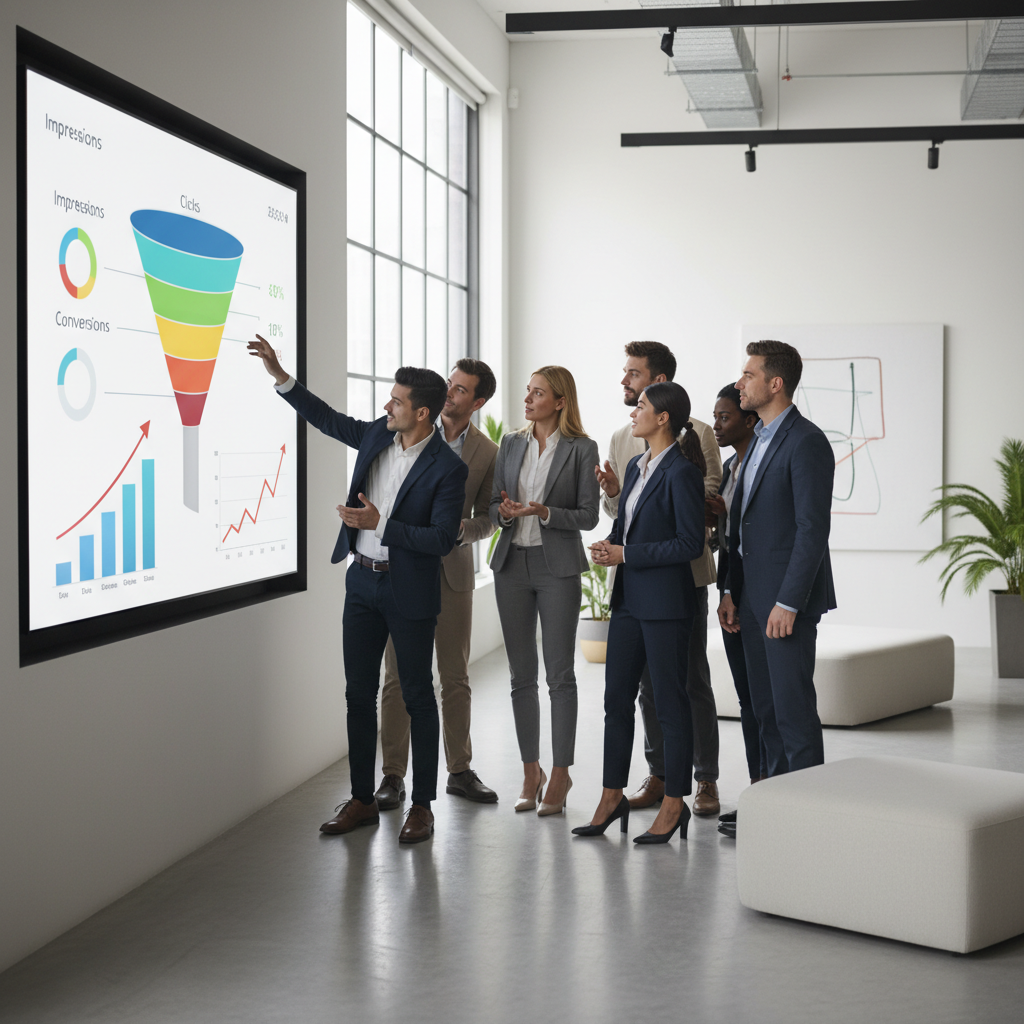
- Think of your funnel as the measurable path from first touch to long term revenue, not just a set of ad campaigns.
- Awareness → Consideration → Conversion → Retention are the core stages; each needs its own offers, messaging, and KPIs.
- Full funnel performance marketing means holding every stage accountable to real outcomes (leads, ROAS, LTV) instead of impressions alone.
- The best funnels combine research, creative testing, and analytics, then keep iterating which is how Setsail’s ROI Framework is built.
1. What is a performance marketing funnel?
A performance marketing funnel is the structured path that turns strangers into customers and, eventually, advocates with clear targets and metrics at every step.
Instead of running “some Google Ads and some social,” you design a sequence of touchpoints:
- People who have never heard of you see offers that build awareness and qualify the right audience.
- People who are actively researching see proof, comparisons, and deeper education.
- People who are ready to act see high intent offers and low friction conversion paths.
- Existing customers see upsell, cross sell, and retention campaigns.
On the back end, tracking ties those touchpoints to real numbers: leads, sales, customer lifetime value (CLV), and return on ad spend (ROAS). This is where many organizations lean on a partner agency like Setsail Marketing, especially if they need PPC, web, and analytics under one roof.
2. Why full funnel performance marketing wins
When teams say “we’re performance focused,” they often mean “we spend most of our budget on bottom of funnel search and retargeting.” Research from Google and Nielsen shows that brands using full funnel strategies (spending across awareness, consideration, and conversion) see up to 45% higher ROI than those focusing on a single stage. In other words: if you only fund the bottom of the funnel, you eventually starve future demand.
Complementary analysis in WARC’s Multiplier Effect report finds that brands over investing only in performance channels can see revenue returns fall by 20–50%, while shifting to a better balanced mix of brand and performance activity can lift ROI by 25–100%, with a median uplift around 90%.
Full funnel performance marketing fixes that by:
- Building demand with smart upper funnel video, display, and social.
- Catching in market prospects with search and high intent campaigns.
- Retaining and reactivating buyers with email, CRM, and remarketing.
Instead of asking one or two campaigns to carry the whole revenue target, you share the load across the entire journey.
“Full funnel performance means every stage shares responsibility for revenue, not just the last click.”
3. The four core funnel stages (and what to run in each)
A strong performance marketing funnel spreads your budget and creative across each stage, instead of betting everything on last click campaigns.
Stage 1: Awareness
Goal: reach the right people, at the right moment, with a message that actually lands.
- Channels: YouTube, Meta (Facebook/Instagram), TikTok, programmatic display, top of funnel SEO content.
- Creative: Brand story, problem/solution videos, short testimonials, “explainer” assets.
- Offers: Educational guides, blog posts, quizzes, light weight CTAs such as “Learn more.”
At this stage, you’re not pushing hard for the sale. You’re earning attention and beginning to qualify who is worth paying for later in the funnel.
Stage 2: Consideration
Goal: help interested prospects compare options and feel confident shortlisting you.
- Channels: Search ads with mid intent keywords, comparison and use case pages, email nurture, remarketing.
- Creative: Case studies, in depth blog content, feature breakdowns, FAQ style ads.
- Offers: Webinars, buyer guides, ROI calculators, “Talk to an expert” consultations.
Here, proof is everything. A Wunderkids ecommerce case study, for example, often does the heavy lifting: showing ROAS, revenue, and what changed after a campaign launched.
Stage 3: Conversion
Goal: remove friction and make the next step feel obvious.
- Channels: High intent search (“near me,” “pricing,” “book now”), direct response social, landing pages, live chat.
- Creative: Clear value proposition, social proof near the form, urgency driven by real constraints (deadlines, limited seats).
- Offers: Free consult, demo, quote request, booking, trial, or application.
This is where conversion focused websites and landing pages matter a lot. They connect your ads to a focused page with one main call to action, not a vague “learn more” that drops people on the homepage. For a deeper dive on the web side, see how to build a high converting website.
Stage 4: Retention & expansion
Goal: increase lifetime value, referrals, and long term ROI.
- Channels: Email, marketing automation, CRM remarketing, loyalty campaigns, retargeting based on product usage.
- Creative: How to content, upgrade offers, cross sell campaigns, “thank you” and milestone sequences.
- Offers: Renewal incentives, bundles, member only content, referral rewards.
For government, utilities, and public sector campaigns, this “retention” stage often looks like ongoing engagement and education, not a typical purchase but the funnel logic stays the same.
4. How to measure funnel performance marketing
A funnel only deserves the word “performance” if you can measure what’s happening at every layer. At minimum, you want:

The magic is in connecting these numbers. For example: when Setsail runs Marketing Lab experiments, we can see how a new awareness video improves branded search, which then boosts conversion rates on existing search campaigns. Frameworks like Google’s full funnel media measurement framework help teams link upper funnel lift, mid funnel engagement, and lower-funnel conversions in one view, rather than treating each channel separately.
Benchmarks can provide useful guardrails. Analyses like WordStream’s Google Ads benchmarks typically see average search conversion rates in the mid single digits and wide variation in cost per lead by industry, which is why building your own funnel benchmarks matters more than chasing generic “good” metrics.
For retention and CLV, resources like Qualtrics’ guide to calculating customer lifetime value walk through how to combine purchase frequency, average order value, and customer lifespan so you can judge acquisition costs and retention efforts against long term revenue, not just the first transaction.
5. Building your funnel step by step
If you’re starting from “we run some ads,” here’s a simple roadmap to a true funnel.
- Clarify who you want and what “success” means. Define your ICPs, regions, and decision makers, then set lead, revenue, and ROAS targets.
- Map your current journey. List each step from first touch to signed contract and note what prospects see, what you track, and where they drop.
- Audit your assets by stage. Sort current assets by funnel stage and identify gaps in awareness creative, proof content, or conversion pages; prioritize the weakest stage first.
- Wire tracking before scaling spend. Configure analytics, conversions, and offline revenue imports so platforms optimize toward real business outcomes.
- Launch controlled tests, not random experiments. Start with a focused mix (for example, Google Search + Meta prospecting + remarketing) and change one major variable at a time.
- Review, learn, and reallocate budget monthly. Shift budget toward campaigns and stages that lift end to end ROAS, using fixed timelines and deliverables to keep optimization cycles on track.
Many Setsail clients bundle this into a performance marketing package that covers strategy, tracking, creative, and ongoing management in a single engagement, rather than juggling multiple vendors.
6. Common mistakes that break funnels
- Only funding the bottom of the funnel.
Relying on “people already searching for us” works until competition increases and cost per click (CPC) spikes. - Sending all traffic to the homepage.
If your ads promise one specific outcome but your page talks about everything you do, conversion rates quietly fall. - Measuring success on clicks instead of revenue.
High CTR and low CPC look good in platform, but if lead quality is poor, you’re just paying for noise. - Ignoring post conversion experience.
Slow follow up, messy forms, or unclear next steps can erase the value of great campaigns in minutes. - No single owner for the full funnel.
One vendor runs search, another runs social, a third runs email and nobody is responsible for total pipeline.
The fix is simple but not always easy: one strategy, one measurement plan, and one accountable team.
“When one team owns the whole journey, you stop optimizing ads in isolation and start optimizing for revenue.”
7. Example: a real world full funnel campaign
For Pear Tree Camps, Setsail launched a 67 day full funnel summer campaign. It generated roughly $224K in revenue from $33K in ad spend about 6.8x ROAS and a 577% ROI. The Pear Tree Camps case study breaks down how prospecting, remarketing, and post purchase touchpoints moved parents from first impression to registration.

That same full funnel structure powers Setsail’s ecommerce and app work, including the Wunderkids ecommerce case study, where campaigns drive both acquisition and retention across channels.
8. How Setsail builds and runs funnels
Setsail’s ROI Framework Vision, Lab, Scale turns the roadmap above into a managed engagement that keeps every stage of your funnel accountable to revenue.
- Vision Mapping: Define audience, goals, and buying journey so the funnel reflects real decision makers.
- Marketing Lab: Rapid testing of creative, offers, and landing pages across channels like Google, Meta, and YouTube.
- Scale & Optimize: Shift more budget into proven stages while tracking ROAS, CLV, and pipeline quality.
As a Google Partner & B Corp, Setsail pairs this with enterprise grade tools, transparent reporting, and a focus on long term impact as well as short term wins.
To see how this could look for your organization, explore our performance marketing services or learn more about our full funnel approach, then hit “Get Started” to talk through your funnel.
9. FAQ: performance marketing funnels
What’s the difference between funnel performance marketing and “regular” campaigns?
Funnel performance marketing starts with the customer journey and builds campaigns for each stage, then measures outcomes across the whole path. “Regular” campaigns often chase isolated metrics (clicks, views) without a plan for what happens next.
How long does it take to see results from a new funnel?
Most organizations start to see clearer data and early wins within 30–60 days if tracking is set up properly. Bigger lifts in ROAS and pipeline quality usually show up over 3–6 months, as you test offers and optimize weak stages.
Do I need new creative for every funnel stage?
Not every asset has to be brand new, but you do need different angles. A 30 second story video might shine at awareness, while a short testimonial clip works better in remarketing, and a direct response graphic works best at conversion.
Is full funnel performance marketing only for ecommerce?
No. The same logic works for B2B services, education, government, utilities, and more. The “conversion” might be a lead, a registration, or a behaviour change instead of a purchase, but you still have the same stages and the same need for measurable impact.
Jason Atakhanov
August 4, 2026
Recent Posts:
A Complete Guide to Corporate Video Production: Strategy, Process & ROI
Learn how corporate video production works, from strategy, storyboarding to filming, plus how to measure real ROI for your business.
Video Production Process: Guide for Marketing Teams
A complete guide to the video production process from pre production strategy to post production delivery, so your marketing team can execute with confidence.

How Much Does Website Design Cost in 2026?
Discover how much does website design cost in 2026 and what businesses should expect to pay for professional website design services with impacts.