


The Website Development Process Explained (From Strategy to Launch)
Discover how the website development process works, including research, UX design, technical build, and post launch optimization for long term growth.

Jason Atakhanov
10 mins
August 4, 2026
If you’ve ever tried to plan a new site and felt stuck between “we just need something live” and “this has to drive real revenue,” you’re not alone. Many marketing leaders and founders know their website should work harder, but the website development process itself can feel fuzzy, full of jargon, and hard to tie back to pipeline.
At Setsail, we treat websites like performance engines, not online brochures. That means every stage from early research to post launch optimization links back to leads, sales, and measurable ROI. In this guide, we’ll walk through the exact stages we use with clients across ecommerce, professional services, and public sector so you can compare your current approach, spot gaps, and walk into your next project with a clear game plan.
TL;DR
- Your site should be planned like a product, with clear success metrics.
- A good website development process flow has four big phases: strategy, design & build, content & SEO, QA & launch.
- Ecommerce sites add complexity around product data, checkout, and performance, so they benefit from a specialized workflow.
- Fixed timelines and fixed deliverables keep projects on track and tied to business outcomes, not endless tweaks. website design services
What is the website development process?
The website development process is the structured set of stages a team follows to turn business goals into a live, measurable website. At a high level, it connects three things:
- Your goals (leads, sales, citizen engagement, self serve support)
- Your audience (what they need to see, understand, and do)
- Your platform (Shopify, Webflow, WordPress, or a custom build)
When the process is clear, you make decisions faster, control scope, and reduce painful rework later. When it’s vague, projects drift, budgets swell, and the site underperforms.
That’s why our web design and development services always start by agreeing on a shared roadmap, upfront. Working with a remote development partner can also streamline execution by giving you access to a dedicated team that aligns with your roadmap and accelerates delivery.
A simple website development process flow
Here’s the website development process flow we use as a base for most projects:
- Strategy & discovery – goals, audience, competitive and SEO research.
- Information architecture (IA) – sitemap, user flows, and key journeys.
- Wireframes – page structure and content priorities.
- Visual design – UI, components, and brand application.
- Development – build templates, components, and integrations.
- Content, SEO & tracking – on page copy, schema, analytics.
- QA, launch & optimization – testing, go live, and ongoing experiments.
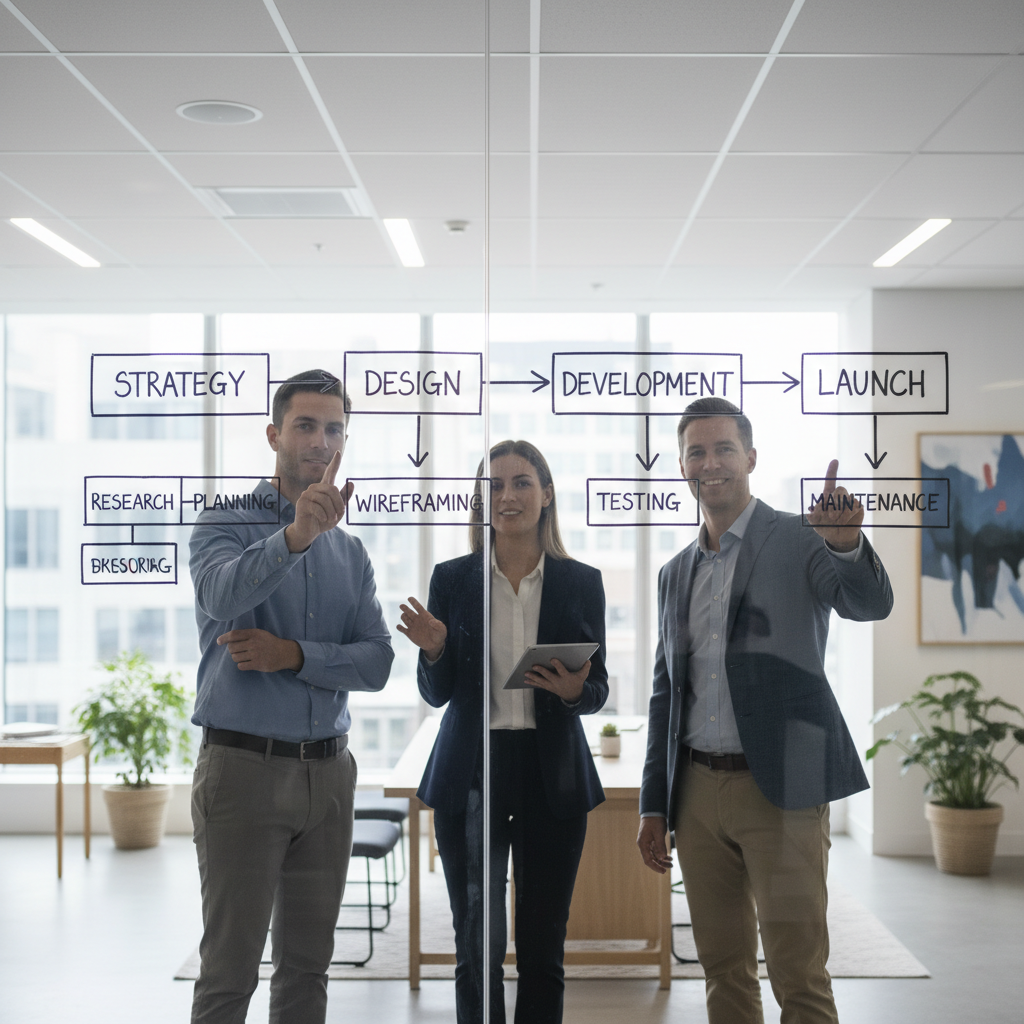
Different teams label these steps in different ways, but the core flow stays roughly the same whether you’re rebuilding a city’s public facing site or a Shopify store.
Phase 1: Strategy and discovery
Strategy is where strong websites are won or lost. Before a designer opens Figma or a developer touches code, the team should answer three questions:
- What business outcomes should the site move? (Leads, sales, sign ups, fewer support calls?)
- Who are the priority audiences and what are they trying to get done?
- What are we competing with both online and offline?
At Setsail, this sits inside our ROI Framework: Vision Mapping, Marketing Lab, and Scale & Optimize. In week one of a typical website project, we run market segmentation, SEO and analytics audits, and competitor reviews to anchor the build in real data, not guesswork. website development process
This is also the right time to choose your platform and tech stack, review existing content, and agree on success metrics such as form submissions, online orders, or cost per qualified lead.
If your website is a major revenue or citizen engagement channel, budgeting for this phase pays off many times over just ask the ecommerce and public sector teams in our web development portfolio. On our Owens Valley Career Development Center branding project, for example, stronger strategy and UX contributed to 85% higher community engagement and 65% more program participation after launch. OVCDC case study
Phase 2: Website design and development process
Once strategy is locked, the website design and development process turns that plan into a usable interface.
1. Information architecture & UX
Information architecture is the blueprint of your site: the sitemap, navigation, and key user flows (for example, “Home → Service page → Case study → Contact”). A clear IA helps users and search engines understand how your content fits together, and aligns with guidance from Google’s SEO Starter Guide on logical site structure. Google SEO guide
2. Wireframes & content priorities
Wireframes are low fidelity layouts that show where headlines, CTAs, forms, and visuals will sit. They answer questions like:
- What should a visitor see first on this page?
- Where do we handle common objections?
- What supporting proof (stats, testimonials, case studies) belongs here?
For government and utility clients, this might mean surfacing key services and self serve tools; for B2B and ecommerce brands, it might mean bringing proof and pricing closer to the top.
3. Visual design
Now the brand comes to life. External design teams or a specialized SOC2 compliant design agency can help create a UI system colors, typography, buttons, cards, and components that feels consistent across every template. Accessibility (contrast, type size, focus states) should be baked in from the start, not bolted on at the end.
Pull quote: Think of design as guiding decisions, not decorating pages.
4. Development & integrations
Developers translate approved designs into a working site. For most clients we build on platforms like Webflow, Shopify, or WordPress, depending on whether the primary goal is ecommerce, lead generation, or content publishing.
Typical tasks in this stage include:
- Building responsive templates and reusable components
- Connecting forms to CRMs and marketing automation
- Integrating payment gateways, search, or booking tools
- Setting up redirects and clean URLs
Performance should be a first‑class concern here. Tools like Google’s PageSpeed Insights help teams monitor Core Web Vitals such as Largest Contentful Paint (LCP) and Cumulative Layout Shift (CLS), which influence both user experience and search performance.
At Setsail, design and development run in parallel with tight feedback loops, which keeps projects moving within fixed timelines instead of stretching for months.
Phase 3: Content, SEO & analytics
Even the cleanest build can underperform if the content doesn’t answer real questions or show clear next steps.

On page SEO basics
Strong SEO foundations usually include:
- Search driven page titles and meta descriptions
- Clear H1 to H3 heading structures with natural use of target keywords
- Internal links that help users (and crawlers) move between related pages
- Descriptive, human readable URLs
These align closely with best practices in Google’s own documentation for site owners. Google SEO starter
Conversion focused copy
For each key page, copy should answer three things fast:
- Who is this for?
- What outcome does this page help them achieve?
- What step should they take next?
That might be booking a consultation, requesting a proposal, or starting an application. In our Steepe & Co. project, for example, the website and content were structured to support advisors through each step of their decision process, contributing to 150% more client leads and 45% more qualified consultations from their pipeline.
Analytics & tracking
Before launch, every primary action form submissions, file downloads, phone clicks, ecommerce conversions should be tracked in tools like Google Analytics and your ad platforms. This is what turns your site into a performance asset instead of a “pretty” line item.
Phase 4: QA, launch & ongoing optimization
A rigorous QA process, supported by software testing, protects your launch and your brand. It covers:
- Layout and functionality checks across modern browsers and devices
- Form, search, and checkout tests
- Accessibility checks (keyboard access, alt text, contrast)
- SEO checks (titles, metas, open graph tags, schema, redirects)
We also run performance checks using PageSpeed Insights and related tools to catch heavy scripts, uncompressed assets, or layout shifts that could hurt conversions. Core Web Vitals docs
Launch itself should be uneventful because the work has already been done in staging: DNS changes, SSL certificates, redirects, and backup plans are agreed in advance. After go live, we usually monitor closely for a few weeks, fix any small issues, and then move into an optimization rhythm A/B tests, UX improvements, and new content based on what the data shows.
How the ecommerce website development process differs
The core steps are the same, but the ecommerce website development process adds a few extra layers.

Product data & filters
For online stores, clean product data is everything: titles, variants, collections, filters, and search. In our ecommerce work with brands like ENVO Drive Systems and GVA Brands, a big portion of the project involved structuring products so customers could compare models, find compatible accessories, and order with confidence.
Checkout & trust
Ecommerce sites need extra attention on:
- Checkout friction (guest checkout, payment options, address lookup)
- Trust signals (reviews, guarantees, security badges)
- Post purchase flows (order confirmations, tracking, onboarding emails)
We often recommend Shopify for ecommerce because of its ecosystem, security model, and app integrations, then pair it with performance ad campaigns and email automation. Shopify ecommerce support
Performance at scale
High traffic stores feel performance issues quickly. Images, scripts, and third party apps all influence Core Web Vitals, which in turn influence rankings and revenue. Google’s documentation on PageSpeed and Core Web Vitals is a good reference point for technical teams here.
If you’re weighing a redesign for your store, our ecommerce marketing services combine this development workflow with SEO, Shopping ads, and lifecycle email so the store and the traffic strategy work as one system.
Timelines: how long does a website take to build?
Timelines depend on scope, decision speed, and how many stakeholders are involved, but some patterns hold:
- Lean marketing site (up to ~10 pages): ~6–8 weeks from strategy to launch.
- Larger B2B or public sector site: often 8–16 weeks, especially if there are complex approval layers.
- Full ecommerce build or replatform: 10–16+ weeks depending on catalog size and integrations.
Our own roadmap typically looks like week 1 for strategy, weeks 2 to 6 for design and development, and weeks 6 to 8 for launch and optimization, with clear milestones and fixed deliverables along the way.
If your past projects have dragged on, chances are the missing pieces were: a clear decision maker, tight scope, and a written process like the one above.
Choosing the right website development partner
Once you understand the process, it becomes much easier to evaluate agencies and freelancers. A strong partner will:
- Talk about leads and revenue, not only “fresh design”
- Show a repeatable process with specific milestones, not vague phases
- Share case studies with clear before and after metrics
- Offer fixed timelines and deliverables so you’re not signing up for an endless build fixed scope projects
At Setsail, our websites plug directly into the rest of your marketing: SEO, paid media, content, and automation all live under one roof in our Marketing Lab. That means the same team who designs your site can also test landing pages, iterate creatives, and optimize campaigns against ROI.
If you’re planning a new site or considering a redesign and want a process that connects every stage to real business outcomes you can get in touch for a practical conversation about scope, budget, and timelines.
Jason Atakhanov
August 4, 2026
Recent Posts:
A Complete Guide to Corporate Video Production: Strategy, Process & ROI
Learn how corporate video production works, from strategy, storyboarding to filming, plus how to measure real ROI for your business.
Video Production Process: Guide for Marketing Teams
A complete guide to the video production process from pre production strategy to post production delivery, so your marketing team can execute with confidence.
How Much Does Website Design Cost in 2026?
Discover how much does website design cost in 2026 and what businesses should expect to pay for professional website design services with impacts.