


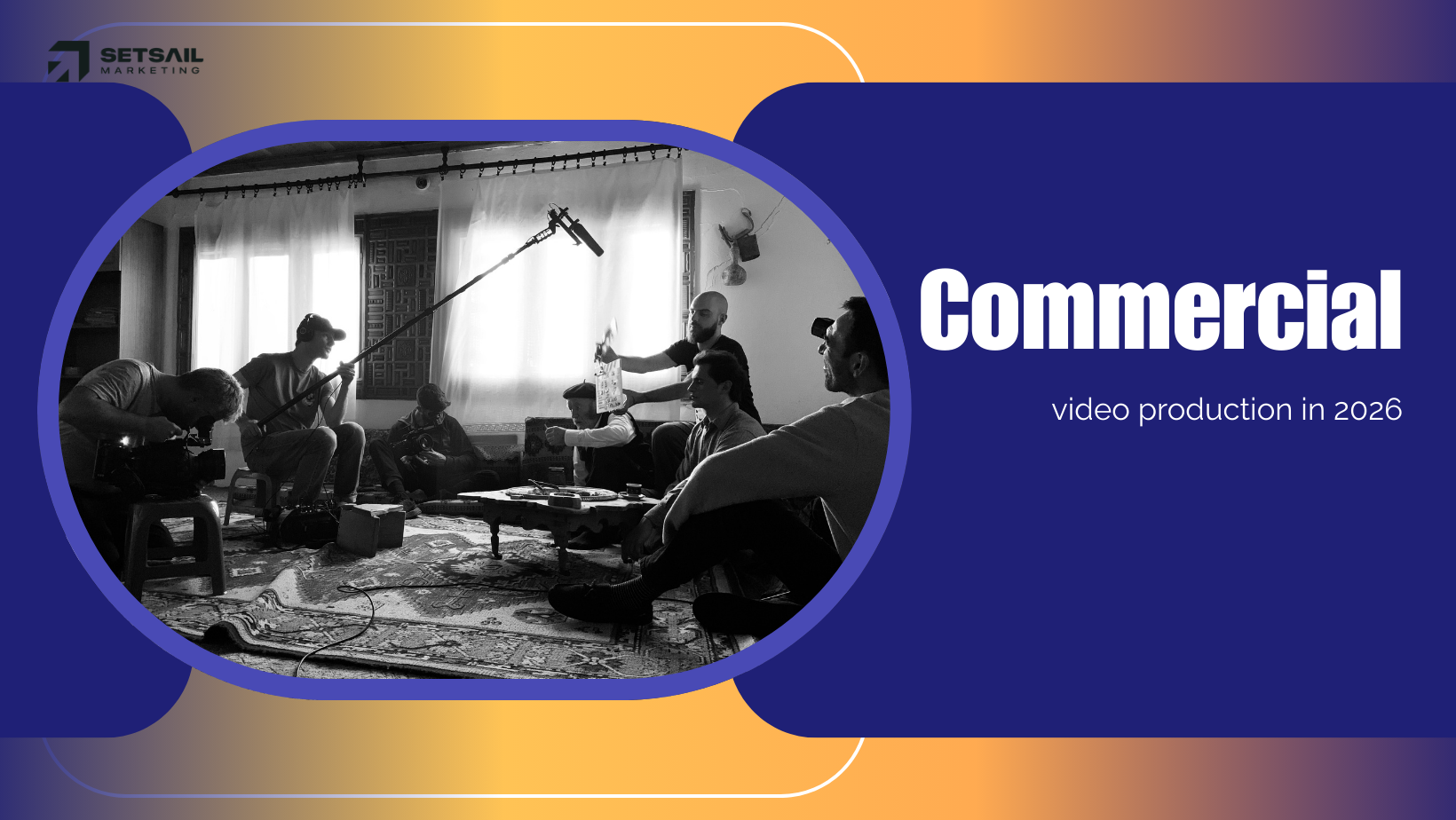
The importance of commercial video production in 2026
Learn why commercial video production is essential in 2026 for building trust, increasing conversions, and staying competitive in the digital world.

Jason Atakhanov
10 mins
July 20, 2026

TL;DR
- Video is still the fastest way to earn attention in crowded feeds and on connected TV.
- The win in 2026 isn’t just “making a nice spot”, it’s connecting creative, media, and measurement.
- Commercial video production services that sit inside a performance strategy give you real ROI, not just views.
- Municipalities, utilities, and growth stage brands can use modern video commercial production to drive signups, program participation, and sales and prove it.
Think back to the last ad that genuinely stuck with you. Chances are, it wasn’t a banner or a static image; it was a story in motion. That’s the power of commercial video production when it’s done with strategy, not just good cameras.
In 2026, leaders in government, utilities, and growth stage brands are under pressure to prove that every campaign moves the needle. Boards and councils aren’t asking, “Did people like the ad?” They’re asking, “Did it change behaviour, grow participation, or increase revenue?” That shift is exactly why commercial video production belongs at the centre of your marketing strategy, not off to the side as a “nice to have.”
Why video commercials still win attention in 2026
Video is now the language of the internet. From connected TV (CTV) spots during streaming to six-second preroll on YouTube, your audience is consuming stories at 30 frames per second all day long.

For municipalities and utilities, that might look like a short, clear CTV ad about a water conservation program. For an e-bike brand, it might be a 15 second vertical video showing what “Monday morning” looks like when you stop sitting in traffic.
The real value of commercial video production in 2026 isn’t views it’s the actions your audience takes after watching.
When your spots are planned alongside your media buying and PPC strategy, they do more than entertain. They hook the right people, at the right moment, with a clear next step.
What “commercial video production” means now
A decade ago, commercial video mostly meant a 30 second TV ad. In 2026, it covers an ecosystem of assets that all work together:
- CTV and over the top (OTT) spots for streaming platforms
- Preroll and in feed ads on YouTube, Meta, and TikTok
- Vertical, sound off videos built for mobile feeds
- Explainers or testimonials on your website and landing pages
- Short clips remarketing to warm audiences who already visited your site
Under the hood, commercial video production follows a few core stages:
1. Strategy and message
Who exactly are you speaking to? What behaviour are you trying to change? How will success be measured? This is where audience research, Vision Mapping, and campaign objectives come together.
2. Preproduction
Scripts, storyboards, casting, locations, production schedules, and asset lists. Decisions here decide how well your final videos fit every placement in your media plan.
3. Production
Shoot days, direction, lighting, and sound. This is where on screen talent and real environments bring your message to life. For public sector clients, it might also include filming in community spaces or transit hubs.

4. Post production and versioning
Editing, motion graphics, accessibility captions, colour, and audio mix. Then: recutting for 6s, 15s, and 30s versions, square vs vertical, and platform specific needs. This is where a single shoot turns into a whole library of assets.
5. Distribution and optimization
Launching the campaign across video platforms, then watching how each asset performs. Which hooks hold attention? Which CTAs drive actions? Integrated teams use those signals to fine tune both the media plan and creative.
If you want a deeper technical overview of placements, Google’s guide to video ad formats is a helpful reference.
How strong video spots drive measurable ROI
A good commercial doesn’t just look polished. It moves someone from “I’ve heard of this” to “I’ll act on this.”
From awareness to action
- Awareness and recall: Story, visuals, and sound make your message stick long after the ad ends.
- Consideration: Clear proof points, social proof, and benefits shift your audience from “maybe” to “this might be for me.”
- Conversion: Strong CTAs and landing pages tuned for video traffic turn attention into signups, applications, or purchases.
Linking video to performance metrics
Because video can run across YouTube, CTV, Meta, TikTok, and programmatic platforms, you can track:

- View through rate and completion rate
- Click through and post view conversions
- Cost per completed view and cost per acquisition
- Brand lift where studies are available
The magic happens when your production team works hand in hand with your SEO and search teams and media buyers. Messaging stays consistent, and every spot is built to help your whole funnel, not just a single campaign.
Key trends shaping video commercials in 2026
Short, vertical, and sound off by default
Most people now encounter your ad on a phone, often with the sound down. That means bold visuals, on-screen text, and captions are no longer optional extras.
Connected TV as “the new prime time”
CTV lets you pair TV level storytelling with digital level targeting. You can show different creative to families in a specific municipality versus young professionals in a downtown condo, all using the same core campaign story.
Accessibility and inclusivity
Captions, clear language, and representation in casting are now table stakes. For public sector campaigns in particular, accessible video builds both trust and reach.
Smarter use of AI
AI tools help with tasks like script drafts, shot list planning, and versioning, but they’re not a substitute for real creative direction. The teams getting the best results use AI to speed up production while keeping humans in charge of story and brand.
If you want to keep an eye on how marketers are using video overall, annual reports from sources like HubSpot’s marketing statistics are a useful benchmark.
What to look for in commercial video production services
Choosing a partner is where many campaigns are won or lost. A beautiful reel on its own doesn’t guarantee performance.
- Strategy first thinking: Do they start by clarifying audiences, behaviours, and KPIs or by pitching concepts right away?
- Integration with media and analytics: Are they collaborating with your media buyers and measurement teams, or handing over files and walking away?
- Experience with your sector: Public safety campaigns, B2B services, and DTC ecommerce all speak different “dialects.” Look for work in categories that look like yours.
- Multi format thinking: Can they plan a single shoot that feeds TV, CTV, YouTube, social, and your website?
- Transparent timelines and deliverables: Clear scopes, fixed timelines, and set deliverables make it easier to report back internally.
A quick way to sanity check a partner: ask how they’d connect your video to an existing email or automation program. If the answer stops at “We’ll send you an MP4,” you’re missing half the value.
In house team vs agency vs production studio
There’s no single “right” model, but each option comes with tradeoffs.
Many organizations land on a hybrid model: internal teams handle day to day content, while an integrated partner manages bigger campaigns and high stakes launches.
For a sense of how integrated campaigns can look in practice, you can explore case studies from multi channel campaigns on sites like Think with Google.
Budgeting for your next campaign
Budget talks often start with the wrong question: “How much does a video cost?” The better question is, “What level of business impact are we aiming for, and what’s a reasonable investment to get there?”
In 2026, most campaigns fall into a few buckets:
- Social first campaigns: Lean crews, short shoot days, and multiple vertical variations tuned for feeds.
- Integrated launch campaigns: Larger shoots that cover CTV, YouTube, and social, with multiple scripts and locations.
- Ongoing always on content: Quarterly shoots that refresh creative for evergreen programs like recruitment or ridership.
However you budget, keep production and media in the same conversation. A showpiece spot with no reach underperforms just as badly as a big media buy powered by weak creative.
At Setsail, we typically structure scopes with fixed timelines and fixed deliverables, so you can walk into internal approvals with clear expectations instead of rough guesses.
How Setsail connects video commercial production to performance marketing
Setsail’s inhouse studio sits inside a full performance marketing team. That means your video commercial production isn’t a side project it’s baked into your entire funnel.
- Vision Mapping: We clarify audiences, barriers, and desired behaviours before a single frame is shot.
- Marketing Lab: We plan multiple creative hypotheses into each shoot, then test them across platforms like YouTube, Meta, and CTV.
- Scale & Optimize: We keep what works, retire what doesn’t, and roll learnings into future campaigns and landing pages.
Because our campaign and creative teams ship together, you get a straight line from storyboard to ROAS, not a tangle of disconnected vendors.
Whether you’re promoting a public safety initiative or scaling a North American ecommerce brand, our goal is the same: video that your audience remembers, and numbers you can bring to your next quarterly report.
Questions to ask before your next shoot
Heading into planning mode? These prompts help sharpen your brief:
- What single behaviour change would make this campaign a success?
- Who exactly needs to see this? What do they care about right now?
- How will we measure results beyond views or impressions?
- Which channels (CTV, YouTube, social, web) will carry the heaviest load?
- What existing assets can we repurpose, and where do we need fresh footage?
- How will we keep creative and media teams working from the same playbook?
If you’d like a partner who can answer those questions with you and connect every frame to performance the Setsail team can help.
Get Started with commercial video production
Jason Atakhanov
July 20, 2026
Recent Posts:

How to Build a Social Media Marketing Team for Growth
A step by step guide on how to build a social media marketing team, including hiring priorities, content operations, and performance tracking that gives an actual growth.
A Complete Guide to Corporate Video Production: Strategy, Process & ROI
Learn how corporate video production works, from strategy, storyboarding to filming, plus how to measure real ROI for your business.
Video Production Process: Guide for Marketing Teams
A complete guide to the video production process from pre production strategy to post production delivery, so your marketing team can execute with confidence.