


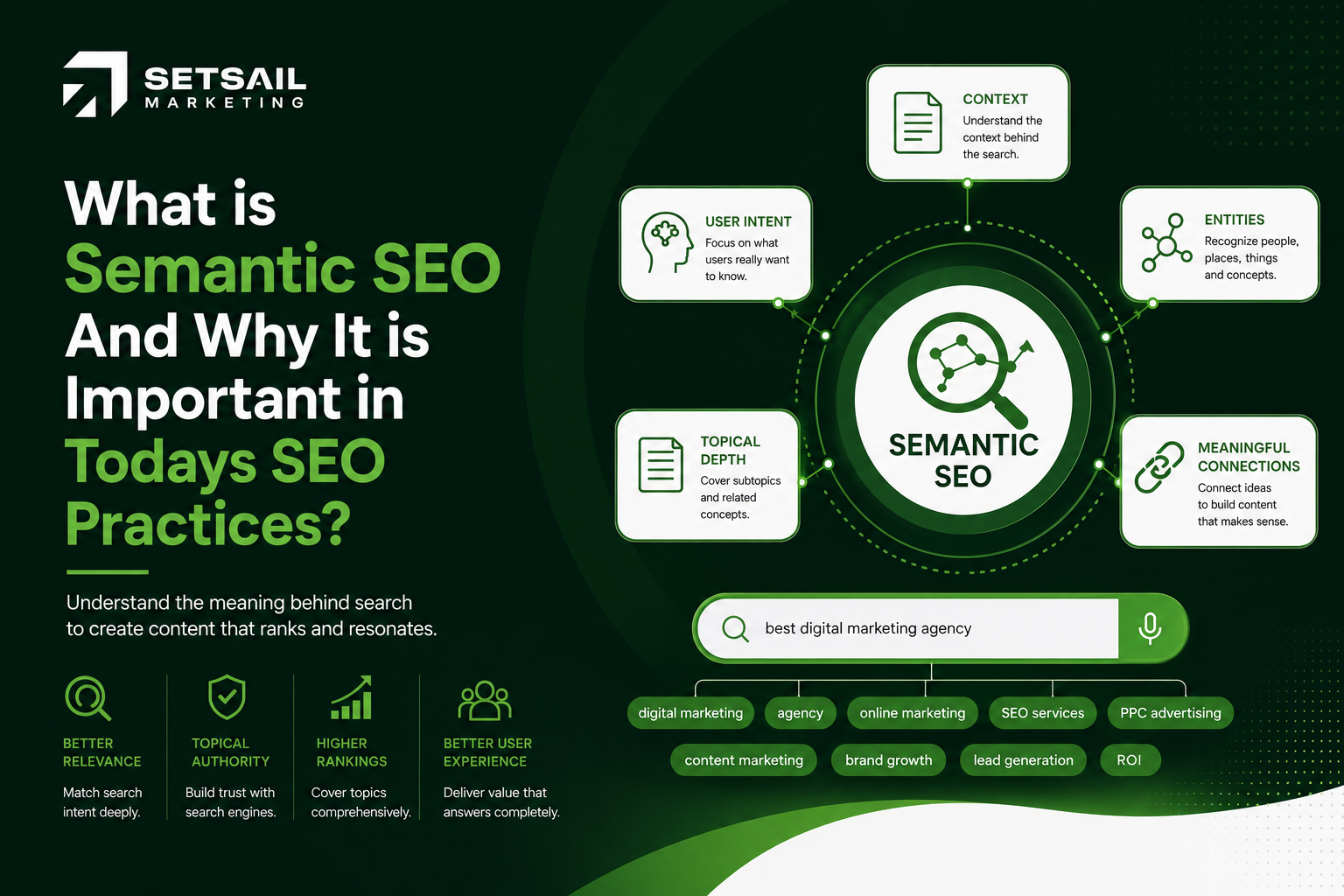
Semantic SEO: What It Is & Why It Matters in Today’s SEO Practices
Discover how semantic SEO helps websites rank better through topical authority, search intent optimization, and smarter content structure.

Jason Atakhanov
14 min
June 2, 2026
If you have noticed Google showing AI style summaries, “People also ask” boxes, and long conversational answers, you have already seen what semantic SEO is about. Search is no longer just matching strings of words; it is trying to understand the meaning behind every query so it can surface the most useful result.
For marketing leaders, that shift can feel messy at first. The upside is big, though: when your content is structured around topics, intent, and entities, you stop chasing single keywords and start building an asset that wins across hundreds of related searches and drives far better leads.

TL;DR
- Semantic SEO means writing and structuring content so search engines understand topics, intent, and entities, not just keywords.
- It combines high quality content, internal linking, and semantic markup (like schema.org) to unlock more long tail rankings and richer snippets.
- Done properly, it leads to higher quality organic traffic, stronger engagement, and more revenue producing conversions.
- You do not need an entire site rebuild; you can start with a few key pillar pages and build from there.
What is semantic SEO?
So what is semantic SEO, in plain language? It is an approach to search optimization where the main focus is meaning: what a page is about, which questions it answers, who it is for, and how all of that connects to the rest of your site.
Instead of treating “SEO Vancouver plumber”, “plumbing company in Vancouver”, and “emergency plumber near me” as three separate jobs, semantic SEO treats them as variations inside one topic cluster: plumbing services for local homeowners with urgent problems. Your site then uses clear content, headings, internal links, and structured data to spell that out for both people and search engines.
How search changed from keywords to topics
A decade ago, search engines were far more literal. Exact match keywords in titles, headings, and anchor text had outsized influence. That is why so many legacy sites still have thin service pages and awkward city landing pages.

Over the last decade, Google’s algorithm updates like RankBrain, BERT, and modern AI models changed the game. Today, Google looks at:
- Search intent — what the person is trying to do (research, compare, buy, troubleshoot).
- Entities — people, brands, places, and products mentioned on the page.
- Context — related pages, internal links, and external references.
- User signals — do visitors stick around, scroll, and convert, or bounce quickly?
When your content lines up with those signals, you stand a far better chance of showing up in organic results, featured snippets, and AI powered overviews.
Semantic SEO vs. traditional keyword SEO
The easiest way to see the difference is side by side.
When you shift from chasing single keywords to owning topics, organic search stops being a lottery ticket and starts behaving like a reliable channel.
How semantic SEO works in practice
Under the hood, semantic SEO combines three big building blocks: intent, entities, and structure.

1. Start with intent driven keyword research
You still begin with keyword research, but the lens changes. Instead of exporting thousands of rows and calling it a day, you group keywords by:
- Intent type (informational, commercial, transactional, navigational).
- Stage of the journey (problem aware, solution aware, ready to buy).
- Topic (e.g., “heat pumps”, “commercial leases”, “electric bikes”).
That gives you a clear map of which pages you need: a handful of pillar pages, plus supporting blog posts and FAQs that deepen coverage and link back to those pillars.
2. Think in entities, not just keywords
Entities are the “nouns” of your market brands, products, locations, services, audience segments. Semantic SEO treats each page as a collection of relationships between those entities. For example:
- [Brand] — offers — [Service]
- [Service] — solves — [Problem]
- [Service] — for — [Audience] in [Location]
When your copy, headings, and semantic markup reflect those relationships, search engines can connect your pages with a much wider set of relevant queries.
3. Use clear structure and internal links
Semantic SEO leans heavily on structure:
- Logical heading hierarchy (H1 > H2 > H3).
- Short, descriptive URLs and slugs.
- Internal links that connect related topics and pass context between them.
- Supporting assets like FAQs and glossaries that sit close to conversion pages.
If you already use topic clusters, this will sound familiar. If not, this content cluster guide is a helpful companion piece.
What is semantic markup in SEO?
Many teams hear phrases like semantic markup SEO or SEO semantic markup and think it is a separate strategy. In practice, semantic markup is the technical layer that supports everything above.
HTML semantics
First, your HTML should use meaningful tags, sometimes referred to as semantic HTML elements:
<header>,<main>,<footer>instead of generic<div>everywhere.- Heading tags that follow a clear outline, not used only for styling.
- Lists, tables, and definition lists where they help explain concepts.
Schema markup and structured data
Second, structured data gives search engines explicit clues about what sits on your page. Using JSON LD and schema.org vocabulary, you can describe products, services, reviews, FAQs, events, and more.
A simple FAQ schema block, for example, might look like this:
{"@context": "https://schema.org","@type": "FAQPage","mainEntity": [{"@type": "Question","name": "Do you offer emergency service?","acceptedAnswer": {"@type": "Answer","text": "Yes, we provide 24/7 emergency support across Metro Vancouver."}}]}
When combined with clear on page FAQs, this markup can help your answers surface directly in search results. Google’s own structured data documentation is the best reference for supported formats and guidelines.
Why semantic SEO matters for your business
All of this is interesting theory, but how does it connect to revenue?
- Better coverage with fewer pages. One strong pillar page + supporting content can rank for hundreds of long tail queries.
- Higher quality traffic. When you map topics to intent, visitors who arrive are more likely to be in the right stage of the journey.
- Stronger on site engagement. Clear internal links keep people exploring, which often leads to more form fills, calls, and booked demos.
- Richer search features. Schema powered FAQs, how to's, and reviews help you stand out even when competitors rank nearby.
- Future ready content. As AI powered overviews and chat style results expand, well structured, semantically rich pages give your brand a better chance to be pulled into those answers.
At Setsail, we see the best results when semantic SEO, technical fixes, and performance tracking live together, not in silos. That is why our SEO services connect content strategy, schema, and analytics from day one.
Step by step: implementing semantic SEO on your site
You do not need to rebuild everything at once. Here is a practical rollout plan we use with clients.

1. Pick one high value topic
Start with a topic that already drives revenue: “commercial solar installation,” “family law services,” “enterprise payroll software,” and so on. Pull current rankings, traffic, and conversions for that topic in your analytics tools.
2. Group your keywords by intent
Take your existing keyword research, plus fresh data from tools like Google Search Console, and group phrases into:
- Core service or product terms.
- Problem based queries (“how to,” “why is,” “best way to”).
- Comparison queries (“X vs Y,” “X pricing”).
- Local modifiers (“near me,” city names, neighbourhoods).
3. Create or upgrade your pillar page
Build one authoritative page that becomes the “hub” for that topic. It should explain what you do, who it is for, and why it matters, with sections that match the main intents you identified. Link from this page to deeper content on your blog, such as your advanced SEO guide or case studies.
4. Add supporting content and internal links
Turn recurring questions into supporting posts, videos, or FAQs. Each should:
- Answer one clear question in depth.
- Link back up to the pillar page with descriptive anchor text.
- Link sideways to other related resources where it helps the reader.
Over time, this creates a semantic network inside your site that mirrors how people actually think and search.
5. Layer on semantic markup
Finally, implement structured data where it makes sense: FAQ schema on Q&A sections, Product or Service schema on offering pages, Local business schema on your contact or locations pages. If your team needs a deeper technical reference, our website ROI guide pairs well with this article.
Common mistakes to steer clear of
- Thinking semantic SEO is just schema. Markup without strong content and internal links will not move the needle much.
- Creating new pages for every question. Most queries belong in a cluster; spreading them across dozens of thin posts weakens your authority.
- Ignoring UX and performance. A beautifully structured page that loads slowly or confuses visitors still loses conversions.
- Writing only for bots. Semantic SEO rewards clarity. If your copy reads like it was written just to impress an algorithm, users will bail and you send the wrong signal back to search engines.
How Setsail approaches semantic SEO
At Setsail, semantic SEO sits inside a larger ROI framework. We begin with Vision Mapping to understand what your best buyers care about, then use our Marketing Lab to test content, internal links, and schema changes against real metrics: qualified leads, booked meetings, and closed revenue.
If you want help turning your site into a topic based, conversion driven asset, our digital marketing services and dedicated SEO packages are built around fixed timelines, fixed deliverables, and transparent reporting.
Ready to see what semantic SEO could do for your organization? Explore the Setsail ROI Framework or reach out to our team to get started on a focused SEO roadmap.
FAQs
Is semantic SEO replacing traditional SEO?
Not really. Think of it as the evolution of on page SEO. You still need technical health, backlinks, and strong content; semantic SEO shapes how you plan and connect that content so search engines can interpret it properly.
Where does semantic markup fit into my SEO roadmap?
Treat semantic markup as a force multiplier. Once your pages answer real questions and have clear structure, schema markup helps those answers show up in richer ways: FAQs under your result, review stars, event dates, and more.
Can small teams realistically do this?
Yes. Start with one or two topics that matter most to your pipeline and build clusters around them. As those perform, reinvest into more topics. The key is consistency, not trying to overhaul hundreds of URLs in one quarter.
Jason Atakhanov
June 2, 2026
Recent Posts:

How Much Does Website Design Cost in 2026?
Discover how much does website design cost in 2026 and what businesses should expect to pay for professional website design services with impacts.

How to Build a Social Media Marketing Team for Growth
A step by step guide on how to build a social media marketing team, including hiring priorities, content operations, and performance tracking that gives an actual growth.
Podcast: How Do I Know If My Marketing Is Actually Working? (and How to Fix It)
Too many businesses invest heavily in digital marketing agencies, SEO services, PPC management services, and social media marketing companies—but don’t see the profit they expected. The problem? Most marketing agencies focus on vanity metrics instead of real business results. If your marketing agency can’t directly tie their work to increased leads, sales, or revenue, you’re working with the wrong partner.