


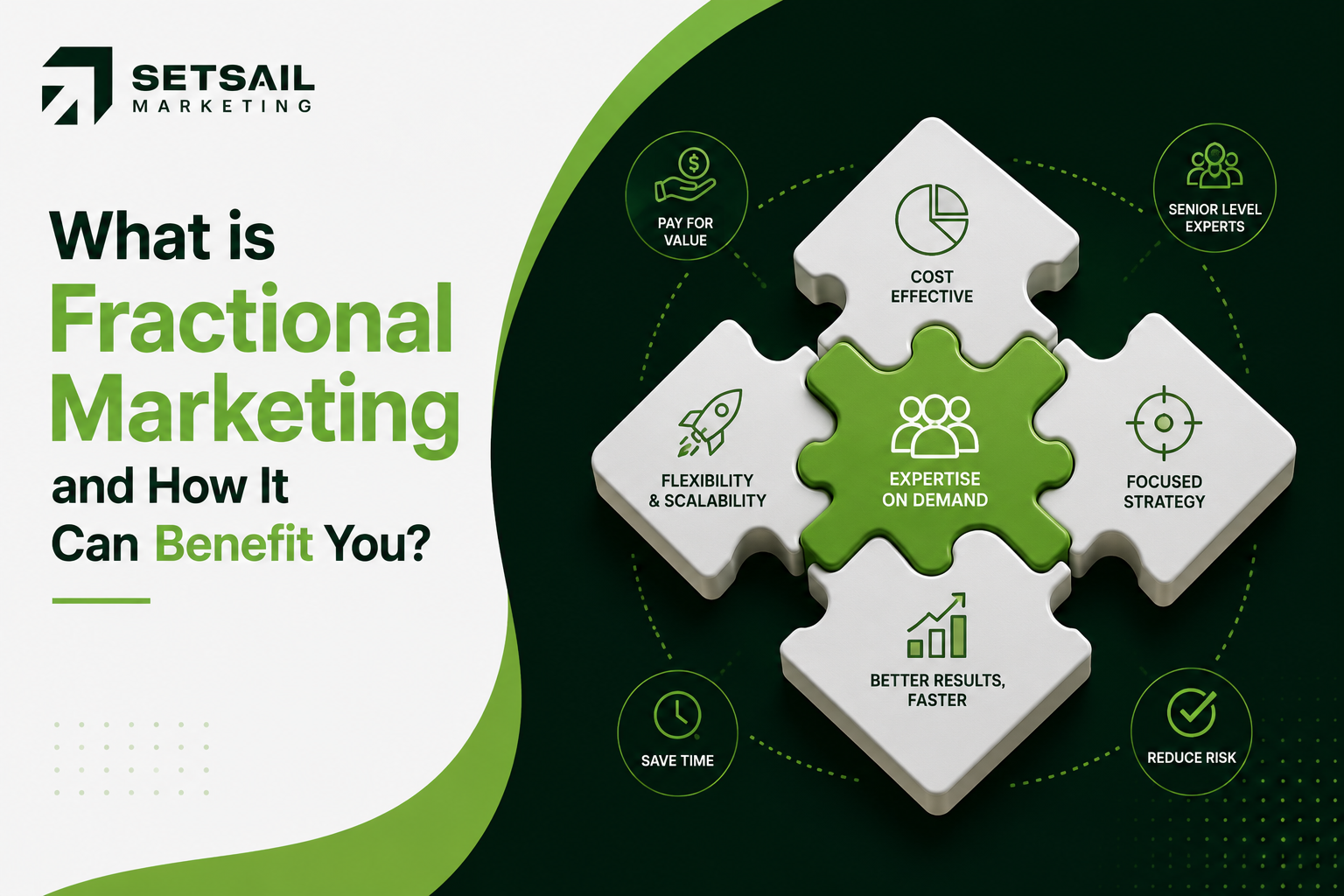
What is fractional marketing and how can it benefit you?
Explore the benefits of fractional marketing, including reduced costs, strategic guidance, and scalable business growth support.

Jason Atakhanov
12 min
August 4, 2026
You’re under pressure to show real marketing results, but your team is already stretched. Hiring a senior marketer full time is expensive, and traditional agency retainers can feel like a leap of faith. Somewhere between those two options sits fractional marketing: experienced marketers you share with other organizations, for only the portion of time and budget you actually need. In this guide, we’ll unpack how it works, what these teams really do day to day, and how organizations across Canada and the US are using this model to reach revenue targets with less guesswork.
TL;DR
- Fractional marketing means renting a senior marketing function (or full team) for a set number of hours or deliverables per month, instead of hiring full time.
- A fractional marketing team can include strategists, media buyers, creatives, web developers, and marketing automation specialists working as one unit.
- It fits best when you need experienced help now, but don’t have the budget or volume to justify several in house roles.
- Fractional marketing services should be tied to clear KPIs: pipeline, leads, customer acquisition cost, and revenue not just clicks or impressions.
What is fractional marketing?
At its core, fractional marketing is a way to access senior marketing talent and an integrated team fractionally for part of the week or month, instead of as full time staff. Rather than hiring a full in house department, you work with a partner that supplies strategy, execution, and reporting on a shared basis.
If you’ve heard of a “fractional CMO,” this is the same idea extended across the whole function. Instead of one senior leader parachuting in a few hours a week, you get a coordinated team that can plan campaigns, run paid media, manage SEO, ship landing pages, and report on revenue impact.
In other words, when people ask “What is fractional marketing?” the simplest answer is:
You share a high performing marketing department with other organizations, paying only for the slice you need with results measured against leads and sales.
How a fractional marketing team works in practice
Picture the calendar of your internal marketing lead. They’re fielding ad hoc requests, coordinating vendors, trying to keep an eye on analytics, and still expected to ship new campaigns. A fractional marketing team steps in as an extension of that person (or as the function itself) with clear responsibilities, standing meetings, and shared goals.
Typical roles in a fractional marketing team
- Marketing strategist / fractional CMO: owns the marketing plan, budget, and KPIs.
- Performance marketer: manages PPC, paid social, and other media buys.
- SEO and content specialist: builds search visibility and content that converts.
- Designer and developer: builds landing pages, website updates, and creative assets.
- Marketing automation / email specialist: manages nurture flows, segmentation, and CRM integrations.
- Analytics lead: sets up tracking, dashboards, and reporting.

How engagement usually works
Most fractional marketing services run on a fixed scope basis. For example:
- A 3–6 month engagement with a defined roadmap and deliverables.
- Weekly or biweekly working sessions with your internal lead.
- A shared dashboard or report that highlights KPIs such as cost per lead, revenue by channel, and ROAS.
- Clear boundaries on what is in scope each month, with room to test new ideas through a structured process.
This structure keeps your costs predictable while still giving you a multidisciplinary fractional marketing team that runs as one unit.
Fractional marketing vs. in house hires vs. agencies
When leaders start comparing options, the same three paths show up: build an in house team, hire a traditional agency, or work with a fractional partner. Here’s a side by side snapshot.
Industry groups like the American Marketing Association have pointed out how quickly marketing disciplines are multiplying. One person can’t realistically be a pro in paid media, SEO, analytics, creative, and automation all at once which is exactly where a fractional structure shines.
When fractional marketing makes sense (and when it doesn’t)
Fractional models are not a silver bullet for every organization. They work best in specific situations.
Good signals fractional marketing is a fit
- You have clear growth or engagement targets, but no complete plan to reach them.
- Your internal team is strong on subject matter expertise, but light on execution capacity.
- You need multiple skills (media buying, SEO, web, creative, automation) but can’t staff each role full time.
- You want accountability to revenue, not just impressions or vanity metrics.
- You’re open to structured experimentation testing creative, audiences, and landing pages in a controlled way.
When another model might serve you better
- You already have a well resourced in house department with channel experts.
- You need someone on site daily for internal change management or stakeholder politics.
- Your leadership team is not ready to share data or give access to the tools needed for meaningful testing.
If you’re not sure where you land, talking through your current stack and roadmap with a partner like Setsail can help you see whether a fractional approach is the right stage of growth for you now, or something to plan for later.
What fractional marketing services usually include
Because each organization is different, fractional engagements look a little different too. That said, most fractional marketing services fall into a few core buckets:
- Strategy & planning: market research, positioning, messaging, channel mix, and budget planning.
- Performance marketing: PPC and paid social campaigns, landing pages, and conversion tracking.
- Search & content: technical SEO, content strategy, on page optimization, and high intent content like case studies and service pages.
- Web and UX: website updates, conversion audits, and new page builds to support campaigns.
- Email & automation: segmentation, campaign flows, and marketing automation in platforms such as Klaviyo or HubSpot.
- Analytics and reporting: dashboards, attribution models, and regular performance reviews.
For example, at Setsail those pieces are anchored by our ROI Framework: Vision Mapping, Marketing Lab, and Scale & Optimize. That structure keeps both sides focused on the same outcome measurable growth.
If you want to see how this looks in the wild, have a look at some of our client case studies where multi channel campaigns run from one integrated team.
How to measure ROI from a fractional marketing team
The biggest upside of fractional marketing is also the biggest test: can your partner connect their work directly to outcomes your leadership team cares about?

Step 1: Define success in numbers, not tasks
Instead of “launch a campaign,” think “reduce cost per qualified lead by 20% in six months” or “increase online bookings from search by 30%.” Agree on 3–5 primary KPIs before work starts.
Step 2: Map KPIs to channels and tactics
Connect each KPI to specific levers. For example:
- Lower cost per lead → better targeting and creative in paid campaigns, plus stronger landing pages.
- Higher organic traffic with intent → improved technical SEO and content aligned to buyer questions.
- More revenue from existing audiences → better lifecycle email and remarketing sequences.
Step 3: Set baselines and tracking
Before the first ad goes live, confirm baselines: current traffic, conversion rates, revenue by channel, and funnel drop off points. Confirm analytics setup, pixels, and CRM connections so everyone is looking at the same truth.
Step 4: Review, test, repeat
Effective fractional teams work in cycles. Every month or quarter, they review performance, propose tests, and shift budget toward what is working. Over time, this turns scattered experiments into a repeatable growth engine.
Resources like HubSpot’s guides to marketing metrics can be useful reference points, but your partner should help you pick a short list that actually moves the needle for your organization.
What fractional marketing looks like with Setsail
At Setsail, a lot of our work with municipalities, utilities, and high growth brands already functions like an embedded, fractional marketing team even when clients first come to us for “just PPC” or “just SEO.”
Here’s how a typical engagement is structured:
- Vision Mapping (weeks 1–4): we run research, stakeholder interviews, and data audits to understand what truly drives your audience to act, and where you’re leaving revenue or engagement on the table.
- Marketing Lab (weeks 4–12): we launch focused experiments across channels such as Google Ads, Meta, search, and email. Every test has a hypothesis, a time frame, and a way to measure success.
- Scale & Optimize (months 3+): we double down on what works, refine what’s close, and sunset what isn’t earning its place in the plan.
Throughout, you work with a consistent team: strategist, performance marketer, creative, and data specialist. Pricing is based on fixed timelines and fixed deliverables, not endless hours.
If you’d like to see how this could apply to your organization, you can get started with a quick consult no long slide decks, just a clear sense of fit.
How to choose the right fractional marketing partner
Once you’re sold on the model, the next question is: who should you trust with it? Here’s a short checklist you can use in conversations with any potential partner (including us).
- Do they tie everything back to ROI? Ask how they measure success and which dashboards you’ll see regularly.
- Is the team cross functional? Look for strategy, media, creative, web, and analytics under one roof, not a loose collection of freelancers.
- Are timelines and deliverables defined? You should know what will be shipped in the first 30, 60, and 90 days.
- Do they understand your sector? Working with governments, utilities, or regulated industries is very different from direct to consumer ecommerce.
- Can they share relevant work? Case studies, references, or anonymized examples should align with your size and challenges.
- Do they respect your values? For impact driven and B Corp aligned organizations, ethics and transparency matter as much as performance.
As you evaluate partners, it can help to jot answers in a simple comparison sheet. A resource like the CMO Survey can also give context about what other marketing leaders are prioritizing this year.
Next steps: Is fractional marketing right for you?
If you’ve read this far, there’s a good chance you’re juggling growth targets, limited headcount, and a stack of half connected tools. Fractional marketing gives you another option: share a proven, multidisciplinary team that is accountable to the same KPIs your board or council cares about.
Quick self check
You’re likely ready for a fractional marketing team if you can say “yes” to at least three of these:
- We know who we want to reach, but we’re not consistently meeting them where they are.
- We have budget set aside but aren’t sure which channels deserve it.
- We struggle to turn analytics data into decisions.
- We move slowly because strategy, creative, web, and media buying sit in different places.
- We’re ready to commit to at least 3–6 months of structured testing and optimization.
FAQs
What is fractional marketing?
Fractional marketing is a business model where companies hire experienced marketing professionals or teams on a part time, contract, or flexible basis instead of employing full time staff. It allows businesses to access high level marketing expertise while reducing overhead costs.
How do fractional marketing teams improve ROI?
Fractional marketing teams improve ROI by focusing on high impact marketing activities, reducing unnecessary spending, improving campaign performance, and bringing specialized expertise without full time salary expenses.
What does a fractional content marketer do?
A fractional content marketer may handle content strategy, blog writing, SEO content optimization, editorial planning, email content, social media content, and performance analysis.
Jason Atakhanov
August 4, 2026
Recent Posts:

How to Build a Social Media Marketing Team for Growth
A step by step guide on how to build a social media marketing team, including hiring priorities, content operations, and performance tracking that gives an actual growth.

A Complete Guide to Corporate Video Production: Strategy, Process & ROI
Learn how corporate video production works, from strategy, storyboarding to filming, plus how to measure real ROI for your business.

Video Production Process: Guide for Marketing Teams
A complete guide to the video production process from pre production strategy to post production delivery, so your marketing team can execute with confidence.