


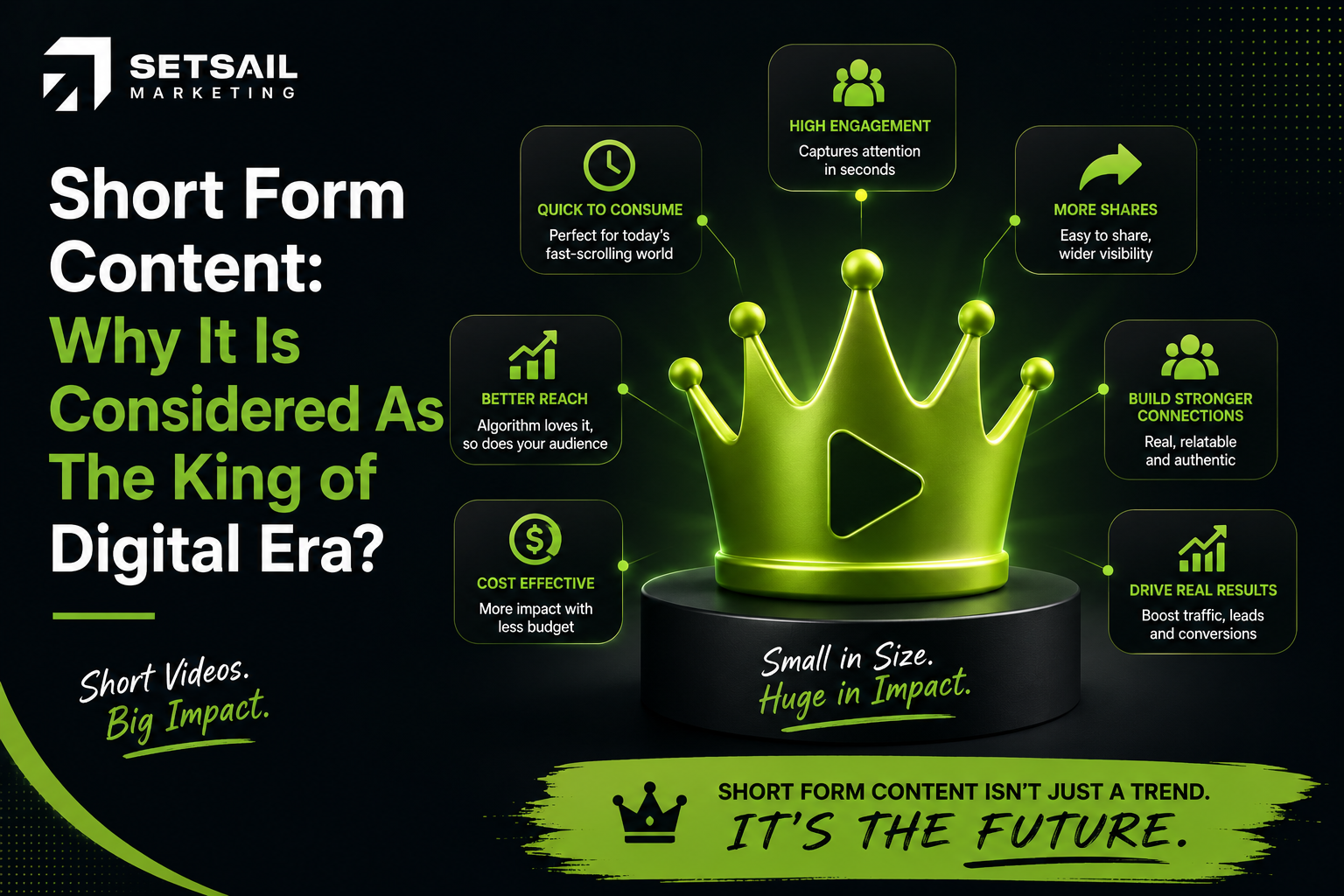
Short Form Content: Why It Is Considered As The King of Digital Era?
Understand how short form content became a powerful marketing tool for brands looking to connect with modern online audiences.

Jason Atakhanov
15 min
June 2, 2026
TL;DR
- Audience attention is short, but demand for helpful, entertaining content is high. That’s the perfect storm for short clips.
- Short form video content on TikTok, Instagram Reels, YouTube Shorts, and similar platforms is often the fastest way to earn awareness today.
- The goal isn’t “going viral”; it’s connecting each quick piece of content to measurable steps in your funnel.
- A simple Hook Value Cue framework helps your team create consistent, on brand short videos without guessing every week.
- Track more than views: look at completion rate, saves, shares, clicks, and assisted conversions across campaigns.
Your audience scrolls through social feeds faster than you can say “skip ad.” That’s why short form content has become the format brands lean on when they really need to earn attention. Marketing leaders know they should be posting Reels, TikToks, and Shorts, but many are still stuck staring at a blank content calendar.

If that’s you, you’re not alone. The question isn’t, “Should we be doing this?” It’s, “How do we do this in a way that actually drives signups, service requests, or sales?” This guide breaks down the strategy behind those quick clips, so you can treat them like a real performance channel, not just a creative side project.
What is short form content?
Let’s start with the basic question: what is short form content in a marketing context?
Short form usually means:
- Length: Under 60–90 seconds for video, or content that can be consumed in under 15 seconds for static posts.
- Format: Vertical video, quick carousels, story frames, GIFs, polls, and simple motion graphics.
- Channels: TikTok, Instagram Reels, YouTube Shorts, Facebook and Instagram Stories, LinkedIn feed posts, and Google’s Discover style surfaces.
In practice, “short” is less about an exact second count and more about content that can be watched, read, and understood before someone’s thumb reaches the next post.
How many seconds is “short” really?
Most platforms favour videos in the 15–45 second range for reach, especially when you’re speaking to cold audiences. That said, if your content holds attention, you can stretch beyond that. The real test is simple:
- Are people finishing the video?
- Are they interacting (likes, comments, DMs, clicks)?
- Does it lead them to a next step that matters for your organization?
At Setsail, we often use short clips to test different hooks quickly, then double down on the ones that deliver actual engagement and downstream results across paid social campaigns.
Where short content shines
Short clips are especially effective when:
- You need to explain one idea, benefit, or answer to a question.
- You’re speaking to people early in the journey who don’t yet know or trust you.
- You want to reinforce a bigger campaign message over weeks or months.
If you think of long form content as the full conversation, short form is the friendly hello that gets someone to stop and say, “Tell me more.”
Why short form rules the digital era
There’s a reason every platform is pushing vertical video and reels style formats: that’s where users spend their time. And platforms follow attention.
Mobile first behaviour
Your audience isn’t “going online” anymore; they’re always online. Commuting, waiting for a meeting to start, standing in a grocery line those are the micro-moments where short clips win. They load quickly, fit the screen, and don’t ask for a big time commitment.

Algorithms love short form video content
Short form video content makes it easier for algorithms to figure out what people enjoy:
- Completion rate gives a clear yes/no signal.
- Replays and saves show deeper interest.
- Sends and shares tell the platform, “More people like this.”
Guides from platforms like TikTok for Business and Meta’s Business Help Center both stress the role of short videos in reach and discovery. For marketers, that means your smartest ideas should exist in short form, not just in decks and long PDFs.
“If your best thinking never makes it into a 30 second clip, your audience may never see it.”
Done well, short content doesn’t replace your in depth assets or SEO content strategy. It amplifies them by seeding curiosity everywhere your audience spends their time.
How short form video content fits your funnel
Think of short videos as small, sharp tools that live at every stage of your funnel not just at the top.

Awareness: reaching people who don’t know you yet
At the top of the funnel, focus on:
- Relatable problems: “Struggling to keep up with permit applications?”
- Quick wins: One simple tip, stat, or myth bust.
- Human faces: Staff, customers, or residents real people, not just stock footage.
These clips should earn attention and positive sentiment. The next step might be a profile visit, a follow, or a click into your case studies.
Consideration: helping people decide
Once someone knows who you are, short videos can:
- Address common objections in 30 seconds each.
- Show real before/after scenarios (e.g., safer intersections, smoother signup flows).
- Highlight FAQs and bite sized walkthroughs.
This is where you link clips to deeper resources: detailed landing pages, webinars, or longer blog content that builds a full picture.
Conversion and retargeting
Short clips also work hard near the bottom of the funnel. Retargeting audiences who already visited your site or engaged with a previous ad with:
- Short testimonials.
- “How it works” breakdowns in 3–4 steps.
- Specific calls to action for quotes, demos, or service bookings.
This is where performance marketers see short form content become a reliable driver of leads and revenue when paired with clear tracking and segmented audiences.
Real examples: public sector, utilities, and brands
Short content isn’t just for consumer brands selling shoes and snacks. It works just as well for municipalities, utilities, and B2B teams when the strategy is clear.
Municipalities and utilities
- Public safety: 20 second clips on wildfire prep, water restrictions, or road closures.
- Program awareness: Quick resident stories explaining how they used a grant, subsidy, or new service.
- Myth busting: “No, your recycling doesn’t all go to landfill” explained in 30 seconds.
These can support larger public information campaigns and feed into performance media buys run with a partner like Setsail Marketing.
Ecommerce and local businesses
- Micro product demos (unboxing, “how it fits,” “how it works”).
- Staff favourites and curated bundles.
- Behind the scenes of production, delivery, or installation.
Short clips here should point to a clear action: add to cart, book a visit, or start an online order.
Professional services and B2B
B2B leaders sometimes think their services are “too boring” for Reels or TikTok. In reality, expertise is exactly what people want in their feeds.
- Turn your most common client questions into quick Q&A videos.
- Summarize one chart or insight from your latest report in 30 seconds.
- Share mini case stories: “Client came to us with X. Here’s the outcome.”
Short videos can also support your PPC and search campaigns when embedded on landing pages or used as YouTube Shorts extensions.
A simple framework for high performing short clips
Most teams don’t post consistently because every video feels like a brand new creative problem. A simple framework removes that friction.
At Setsail, we often lean on a Hook Value Cue (HVC) structure for short videos:
1. Hook (0–3 seconds)
This is the “stop scrolling” moment. Examples:
- “Most residents don’t know this about your water bill…”
- “If your cost per lead is climbing, watch this.”
- “Three things your permit page should never say.”
Use text on screen, a bold statement, or a surprising visual. The hook should speak directly to one audience and one problem.
2. Value (3–25 seconds)
Deliver something useful right away:
- A single tip.
- A mini walkthrough.
- A quick story with a clear lesson.
Think of this as the “part of the meeting where you share the good stuff,” not the teaser before the real content. If they never click through, they should still feel they got something worthwhile.
3. Cue (last 3–5 seconds)
The cue is your next step, such as:
- “Save this for later” or “Send this to your team.”
- “Comment ‘guide’ and we’ll send the full checklist.”
- “Head to the link in bio for the full breakdown.”
On campaigns we run through our ROI Framework, we test multiple hooks and cues around the same core value message, then scale what drives the best quality leads.
How to measure the ROI of short form content
Views feel good, but you don’t report “views” to your CFO or council. You report outcomes. Here’s how to connect the dots.
Metrics that actually matter
- View through rate (VTR) and completion rate: Are people staying with you?
- Engagement rate: Comments, saves, shares, and profile taps.
- Click through rate (CTR): From the video to a landing page or resource.
- Assisted conversions: Leads or transactions where the user engaged with a video at some point in their path.

Set up tracking links, custom UTMs, and clear goals inside your analytics stack so you can see how short clips influence campaign performance reports.
How often should you post short form video content?
There’s no magic number for every brand, but consistency beats intensity. Many accounts see progress posting several times per week rather than disappearing for a month and then dropping a content “batch.”
A simple starting point:
- Pick 2–3 content series (e.g., FAQs, myths, quick tips).
- Plan 1–2 videos per series each week.
- Review performance every two weeks and keep only what moves the needle.
Does short form content help SEO?
Indirectly, yes. While a 20 second clip won’t replace a strong landing page, it can:
- Improve on page engagement when embedded on key pages.
- Drive branded search demand when people start looking you up after seeing your videos.
- Earn links and mentions when your clips are referenced in other content.
Pairing consistent short content with a solid SEO program creates a flywheel: discover via social, research via search, convert via on site experiences.
For deeper reading, guides from sources like HubSpot and Sprout Social outline how short video and search behaviour work together.
Common mistakes (and quick fixes)
Short videos are simple, but they’re not easy. Here are patterns we see when auditing content for new clients.
1. Posting without a clear outcome
If a clip doesn’t have a job awareness, education, nurture, or conversion it becomes noise. Fix this by assigning each series to a stage of the funnel and matching your calls to action.
2. Saying too much in one video
Trying to cram five tips into 20 seconds leaves everyone confused. Instead, give each tip its own video and connect them as a playlist or series. More content, more clarity.
3. Inconsistent branding and weak audio
Low production is fine. Low clarity is not. Aim for:
- Clean audio (use a simple mic or quiet room).
- Consistent on screen text styles.
- Logos and URLs that are present but not overpowering.
4. No testing or iteration
Posting once a week and hoping for a hit is a slow way to learn. Instead, test:
- Different hooks for the same message.
- Length variations (15 vs. 45 seconds).
- Alternate calls to action.
This is exactly the type of work that fits inside a structured Marketing Lab approach like the one we run at Setsail: quick experiments, clear reporting, and scale up of the winners.
What to do next
If your team has been treating short videos as “extra credit,” this is your sign to bring them into your core plan.
- Clarify your audience and the 3–5 questions they ask most often.
- Map those questions to a simple HVC script for each series.
- Commit to a test period (e.g., 8–12 weeks) with consistent posting and real measurement.
If you’d like help tying all of this to a full funnel strategy across paid, organic, web, and automation the team at Setsail can step in with fixed timelines, fixed deliverables, and clear ROI targets. Get started and we’ll walk you through what that could look like for your organization.
FAQs
What is short form content?
Short form content refers to quick, engaging digital content designed to deliver information or entertainment in a short amount of time. It commonly includes videos, social media posts, reels, shorts, stories, and bite sized graphics.
Why is short form content so addictive?
Short form content can reduce attention spans over time because users become accustomed to consuming rapid, highly stimulating information.
How long should short form videos be?
Most high performing short form videos are between 15 and 60 seconds, depending on the platform and content type.
How do you make short form content?
To make short form content, start with a strong hook, keep the message concise, use engaging visuals, add captions, include trending sounds if relevant, and end with a clear call to action.
What type of short form content performs best?
Educational tips, storytelling, tutorials, relatable humor, product demonstrations, before and after transformations, and trend based videos often perform well.
Jason Atakhanov
June 2, 2026
Recent Posts:

How to Build a Social Media Marketing Team for Growth
A step by step guide on how to build a social media marketing team, including hiring priorities, content operations, and performance tracking that gives an actual growth.
A Complete Guide to Corporate Video Production: Strategy, Process & ROI
Learn how corporate video production works, from strategy, storyboarding to filming, plus how to measure real ROI for your business.
Video Production Process: Guide for Marketing Teams
A complete guide to the video production process from pre production strategy to post production delivery, so your marketing team can execute with confidence.