


A Guide on How to Design A Brand Identity
A guide on how to design a brand identity, covering strategy, logo development, typography, color systems, and brand guidelines for lasting impact.

Jason Atakhanov
8 mins
September 1, 2026
Brand refresh projects have a way of landing on your desk at the busiest possible moment. One day you’re approving campaign creative; the next, someone is asking, “Can we get a new logo by next month?” In the middle sit your team, your stakeholders, and a lot of opinions about colors, fonts, and taglines. A clear brand identity turns all that noise into a shared reference point: what your organization stands for, how it shows up, and how it should feel at every touchpoint. This guide walks through a practical process you can use with your team.

TL;DR: what you’ll learn
- What brand identity is (and how it differs from “brand” and “branding”).
- The core building blocks: strategy, visuals, voice, and real world applications.
- A 7 step process for how to design a brand identity your stakeholders can agree on.
- Brand identity examples for public sector and private organizations.
- A checklist you can copy into your project plan or brief to your agency.
What is brand identity?
Think of your organization as a person. Your brand is the gut feeling people have about you. Branding is the work you do to shape that feeling. Brand identity is the set of visual and verbal cues that help people recognize you quickly and feel that same way every time they interact with you.
A complete identity usually includes:
- Name and logo system (primary, secondary, and icon versions).
- Color palette and typography.
- Imagery style, iconography, and layout rules.
- Brand voice, messaging pillars, and key phrases.
- Guidelines for how all of this shows up on your website, signage, social, and campaigns.
When those pieces line up, people can spot you in a feed, on a bus shelter, or in their inbox and think, “I know who that is” before they even read the headline.
Why brand identity matters for performance and ROI
Strong identity work is not just a design exercise; it’s an efficiency and performance lever. Consistent, recognizable creative lifts click through rates, lowers cost per acquisition, and makes every media dollar work harder, because people spend less time figuring out who you are and more time deciding what to do next. If you look at strong brand examples, they preserve their unique tone of voice and style even when doing real time marketing or joking on social media. This makes them even more recognizable in the long run because nothing about their brands feels random.
On the inside, a shared identity:
- Reduces back and forth on creative approvals.
- Aligns departments that all touch your audience (communications, marketing, HR, operations).
- Makes it easier to brief partners, agencies, and vendors.
On the outside, it supports long term growth: consistent presentation builds familiarity and trust, which in turn improves the performance of everything from PPC campaigns to email nurture flows.
At Setsail, we connect identity work to our ROI Framework, so the story you tell and the way you look link directly to measurable outcomes like leads, online sales, and bookings. Learn how in our ROI Framework.
Core components of a strong brand identity
1. Brand foundation
Before anyone opens a design file, you need a clear foundation:
- Purpose and mission: why you exist.
- Vision: what future you’re working toward.
- Values: how you behave along the way.
- Audience segments and key needs.
- Positioning and value proposition: why choose you over alternatives.
2. Visual identity
Visual identity is the shorthand people see first. It includes:
- Logo system and clear rules for how to use it.
- Primary and secondary color palettes.
- Heading and body fonts, plus web safe backups.
- Photography and illustration style.
- Iconography and layout grids.

If your website is due for a refresh along with your identity, it helps to think about those two together. A new look lands much better on a site that’s built to convert. See our web design and development services for examples of how we connect identity and UX.
3. Verbal identity
Verbal identity is how you sound on the page, on stage, and in someone’s inbox. It covers:
- Brand voice attributes (for example: plain spoken, optimistic, pragmatic).
- Messaging pillars that anchor your stories.
- Taglines, elevator pitches, and boilerplate.
- Writing guidelines (jargon to skip, words you use often, tone by channel).
4. Brand experience and applications
Finally, identity has to live somewhere: your site, social channels, paid ads, vehicles, uniforms, forms, and slide decks. The more channels you have, the more valuable a clear identity becomes, because it keeps everything coherent even as campaigns and teams change.
How to design a brand identity in 7 steps
Whether you’re a municipality, a utility, or a high growth brand, the steps are surprisingly similar. Here’s a process we use with clients and that you can adapt for your own team.

Step 1: Align on goals, scope, and decision makers
Start with a short working session that includes the people who will approve the work. Clarify:
- Why you’re updating (or creating) your identity now.
- Which touchpoints are in scope for phase one.
- Who gives feedback, and who makes the final call.
- What success looks like 6 to 12 months after launch.
Document this in a one page brief. It will save you from “surprise feedback” later.
Step 2: Do focused research
You don’t need a year long study, but you do need real input. Look at:
- Audience: interviews, surveys, or even a quick call with front line staff.
- Current materials: where you already look and sound consistent, and where you don’t.
- Category: how peers and competitors present themselves, and where there’s white space.
If you like structured exercises, HubSpot offers a free brand identity worksheet and style guide template you can adapt to your own organization.
Step 3: Define your brand strategy
Turn your research into clear decisions:
- A concise positioning statement (“For [audience], we are the [category] that [key benefit] because [proof].”).
- Three to five messaging pillars that support that positioning.
- A short list of personality traits that describe how you should come across.
This is the filter your creative team will use to check every visual and every line of copy.
Step 4: Explore visual identity concepts
With strategy in hand, a designer or agency can start exploring directions. Most teams review two or three routes that all fit the brief but express it differently (for example: more civic and formal vs. more human and conversational).
Each concept should show the logo in context (on a website header, social tile, or sign), not just floating on a blank page. That context helps non designers react to how the system behaves in the real world, not just whether they like a shape.
For more visual inspiration and reference points, HubSpot’s brand identity examples can be a useful starting gallery when you need to show stakeholders what “good” looks like.
Step 5: Shape your verbal identity
While visuals are in progress, define how you speak:
- Choose three to five voice attributes and describe what they do (and don’t) mean in practice.
- Write sample headlines, social posts, and email intros in that voice.
- Decide how formal you are, how you handle inclusive language, and how you explain technical topics.
This protects you from the “personality swap” that can happen when one writer leaves and another steps in.
Step 6: Test with real people and refine
Before you lock everything in, show your concepts to a small group of real users or community members. Ask:
- What three words come to mind when you see this?
- Who do you think this organization is for?
- Does anything feel confusing, dated, or off-brand for what you already know about us?
You’re looking for patterns, not votes. Use that feedback to sharpen the identity so it reflects how you want to be seen and still feels authentic to your audience.
Step 7: Document, launch, and measure
Finally, capture everything in a clear set of guidelines. This doesn’t have to be a 120 page manual. A focused deck that covers foundations, visual rules, voice, and key examples is a strong start, especially for small teams.
Plan your rollout in phases: update your website, top performing campaigns, social animated avatars, and main templates first. Then work through lower priority assets over time. Track metrics like brand search volume, ad performance, and engagement to see how the new identity supports your broader marketing goals.
If you’d like a partner for this stage, our brand design services combine research, creative, and implementation under one roof so that what’s in your deck actually shows up in your campaigns.
Brand identity examples you can learn from
You’ve probably seen plenty of polished brand identity examples from global names like Coca Cola or Nike. Those are useful for inspiration, but it also helps to picture scenarios closer to home.
Example 1: A regional transit authority
Challenge: unify a mix of old signage, digital tools, and campaign materials into something residents can trust instantly.
Identity approach:
- High contrast colors and large type to support accessibility.
- Simple, universally understandable iconography for routes and modes.
- Plain language copy that keeps instructions short and friendly.
Example 2: An e‑bike ecommerce brand
Challenge: stand out from low cost imports and highlight safety and service.
Identity approach:
- Confident color palette and distinctive frame graphics that read well in motion.
- Photography that shows real riders in familiar streets, not just studio shots.
- Messaging that balances joy (“more rides, more often”) with practical proof (warranty, local service, certified batteries).
Example 3: A professional services firm
Challenge: move away from generic blue and grey while still feeling trustworthy.
Identity approach:
- Clean typography with one primary typeface across all materials.
- Warm, natural photography of the actual team instead of stock models.
- Jargon light copy that explains outcomes in everyday language.
None of these examples rely on wild visuals. They work because the identity is rooted in real audience needs and then applied consistently across channels. For more real world work, explore our branding case studies.
Practical brand identity checklist
Copy, adapt, or paste this into your project plan:

Foundation
- Clear problem statement and goals for the identity work.
- Documented audience segments and key needs.
- Positioning statement and three to five messaging pillars.
Visual identity
- Primary and secondary logo files (with clear usage rules).
- Color palette with HEX, RGB, and CMYK values.
- Heading and body fonts, plus guidance for digital and print.
- Image and icon style examples.
Verbal identity
- Voice attributes with “do / don’t” examples.
- Short elevator pitch and boilerplate paragraph.
- Sample copy for key channels (website, email, social, ads).
Governance and rollout
- Brand guidelines document stored in a central, easy to find place.
- Owner for keeping the identity current and answering questions.
- Phased rollout plan with timelines and priority channels.
For a more detailed workbook to pair with this checklist, you can also reference HubSpot’s brand building templates.
When to bring in a branding agency
You don’t have to outsource everything, but there are moments when a partner makes life much easier:
- You have many stakeholders and need a neutral facilitator.
- Your internal team is busy running campaigns and can’t take on a full identity project.
- You’re preparing for a major launch, merger, or public initiative where missteps are costly.
- You want identity, website, and performance campaigns working together from day one.
A good agency won’t just hand over a logo; they’ll connect research, creative, and media so that your new identity shows up consistently in your ads, landing pages, and reporting dashboards. If that sounds like the support you need, explore our brand design services or our broader SEO programs and performance marketing.
Next steps
If this feels like a lot, start small. Schedule a 60–90 minute working session with your core team, review your existing materials, and answer three questions: who are we for, what do they need from us, and how do we want them to feel when they interact with us?
From there, you can work through the steps in this guide, one piece at a time. And if you’d like a partner to move faster and stay anchored to results, we’d be happy to talk. Get Started.
Jason Atakhanov
September 1, 2026
Recent Posts:
How Much Does Website Design Cost in 2026?
Discover how much does website design cost in 2026 and what businesses should expect to pay for professional website design services with impacts.

How to Build a Social Media Marketing Team for Growth
A step by step guide on how to build a social media marketing team, including hiring priorities, content operations, and performance tracking that gives an actual growth.
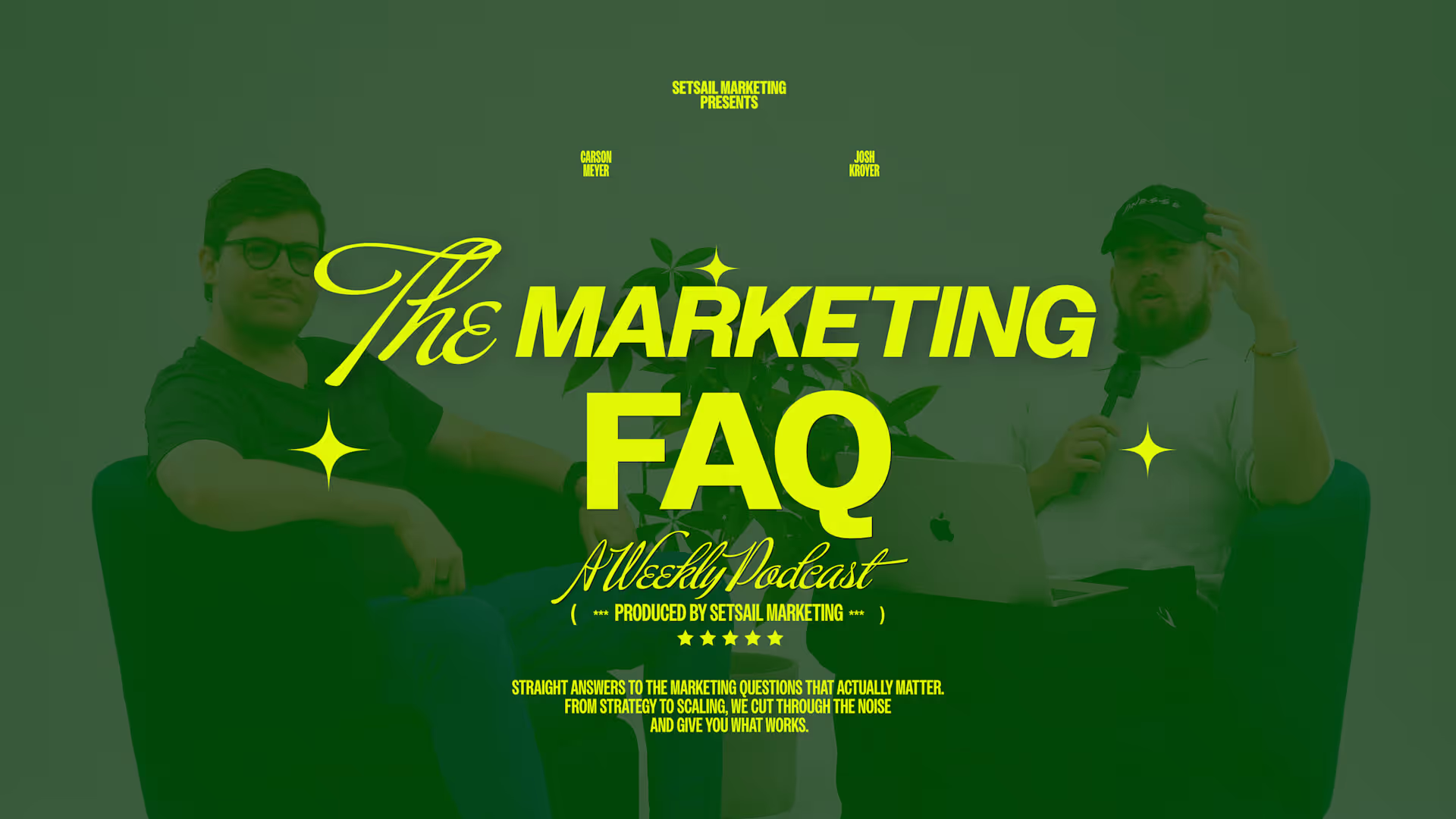
Podcast: How Do I Know If My Marketing Is Actually Working? (and How to Fix It)
Too many businesses invest heavily in digital marketing agencies, SEO services, PPC management services, and social media marketing companies—but don’t see the profit they expected. The problem? Most marketing agencies focus on vanity metrics instead of real business results. If your marketing agency can’t directly tie their work to increased leads, sales, or revenue, you’re working with the wrong partner.